What is friction? Why ice is slippery and what science says about it
Why do we slip on ice but not on dry tarmac? We explain static and kinetic friction and the coefficient of friction with worked examples. We also show why the pressure-melting explanation falls short and look carefully at the idea of a liquid-like layer on the surface of ice.
In this article · 10 sections
In winter you have probably felt your foot suddenly slip on an icy pavement. On dry tarmac, in the same shoes, you walk without a second thought. Your shoes and your weight are exactly the same. What has changed is the friction between your foot and the ground.
In this article we look at what friction is and at the difference between static and kinetic friction. Then we turn to one of the surprisingly open questions in physics: why is ice so slippery?
Let’s say it up front. The explanation you often hear, “ice melts when you press on it, so you slide”, sounds sensible at first. On its own, though, it isn’t enough. We’ll see why, with numbers.
What is friction?
Friction is a force that acts between two surfaces in contact. It resists the surfaces sliding, or tending to slide, past each other. Like every other force, it is measured in newtons (N).
If you’d like a reminder of what a force is and how a spring balance measures one, have a look at the Force and the spring balance lesson.
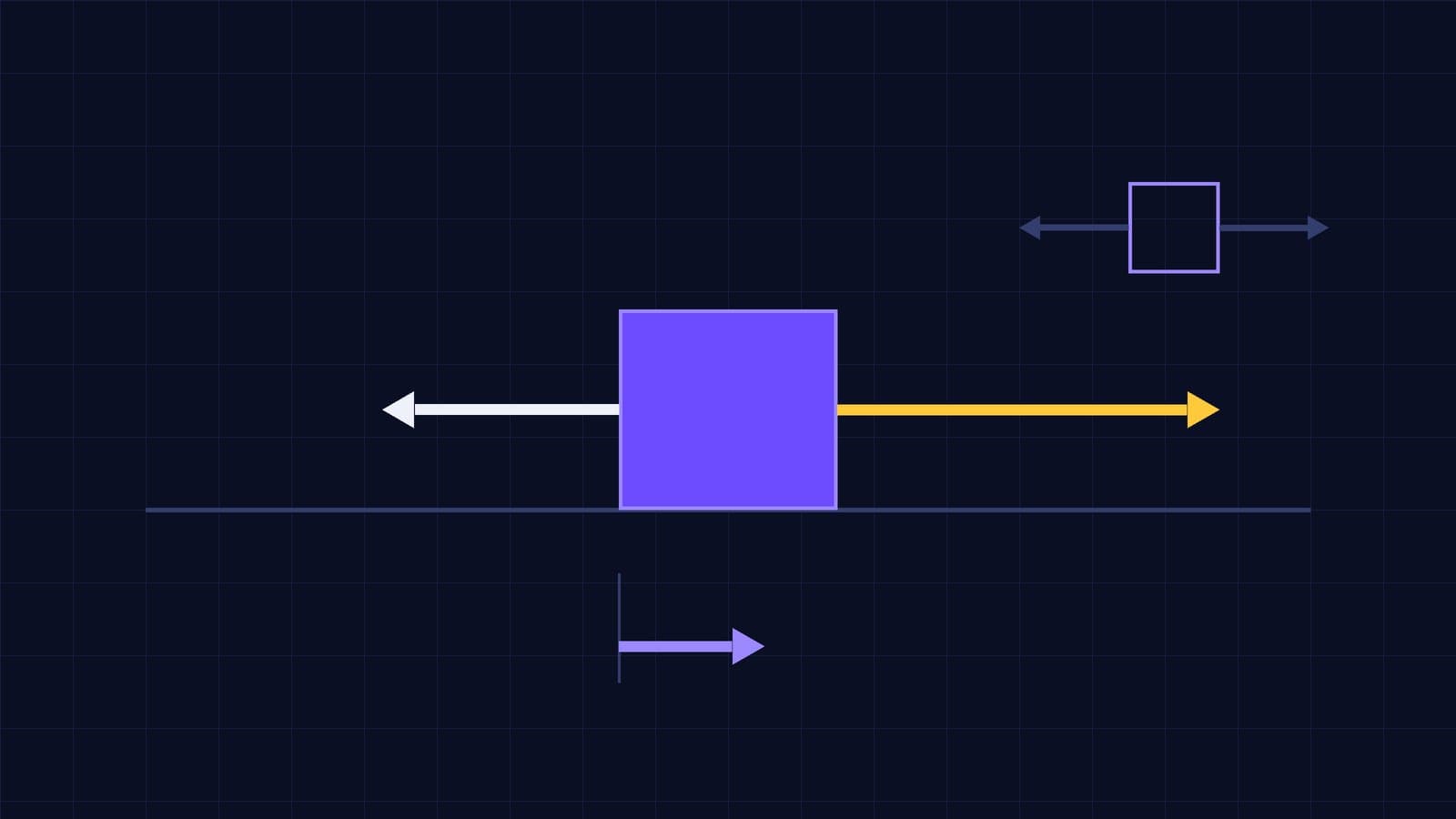
To understand friction, it helps to look at two forces together. Think of a box on a table: the Earth pulls the box down (its weight), and the table pushes it up. This push, at right angles to the surface, is called the normal force and is usually written .
Friction, by contrast, acts parallel to the surface. So the surface does two jobs at once: it holds the object up at right angles to the surface, and it resists sliding along it.
Where does friction come from?
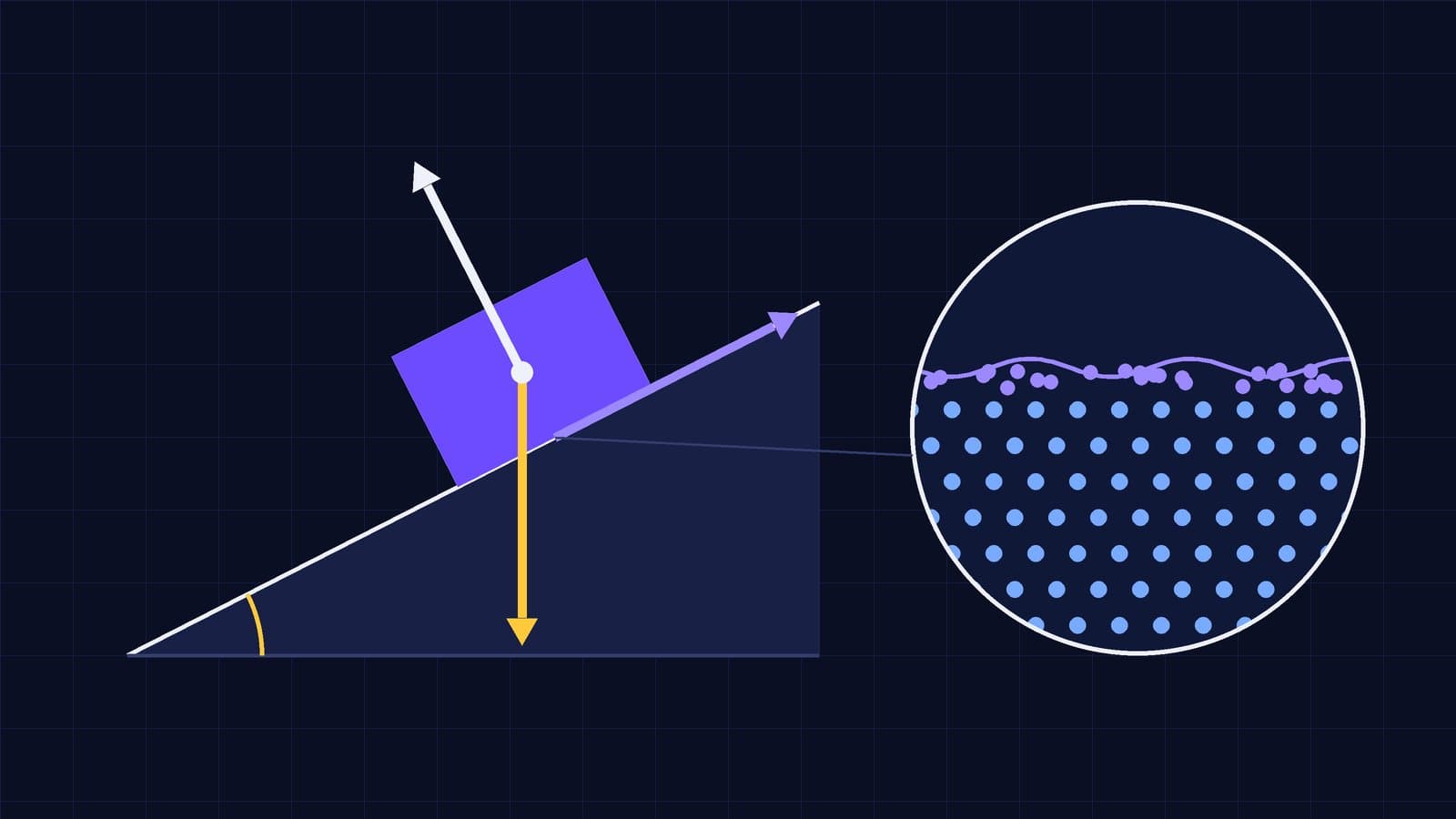
Even the smoothest-looking surfaces are full of peaks and hollows under a microscope. When two surfaces are placed together, they don’t touch everywhere, only at the tips of these tiny peaks. The real contact area is usually a very small fraction of the area we see.
Two things happen at these contact points:
- Interlocking: peaks and hollows fit into each other. To slide, they have to ride over one another or get slightly squashed.
- Adhesion: attractive forces act between the atoms and molecules at the contact points. To slide, these tiny “bonds” have to be broken over and over again.
This is why friction can’t be explained by “roughness” alone. Two very finely polished pieces of glass, for example, can cling to each other more strongly than you might expect, because the real contact area grows and adhesion increases. In everyday life we do see rougher surfaces giving more friction. The two ideas don’t contradict each other; each one simply matters more in different situations.
When an object presses harder on a surface, the peaks are squashed a little more, the real contact area grows and friction increases. That is the microscopic reason why pushing a heavy wardrobe is harder than pushing a light box.
Static and kinetic friction
Imagine you start pushing a heavy wardrobe. You push gently and it doesn’t move. You push harder and it still doesn’t move. Eventually it “breaks away” and starts to slide. Once it is sliding, keeping it going is a little easier than getting it started. This everyday experience describes two different kinds of friction.
Static friction acts when the surfaces are not sliding relative to each other. It has an interesting property: its size is not fixed but adjusts to the force you apply. Push with 50 N and static friction is 50 N. Push with 80 N and it is 80 N, so the wardrobe stays put. But there is an upper limit:
Here (read “mew s”) is the coefficient of static friction. When your push exceeds , static friction can no longer hold the object and sliding begins.
Kinetic friction acts while the surfaces are sliding relative to each other. Its size is roughly constant:
Here is the coefficient of kinetic friction. For most pairs of surfaces . That is why the wardrobe is easier to push once it is moving.
The coefficient of friction has no unit, because it is a ratio of two forces. Its value depends on the materials, how clean they are and whether they are wet or dry. The typical values below come from the table of friction coefficients in OpenStax’s University Physics (Volume 1). These are not exact numbers but approximate examples that vary with conditions:
| Pair of surfaces | (approx.) | (approx.) |
|---|---|---|
| Rubber on dry concrete | 1.0 | 0.7 |
| Rubber on wet concrete | 0.5–0.7 | 0.3–0.5 |
| Wood on wood | 0.5 | 0.3 |
| Ice on ice | 0.1 | 0.03 |
| Steel on ice | 0.4 | 0.02 |
One look at the table shows how unusual ice is. The kinetic coefficient of a steel skate blade on ice is less than a thirtieth of that of rubber on dry concrete.
These simple formulas assume that friction hardly depends on the apparent contact area or (within sensible limits) on the sliding speed. This assumption agrees well with experiments but isn’t perfect. That is why physicists call these relationships “empirical laws”.
Calculating friction: a worked example
Let’s put in some numbers. A wooden crate with a mass of 20 kg stands on a wooden floor. We’ll use the example values from the table, and , and take m/s².
On a level floor, the normal force equals the weight:
The force needed to start it sliding:
- If you push the crate with 60 N, it doesn’t move. Static friction is exactly 60 N and balances your push.
- Once your push goes above 98 N, the crate starts to slide.
The friction while it slides:
If you keep pushing with 100 N once it is sliding, the resultant force is N and the crate speeds up. If you want it to move at a steady speed, you only need to ease your push down to 58.8 N. Then the forces are balanced.
You can explore resultant forces and balance in more detail in the Balanced and unbalanced forces lesson.
What if the kinetic coefficient were 0.03, like the ice-on-ice value in the table? Keeping the sliding crate moving would take only N. That is about the force needed to hold a small bag of apples.
Friction doesn’t always hold things back: walking and braking
Friction is often described as “the force that opposes motion”. A more careful statement is this: friction opposes two surfaces sliding relative to each other. The difference looks small, but it is the key to understanding walking.
When you walk, your foot presses on the ground and pushes it backwards. Because your foot doesn’t slip, the ground pushes your foot forwards with a static friction force. That forward force is what moves you along. So when you walk, the friction on your foot points in the direction you are moving!
This also explains why you slip on ice. On ice, the upper limit of static friction () is very low. In a normal stride, the backward push of your foot easily goes over that limit, and your foot slides.
Taking short steps and keeping your weight right over your feet helps for exactly this reason. It keeps the push along the ground small.
The same idea applies to cars. On a wheel that rolls without skidding, the part of the tyre touching the road is momentarily at rest relative to the road. Static friction is at work there.
If the wheel locks and skids, kinetic friction takes over, and that is usually smaller. Anti-lock braking systems (ABS) keep the wheels rolling without skidding. In this way they aim to keep both grip and steering control.
Spreading grit or sand on icy roads in winter is meant to increase the friction between tyres and the surface. Salt works differently: it lowers the melting point of ice, so the ice melts and the slippery surface disappears.
Why do we slip on ice? The pressure-melting explanation
For a long time the most popular explanation went like this. Ice melts at a lower temperature when it is under pressure. When a skate blade or a shoe presses on the ice, the ice melts. The thin film of water that forms acts like a lubricant.
The first part is true. Water expands when it turns into ice, so pressure really does lower the melting point of ice. But by how much?
To lower the melting point by just 1 °C you need about 135 atmospheres of pressure (roughly 14 MPa). That is 135 times the air pressure at sea level.
Let’s do a rough example calculation. Take a skater with a mass of 60 kg, so a weight of about 600 N. As an example, assume the part of the blade touching the ice is 3 mm wide and 5 cm long:
This pressure lowers the melting point by only about 0.3 °C. So if the ice is colder than −0.3 °C, pressure alone can’t melt it. On an outdoor rink at −10 °C, for example, that is the case. Yet ice is still very slippery at that temperature.
The dimensions in this calculation are only an example. The real contact area depends on how curved the blade is and how far it sinks into the ice. Smaller estimates of the area give higher pressures.
Walking in shoes makes the point even more clearly. The sole is many times larger than a blade, so the pressure is far lower. The change in melting point is a small fraction of a degree. Even so, we slip on icy pavements.
In short, pressure melting is a real effect. It just isn’t big enough to explain the slipperiness of ice on its own.
The liquid-like surface layer and today’s picture
So what makes ice so slippery? Today scientists think several effects play a part together. How much each one matters is still being researched. Two ideas stand out:
1. Frictional heating. When something slides over ice, friction produces heat. This heat can melt a very thin layer of ice at the contact points, and the water helps the sliding.
This makes good sense for a moving skater or sledge. But it doesn’t explain on its own the situation before sliding starts, when ice already feels slippery as you stand on it.
2. A liquid-like surface layer (surface melting). Inside ice, water molecules sit in a regular crystal lattice, tightly bound to their neighbours. Molecules at the surface have no neighbours on one side. As a result they are more loosely bound and can vibrate more.
Experiments show that a thin layer exists on the surface of ice even below 0 °C. The molecules in this layer are much more mobile than those in solid ice.
It is called a “liquid-like” or “quasi-liquid” layer, because it behaves neither quite like a liquid nor like an ordered solid. The idea that ice might have a film of water on its surface goes back to Michael Faraday, who experimented with ice in the mid-19th century.
Some known features of this layer:
- Its thickness is on the scale of nanometres, thousands of times thinner than a human hair. Measured values vary quite a lot depending on the method used.
- It gets thicker as the temperature approaches 0 °C and thinner as it gets colder.
- This fits an everyday observation: very cold ice is generally less slippery. In a laboratory study published in 2018, the friction on a steel ball sliding over ice was lowest at about −7 °C and rose clearly on colder ice. The researchers linked this to how mobile the water molecules at the surface are.
Why does the debate continue? Because it isn’t certain that this layer alone can explain why friction on ice is so low.
Some researchers argue that frictional heating during sliding matters more. Others highlight how mobile the surface molecules are, or the mechanical properties of the surface. The dominant effect probably changes with temperature, sliding speed, the material pressing on the ice and whether the ice is wet or dry.
The extra slipperiness of ice very close to 0 °C with water lying on top is easier to explain. In that case a real layer of water acts as a lubricant.
This is one of the fascinating things about science: something we see every day can still be an open research question. An explanation being repeated often doesn’t mean it is complete. It is worth checking with numbers.
Try it yourself: a book ramp and a rubber-band force meter
You will need: a flat board or a piece of thick cardboard, a thick book, a rubber band, a ruler, paper and a pen. A spring balance, if you have one.
Part 1: feeling static and kinetic friction
- Tie the rubber band to the book, or loop it onto a piece of string passed under the book’s cover.
- Pull the book across a table by the rubber band, very slowly, and watch how far the band stretches using the ruler.
- Note the greatest stretch just before the book starts to slide.
- Once it is sliding, pull it at a steady speed and note the stretch again.
Most likely the stretch just before sliding will be a little greater than the stretch while sliding. The more the band stretches, the bigger the pulling force. So this shows that the upper limit of static friction is larger than kinetic friction.
A rubber band doesn’t stretch in exact proportion to the force, so use it for comparison only. If you have a spring balance, repeat the experiment with it and read the values in newtons. If you don’t, you can see how a spring stretches as you hang masses on it in the Lab’s Spring balance figure.
Part 2: the coefficient of static friction from a ramp
- Place the book on the board.
- Slowly raise one end of the board.
- Stop the moment the book starts to slide.
- Measure the height of the raised end above the floor and call it .
- Measure the horizontal distance from the end of the board that rests on the floor to the point directly below the raised end, and call it .
- Estimate the coefficient of static friction like this:
For example, if you measure cm and cm, then , or about 0.38. These numbers are just an example; your own measurement will be different.
Why this formula? At the angle where sliding begins, the part of the weight acting along the ramp equals the upper limit of static friction. A little trigonometry turns this into , and equals the ratio .
Here is an interesting result: the mass of the book doesn’t appear in the formula! Put a second book on top of the first and try again. You may find that the angle at which sliding begins hardly changes.
Repeat the experiment with paper, aluminium foil or fabric laid over the board, and record your results in a table. If you take three measurements for each surface and use the average, your results will be more reliable.
Points that are easily confused
“Friction always holds motion back.” It looks that way at first. But friction opposes surfaces sliding relative to each other. When you walk, the static friction on your foot points forwards and carries you along.
“Static friction is always equal to .” In fact is only the upper limit. If you aren’t applying any sideways force to a book on a table, the static friction on it is zero.
“More contact area means more friction.” In the simple model, friction hardly depends on the apparent contact area. Slide a brick on its wide face or its narrow face and the friction force stays roughly the same.
On the wide face the weight is spread over a large area; on the narrow face it is concentrated on a small one. The real contact area ends up similar in both cases. For soft materials such as rubber, this rule may not hold exactly.
“There is no friction on a smooth surface.” Even very smooth surfaces have friction, because of adhesion. In fact two very smooth surfaces can cling tightly to each other.
“Ice is slippery because it melts when you press on it.” Pressure does lower the melting point, but at everyday pressures the drop is less than a degree. Effects such as frictional heating and the liquid-like surface layer matter more. The topic is still being researched.
“Life would be easier without friction.” Without friction we couldn’t walk, brake or even tie a knot. Friction is useful, but it also causes wear and wastes energy. Engineering is often the art of increasing it in the right places and reducing it in others.
Summary
- Friction acts between surfaces in contact and resists them sliding relative to each other.
- At the microscopic level it comes from interlocking and adhesion; it grows as an object presses harder on a surface.
- Static friction acts when there is no sliding and can be at most .
- Kinetic friction acts during sliding and is about . Usually .
- Walking and wheels that roll without skidding rely on static friction.
- Pressure melting is a real but small effect; it doesn’t explain the slipperiness of ice on its own.
- Frictional heating and a liquid-like layer on the surface of ice are the leading explanations today; the details are still debated.
To explore friction through experiments, take a look at the Friction lesson. For more on forces and motion, visit our Science topics and our physics articles.
Frequently asked
5 questionsWhat is friction?
Friction is a force that acts between two surfaces in contact and resists them sliding relative to each other. It acts parallel to the surface and is measured in newtons (N).
What is the difference between static and kinetic friction?
Static friction acts when the surfaces are not sliding. It adjusts to the applied force and can be at most μs·N. Kinetic friction acts while the surfaces slide and is about μk·N. For most surfaces kinetic friction is smaller, which is why starting an object moving is harder than keeping it moving.
Why is ice slippery?
Scientists are still debating this. There are two leading explanations: heat from friction during sliding can form a very thin film of water, and ice has a thin liquid-like surface layer with more mobile molecules, even below 0 °C. Different effects probably matter more under different conditions.
Why does the pressure-melting explanation fall short?
Lowering the melting point of ice by 1 °C takes about 135 atmospheres of pressure. Even a skate blade lowers it by only a few tenths of a degree, roughly, and a shoe far less. Yet ice is still slippery at −10 °C and when you walk on it in ordinary shoes.
Does friction depend on contact area?
In the simple model, hardly at all. Friction depends on how hard the object presses on the surface (the normal force) and on the materials. Sliding a brick on its wide or narrow face gives roughly the same friction. For soft materials such as rubber, this rule may not hold exactly.
Sources
5 sources- 1.OpenStax — University Physics, Volume 1, Section 6.2: Friction (Table 6.1, approximate coefficients of friction) (opens in a new tab)
- 2.Rosenberg, R. (2005) — Why Is Ice Slippery?, Physics Today 58(12), 50–55 (opens in a new tab)
- 3.Weber, B. et al. (2018) — Molecular Insight into the Slipperiness of Ice, The Journal of Physical Chemistry Letters 9(11), 2838–2842 (opens in a new tab)
- 4.Encyclopaedia Britannica — Friction (opens in a new tab)
- 5.Wikipedia — Friction (opens in a new tab)
- #friction
- #static friction
- #kinetic friction
- #coefficient of friction
- #ice
- #forces and motion