Skip to content

Category

Physics

From light to electricity: articles that explain the laws of physics behind everyday events through intuition and experiments.

NewestPhysics

Faraday's induction experiment: how does a magnet make a current in a coil?

In 1831 Michael Faraday pushed a magnet into a reel wound with copper wire and the galvanometer needle moved; when the magnet stopped, the needle went back to zero. We explain how changing magnetic flux drives a current, the law ε = −N·dΦ/dt, Lenz's law, generators and transformers.

Kuazara Bilim Ekibi13 min read
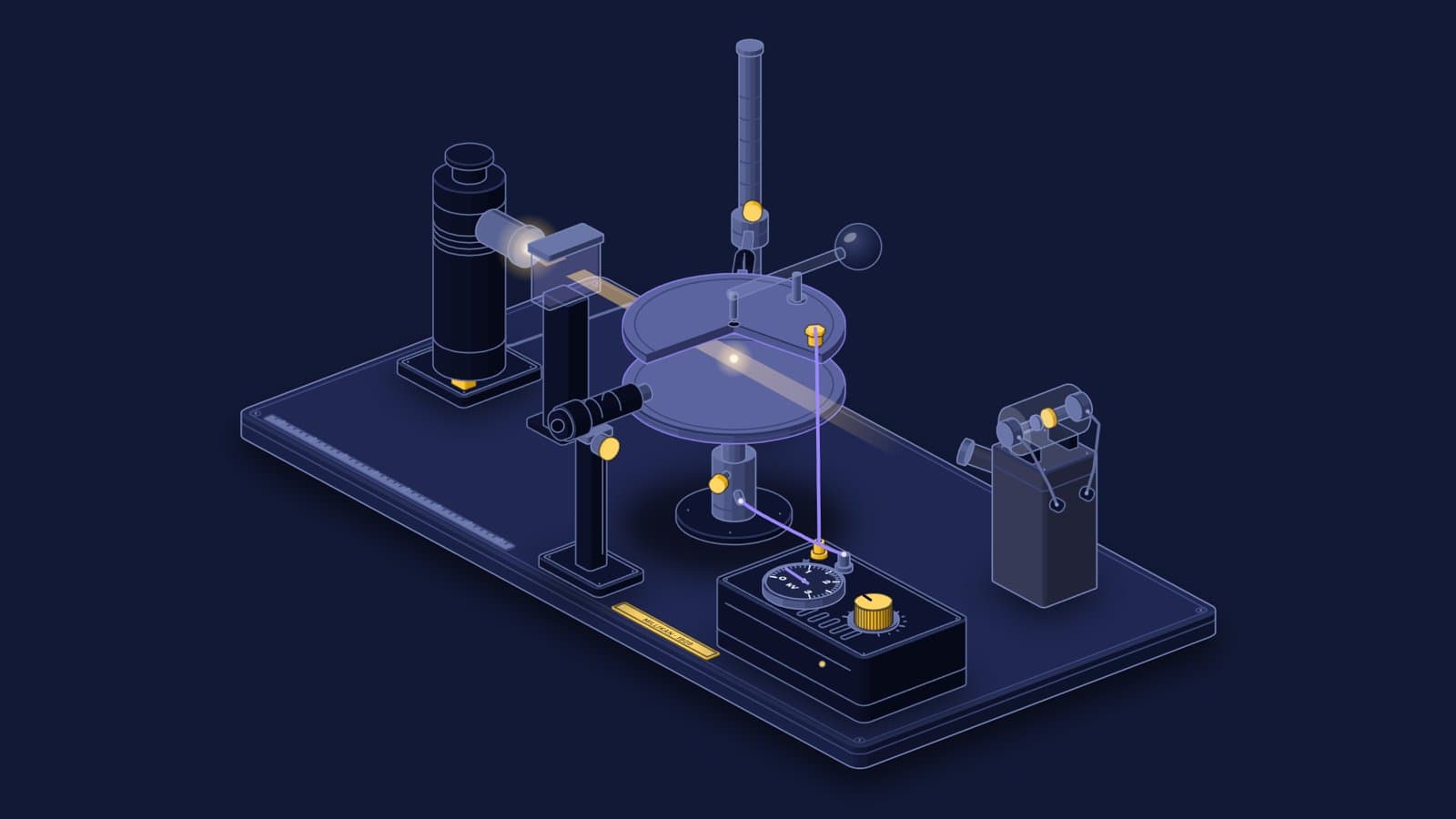
  • Isometric drawing of Millikan's apparatus on a bench: two horizontal metal plates, an atomizer, a lamp, a microscope, an X-ray tube and a voltage supply with a voltmeter
    Physics

    Millikan's oil drop experiment: measuring the charge of the electron

    Between 1909 and 1913 Robert Millikan measured the charge of the electron by watching micron-sized oil drops float between two metal plates through a microscope. We explain the apparatus, Stokes' law, the qE = mg balance and why every charge came out as a whole multiple of e.

    10 min read

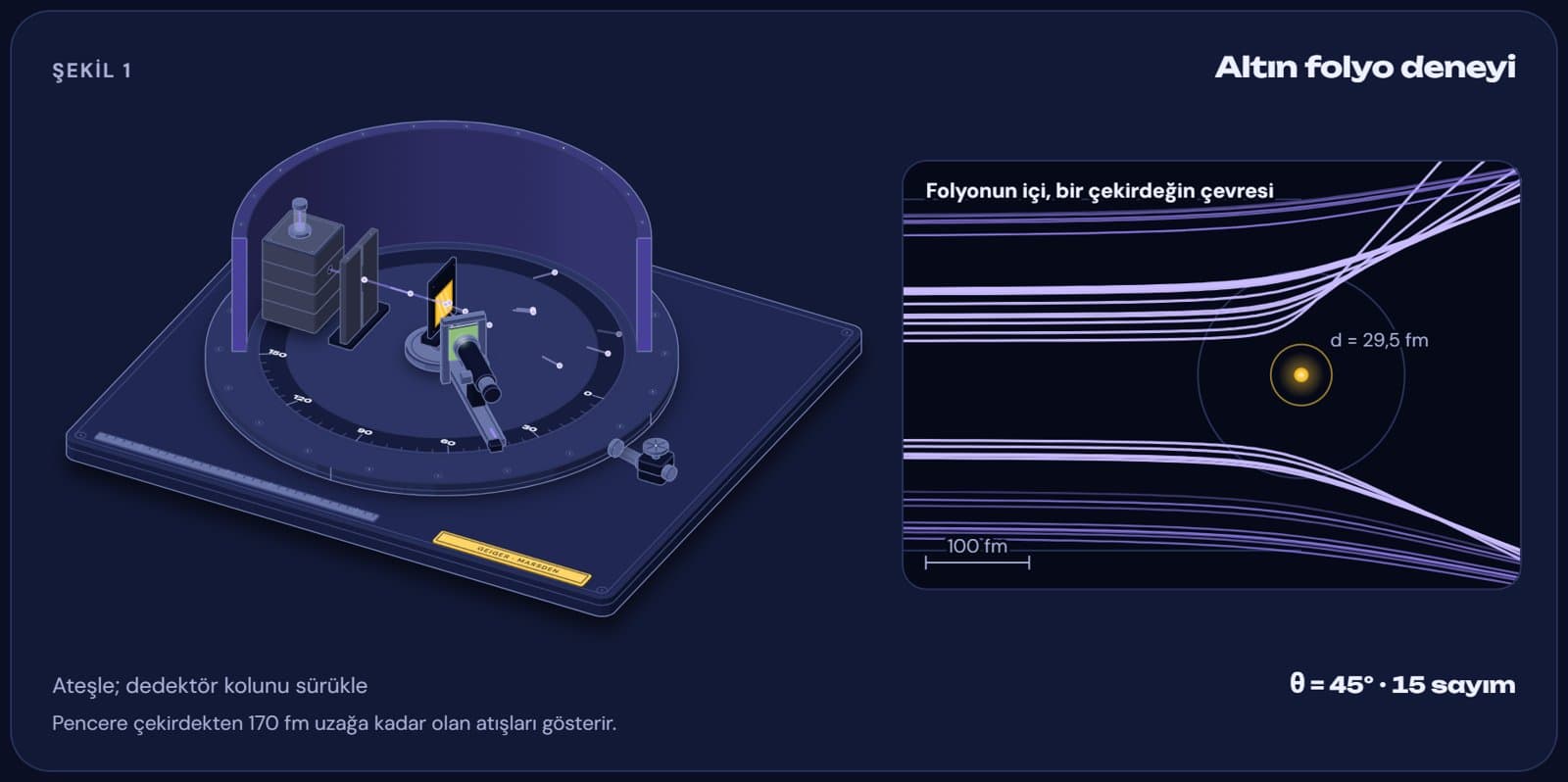
  • Drawing of a cut-away vacuum chamber with a source in a lead block, a thin gold foil and a microscope with a screen turning around the foil, beside alpha tracks bending around a nucleus
    Physics

    Rutherford's gold foil experiment: how the atomic nucleus was discovered

    In 1909 Geiger and Marsden fired alpha particles at thin metal foils; most went straight through, but a few bounced back. We explain Thomson's plum pudding model, the apparatus, Rutherford's nuclear model and the 1/sin⁴(θ/2) scattering formula with a simulation.

    10 min read

  • Physics

    The Foucault pendulum: seeing the Earth turn with your own eyes

    In 1851 a 28-kilogram ball was hung on a 67-metre wire from the dome of the Panthéon in Paris. As the hours passed, its plane of swing slowly turned against the floor. We explain why it turns, why the rate depends on latitude, and how long a full turn takes in Istanbul and Ankara.

    9 min read

  • Physics

    Young's double-slit experiment: why does light behave like a wave?

    Light passing through two thin slits leaves bright and dark bands on a screen. We explain the idea of interference Thomas Young put forward in 1801, the fringe-spacing formula, experiments with single photons and electrons, and why the pattern disappears when we measure "which slit" was used.

    11 min read

  • A large iceberg resting on frozen sea ice under a starry purple night sky
    Physics

    What is density? Why a huge ship floats while a small stone sinks

    A steel ship weighing thousands of tonnes floats, while a stone that fits in your palm sinks. The answer is not weight but density. We explain what density is, Archimedes' principle, why ships do not sink, and a safe egg experiment you can try at home.

    7 min read

  • An Apollo 15 astronaut standing next to the lunar rover beside Hadley Rille on the Moon, in a black-and-white photograph
    Physics

    Do heavier objects fall faster? Free fall and air resistance

    Aristotle said heavier objects fall faster; Galileo disagreed; in 1971 an astronaut dropped a hammer and a feather together on the Moon. The story of free fall, air resistance and a safe paper-and-book experiment you can do at home.

    6 min read