Skip to content

Blog

Science you're curious about

Why is a rainbow curved? Why does a magnet stick to the fridge but not to wood? Short, sourced, clear articles.

NewestTechnology and Engineering

How does a computer get a job done? Processor, memory and cache

A processor takes billions of steps a second, yet it spends much of its time waiting for data. We explain the fetch-decode-execute cycle, the clock signal, registers and the layers of memory from cache to disk, with a workshop drawing where you can type in your own numbers.

Kuazara Bilim Ekibi11 min read
  • Technology and Engineering

    The six-axis robot arm: joints, degrees of freedom and forward kinematics

    A factory robot arm brings its gripper to a point by turning six joints. Using an arm you can play with, we explain what a joint is, why there are exactly six (degrees of freedom) and how to work out where the gripper is from the joint angles (forward kinematics).

    10 min read

  • Technology and Engineering

    How does an electric motor turn? Inside a brushed DC motor

    From toy cars to windscreen wipers, small direct current motors turn everywhere. Using a motor you can play with, we explain the force a magnet puts on a current-carrying wire, the clever switch the commutator makes every half turn, and how voltage, speed, torque and back EMF are linked.

    11 min read

  • Physics

    Faraday's induction experiment: how does a magnet make a current in a coil?

    In 1831 Michael Faraday pushed a magnet into a reel wound with copper wire and the galvanometer needle moved; when the magnet stopped, the needle went back to zero. We explain how changing magnetic flux drives a current, the law ε = −N·dΦ/dt, Lenz's law, generators and transformers.

    13 min read

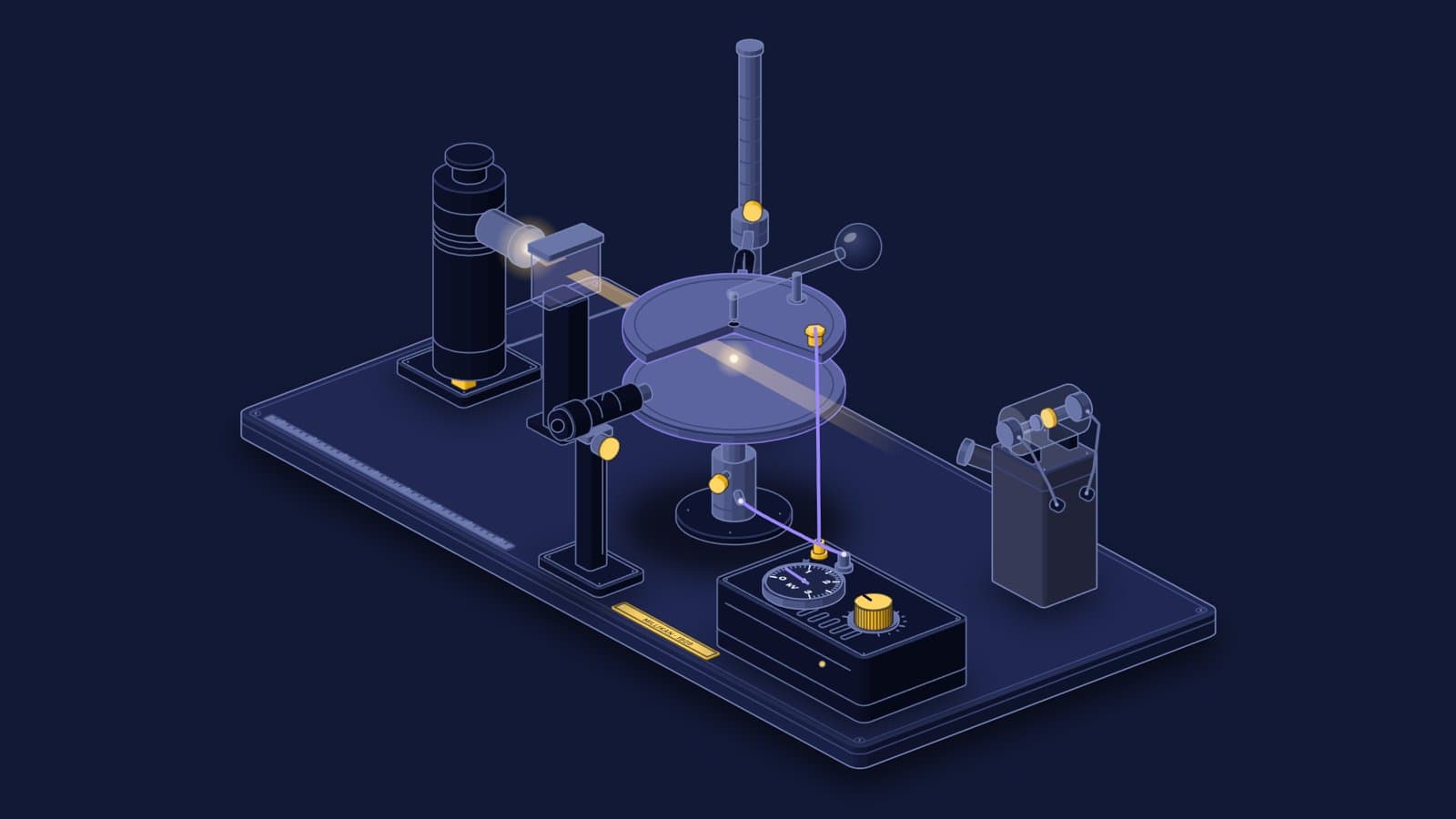
  • Isometric drawing of Millikan's apparatus on a bench: two horizontal metal plates, an atomizer, a lamp, a microscope, an X-ray tube and a voltage supply with a voltmeter
    Physics

    Millikan's oil drop experiment: measuring the charge of the electron

    Between 1909 and 1913 Robert Millikan measured the charge of the electron by watching micron-sized oil drops float between two metal plates through a microscope. We explain the apparatus, Stokes' law, the qE = mg balance and why every charge came out as a whole multiple of e.

    10 min read

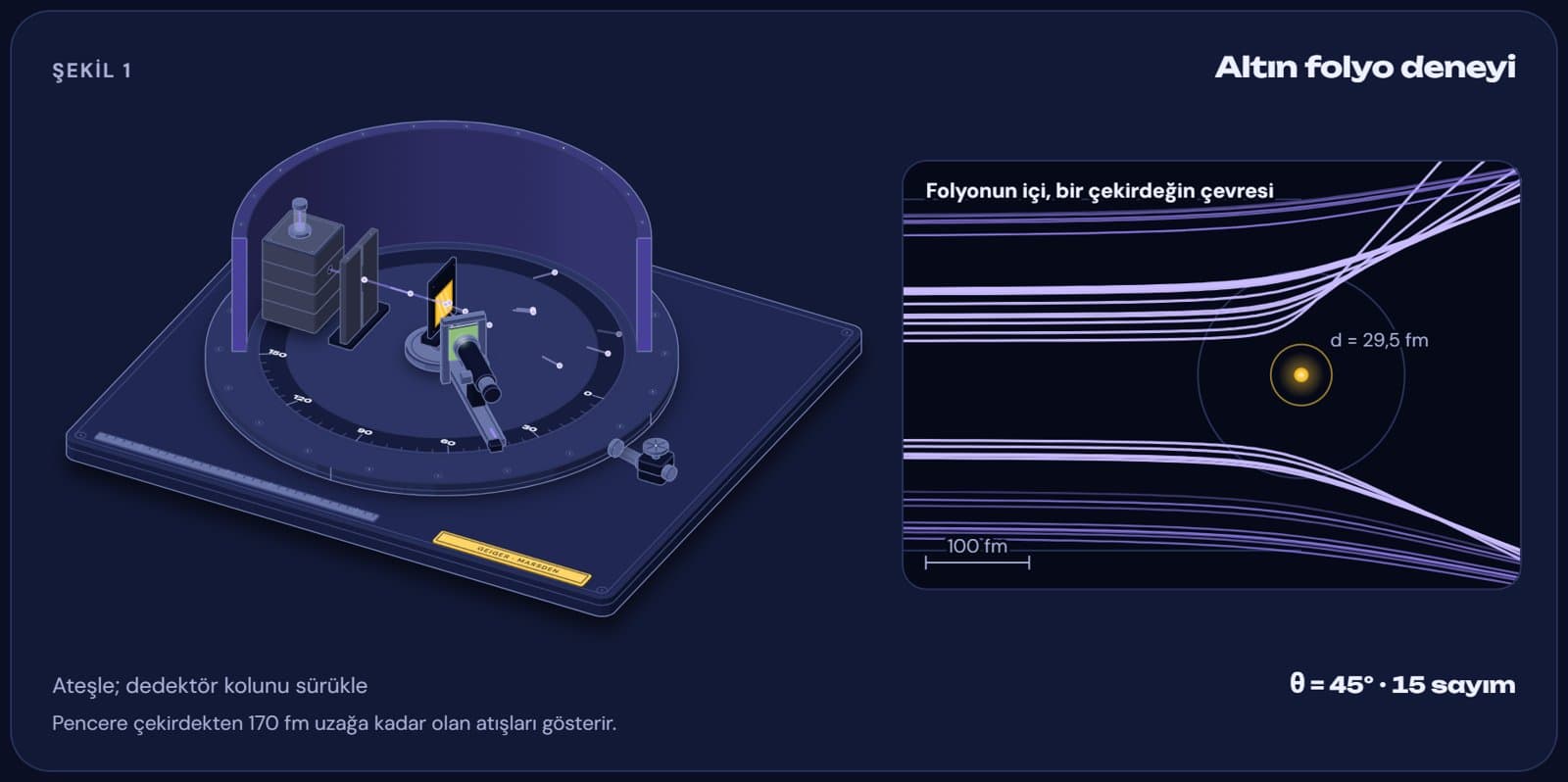
  • Drawing of a cut-away vacuum chamber with a source in a lead block, a thin gold foil and a microscope with a screen turning around the foil, beside alpha tracks bending around a nucleus
    Physics

    Rutherford's gold foil experiment: how the atomic nucleus was discovered

    In 1909 Geiger and Marsden fired alpha particles at thin metal foils; most went straight through, but a few bounced back. We explain Thomson's plum pudding model, the apparatus, Rutherford's nuclear model and the 1/sin⁴(θ/2) scattering formula with a simulation.

    10 min read

  • Physics

    The Foucault pendulum: seeing the Earth turn with your own eyes

    In 1851 a 28-kilogram ball was hung on a 67-metre wire from the dome of the Panthéon in Paris. As the hours passed, its plane of swing slowly turned against the floor. We explain why it turns, why the rate depends on latitude, and how long a full turn takes in Istanbul and Ankara.

    9 min read

  • Physics

    Young's double-slit experiment: why does light behave like a wave?

    Light passing through two thin slits leaves bright and dark bands on a screen. We explain the idea of interference Thomas Young put forward in 1801, the fringe-spacing formula, experiments with single photons and electrons, and why the pattern disappears when we measure "which slit" was used.

    11 min read

  • Technology and Engineering

    How does a gearbox work? The trade between speed and torque

    We shift to an easy gear to ride a bike up a hill and to first gear to pull away in a car. A gearbox makes no power; it shares the motor's power between speed and torque. We explain gear ratios, the torque × speed balance and what happens inside when you change gear, with a gearbox to play with.

    10 min read

  • Technology and Engineering

    How does a solar panel make electricity? From photon to socket

    The dark blue panel on a roof makes electricity without moving at all. We explain how a photon creates an electron–hole pair in silicon, how the p-n junction separates the pair, why half-volt cells are connected in series, and how the angle and the shadow of a single leaf change the power.

    11 min read