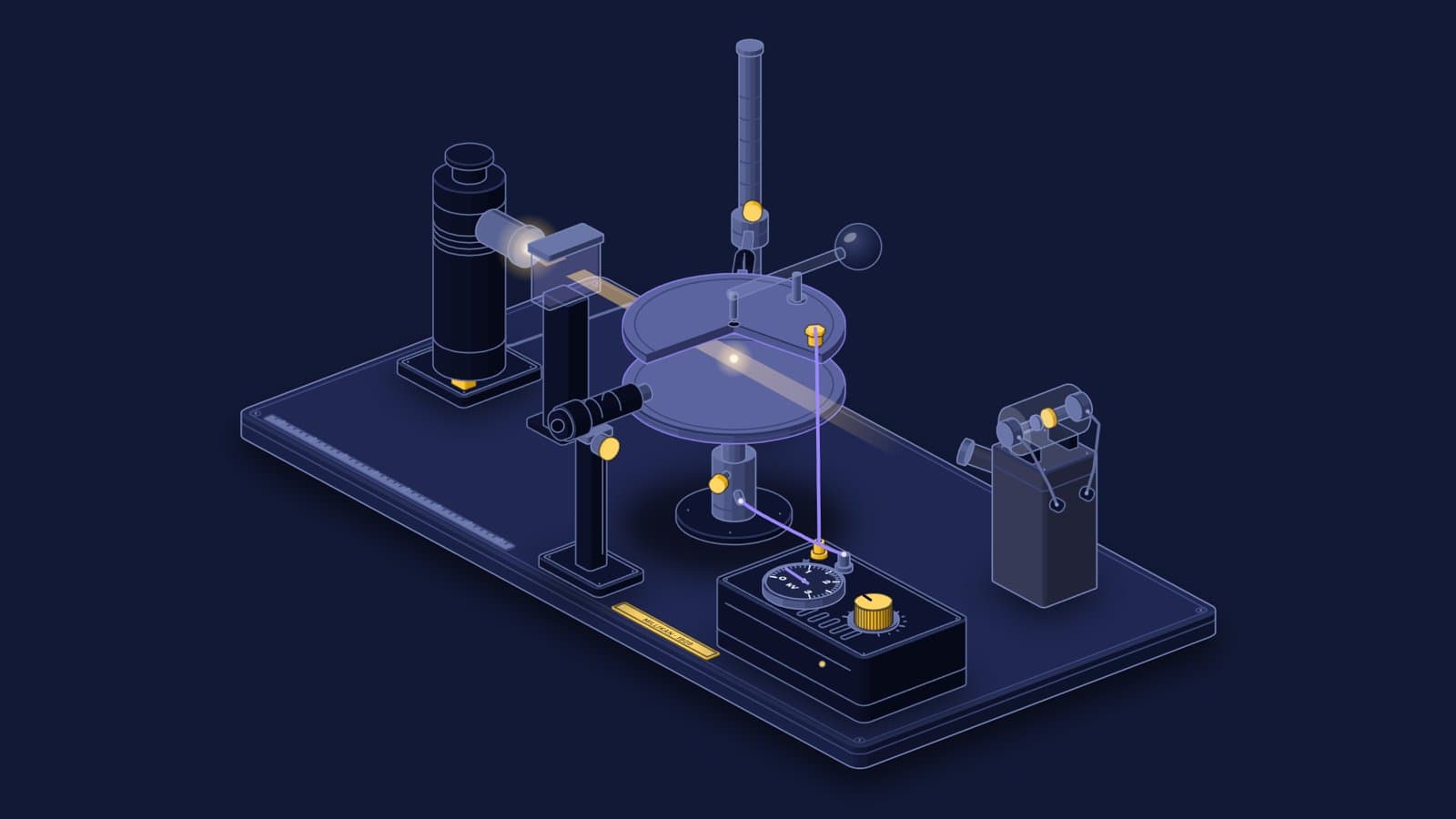
What is the photoelectric effect? The particle side of light and Einstein's photon
Why can bright red light fail to free a single electron from a metal, while dim violet light frees them at once? From Hertz to Einstein and Millikan, we explain the photoelectric effect, the threshold frequency and the stopping voltage with a worked example.
By Kuazara Bilim EkibiPublished: Updated: 13 min read
In this article · 10 sections
Shine a light on a metal plate. If the light is “right”, electrons fly off the plate; this is called the photoelectric effect. At first sight there is nothing surprising about it: light carries energy, and an electron uses that energy to escape from the metal. What is surprising is which light works and which does not. A dazzling red light cannot free a single electron from some metals, while a dim violet light falling on the same metal frees electrons at once. The theory of light of the 19th century could not explain this. The explanation Albert Einstein proposed in 1905 brought into physics the idea that light carries energy in small packets, and it became one of the foundation stones of quantum physics. In this article we cover the history of the experiment, where the classical expectation clashed with what was observed, Einstein’s equation, and where the effect turns up today, from solar panels to light sensors.
From Hertz’s spark to Lenard’s measurements
Ironically, the story begins inside the very experiments that proved light is a wave. In 1887, while producing and detecting electromagnetic waves, Heinrich Hertz noticed that a small spark gap in his receiver sparked more easily when ultraviolet light fell on it, and he published this as a side observation. The following year Wilhelm Hallwachs showed that a negatively charged zinc plate lost its charge under ultraviolet light, while a positively charged plate did not. Light was pulling negative charge out of the metal. In 1899 J. J. Thomson measured that this charge was carried by electrons, the particles he had discovered two years earlier.
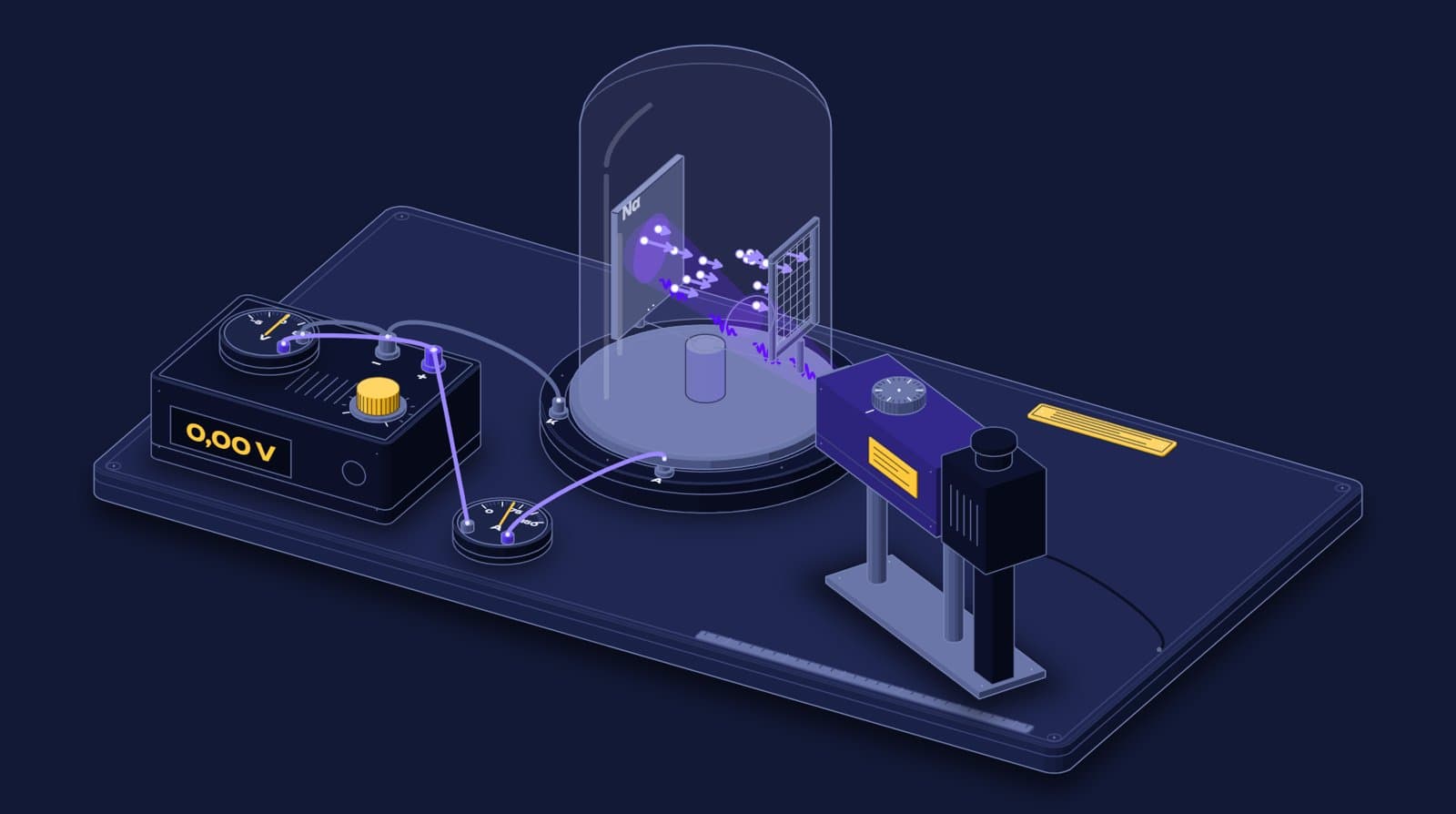
The truly striking results were published by Philipp Lenard in 1902. Lenard placed a metal plate (the cathode) inside a vacuum tube with a collecting plate (the anode) opposite it, lit the cathode and applied an adjustable voltage between the two plates. In this way he could measure both how many electrons came off (the current in the circuit) and how fast they were (the reverse voltage needed to stop them). What he found did not match expectations: making the light stronger increased the number of electrons, but did not change the energy of the fastest electron at all. The energy of the electrons seemed to depend not on the intensity of the light but on its colour.
What did classical wave theory expect?
At the end of the 19th century light was an electromagnetic wave described by Maxwell’s equations, and this theory explained phenomena such as interference and diffraction perfectly. According to the theory, the energy carried by a light wave is proportional to its intensity (the square of its amplitude) and spreads over the metal surface as a continuous, even flow. Three clear expectations follow. The experiment overturned all three:
| Classical expectation | What the experiment showed |
|---|---|
| The more intense the light, the faster the electrons come out. | Intensity only increases the number of electrons; the energy of the fastest electron does not change. |
| Any light, if strong enough or shone long enough, will eventually free electrons. | Every metal has a threshold frequency. Light below it frees no electrons at all, however intense it is. |
| In dim light it takes time for an electron to collect energy; the current starts some time after the light is switched on. | There is no delay. Even in very dim light the first electrons come out at once; measurements in 1928 showed the delay is shorter than a few nanoseconds. |
The third point is especially striking. According to classical theory, the energy that “falls to the share” of a single atom in very dim light is so small that an electron should need minutes, even hours, to collect enough energy to escape. Yet the current starts as soon as the light is switched on.
Einstein’s explanation: light quanta
In a paper published in 1905, Albert Einstein made a bold proposal: light carries its energy not as a continuous flow but in packets of a definite size, and these packets are absorbed whole. The energy of each packet, which we now call a photon, is proportional to the frequency of the light:
Here is the frequency of the light and is Planck’s constant: J·s. Since frequency and wavelength are related by , the photons of short-wavelength (violet, ultraviolet) light carry more energy than the photons of long-wavelength (red) light.
In the photoelectric effect a photon gives all of its energy to a single electron. The electron spends part of this energy escaping from the metal. This minimum escape energy, which shows how tightly the metal holds its electrons, is called the work function and is written (phi). The rest of the energy becomes the electron’s kinetic energy. The electrons that escape with the least energy, those nearest the surface, come out fastest:
This single equation explains all three observations:
- Why does intensity not change the energy? Making the light stronger does not make the photons more energetic; it only makes more of them. More photons mean more electrons: the current rises, but each electron receives the same energy.
- Why is there a threshold frequency? If , a single photon is not enough to free an electron. An electron catching two photons at once and adding their energies almost never happens in ordinary light. The threshold frequency is .
- Why is there no delay? Energy does not build up slowly; the moment the first photon arrives, if it is above the threshold, it frees an electron straight away.
In physics, energies are often given in electronvolts (eV): 1 eV is the energy an electron gains passing through a voltage of 1 volt, J. The work functions of some metals and the matching threshold wavelengths are as follows (the values are for clean, polycrystalline surfaces; on real surfaces they can vary by 0.1–0.2 eV):
| Metal | Work function | Threshold wavelength |
|---|---|---|
| Caesium (Cs) | 2.14 eV | 579 nm (yellow) |
| Sodium (Na) | 2.36 eV | 525 nm (green) |
| Zinc (Zn) | 4.33 eV | 286 nm (ultraviolet) |
| Copper (Cu) | 4.65 eV | 267 nm (ultraviolet) |
This also explains why Hallwachs’s zinc plate lost its charge only under ultraviolet light: no colour of visible light reaches zinc’s threshold.
Stopping voltage: measuring an electron’s speed in volts
Measuring an electron’s speed directly is hard. The cleverness of Lenard’s setup is to stop the electrons instead. If you make the anode negative relative to the cathode, the electrons leaving the cathode slow down on their way to the anode. As the voltage grows, first the slow electrons and then the faster ones turn back. The voltage at which the current drops exactly to zero is called the stopping voltage (). At this point even the fastest electron stops before reaching the anode, so all of its kinetic energy has been spent against the electrical barrier:
Here C is the magnitude of the electron’s charge. Writing energies in eV makes the relation very simple: if eV, the stopping voltage is 0.74 V. A voltmeter thus becomes an instrument that reads the largest electron energy directly.
Worked example: violet light on sodium
Let violet light with a wavelength of 400 nm fall on a sodium plate.
1. Frequency:
2. Photon energy:
3. Energy of the fastest electron: Since the work function of sodium is 2.36 eV,
4. Stopping voltage: V. When we make the anode 0.74 V negative relative to the cathode, the current drops to zero.
5. Top speed: Since and the mass of the electron is kg,
So the fastest electron covers about 510 km every second.
6. What if 600 nm orange light falls on the same plate? The photon energy is eV. This is less than sodium’s work function of 2.36 eV: make the light as strong as you like, and not a single electron comes off. The threshold for sodium is 525 nm.
(The shortcut is the value of in nm·eV: if the wavelength is in nanometres, the photon energy is about eV.)
Try the experiment yourself
The drawing below is a simplified version of Lenard’s setup: inside a glass vacuum tube there is a cathode plate on the left and a wire-mesh anode on the right. Light from the lamp at the front right passes through a monochromator (an instrument that picks a single wavelength out of white light) and falls on the cathode. The adjustable power supply at the front left sets the voltage between anode and cathode; the voltmeter shows this voltage and the ammeter the current through the tube. Try the following:
- Choose copper and go through every colour of visible light. Even at 100% intensity no electron comes off; only below 267 nm do they appear.
- With caesium, halve the intensity. The current halves, but the length of the electrons’ arrows (the top speed) does not change.
- Slowly bring the voltage below zero. First the slow electrons turn back, then the fast ones. Read the voltage at which the current reaches zero and compare it with .
- On the –frequency graph, look at the lines for different metals: they are all parallel.
Millikan’s ten-year test
Einstein’s proposal was not widely accepted at first. That light is a wave had been firmly proved by interference experiments, and thinking of light as “particle packets” seemed like a step backwards to many physicists. The American physicist Robert Millikan spent about ten years trying to disprove the idea. Because metal surfaces oxidise quickly in air and their work functions change, he built an apparatus that cleaned the surfaces inside the vacuum, scraping them with a mechanism inside the tube. He published his measurements on sodium, potassium and lithium in 1916.
The result was a complete confirmation of Einstein’s equation. When he plotted the stopping voltage against frequency, he found a straight line for each metal. Writing the equation in volts:
The slope of the line is and does not depend on the metal; the lines for different metals are parallel and only their threshold frequencies differ. From the slope and the electron charge he had measured himself, Millikan calculated Planck’s constant and obtained a value that agreed within about half a per cent with the one Planck had found from heat radiation. Despite this result, Millikan stayed wary of the idea of light quanta for some time; but his measurements effectively ended the debate.
Einstein received the 1921 Nobel Prize in Physics not for relativity but “for his services to Theoretical Physics, and especially for his discovery of the law of the photoelectric effect”. Millikan won the 1923 Nobel Prize in Physics for his work measuring the charge of the electron and on the photoelectric effect.
The photoelectric effect in everyday life
The photoelectric effect and its close relatives are at the heart of many devices that turn light into an electrical signal:
- Solar panels: In solar cells the photon does not throw the electron out of the material; inside the silicon crystal it lifts the electron from where it is bound to an energy level where it can move freely. This is called the internal photoelectric effect (the photovoltaic effect), and the same rule applies: the photon’s energy must be greater than a threshold called silicon’s band gap (about 1.1 eV). For details, see our article on how a solar panel produces electricity.
- Light sensors: Street lights that switch on by themselves in the evening, phones that adjust screen brightness to their surroundings and the beam sensors of automatic doors use photodiodes and similar components whose current or resistance changes when light falls on them.
- Digital camera sensors: The millions of pixels in your phone’s camera build the image by counting the electrons freed by the photons that fall on them.
- Photomultiplier tubes: These are the descendants of Lenard’s tube. They multiply the single electron freed by a single photon over and over, turning it into a measurable current; they are used in medical imaging devices and particle physics experiments.
Common misconceptions
- “Brighter light means faster electrons.” No. Brightness increases the number of photons, and therefore the number of electrons and the current. Only the frequency sets the energy of the fastest electron.
- “Light below the threshold will eventually free electrons if it is shone for long enough.” No. Each photon is absorbed on its own; however many photons below the threshold there are, each one alone is not enough.
- “All electrons come out at the same speed.” No. is the energy of the fastest electron. Electrons from deeper inside the metal lose energy on the way and come out more slowly; that is why the current falls gradually, not all at once, as the reverse voltage increases.
- “The photoelectric effect proves that light is not a wave.” Not quite. Light behaves like a wave when it interferes and like a particle when it exchanges energy with matter. The photoelectric effect shows the particle side of this dual nature.
In summary
- The photoelectric effect is the release of electrons from a metal that light falls on.
- The number of electrons released grows with the intensity of the light, and their largest energy grows with its frequency; every metal has a threshold frequency, and there is no delay.
- According to Einstein, light is absorbed as photons of energy , and .
- The stopping voltage gives the energy of the fastest electron: .
- Millikan’s measurements showed that the slope of the – line is and is the same for every metal.
- Solar panels, light sensors and camera sensors are applications of the same principle.
For more on light and colour, have a look at our article on why the sky is blue and our other physics articles.
Frequently asked
4 questionsWhat is the photoelectric effect?
What is the threshold frequency?
Does increasing the intensity of the light make the electrons faster?
What does the stopping voltage measure?
Sources
8 sources- 1.Einstein, A. (1905) — Über einen die Erzeugung und Verwandlung des Lichtes betreffenden heuristischen Gesichtspunkt, Annalen der Physik, 17(6), 132–148
- 2.Hertz, H. (1887) — Ueber einen Einfluss des ultravioletten Lichtes auf die electrische Entladung, Annalen der Physik, 267(8), 983–1000
- 3.Lenard, P. (1902) — Ueber die lichtelektrische Wirkung, Annalen der Physik, 313(5), 149–198
- 4.Millikan, R. A. (1916) — A Direct Photoelectric Determination of Planck's h, Physical Review, 7(3), 355–388
- 5.Lawrence, E. O., Beams, J. W. (1928) — The Element of Time in the Photoelectric Effect, Physical Review, 32(3), 478–485
- 6.CRC Handbook of Chemistry and Physics — Electron Work Function of the Elements
- 7.OpenStax, University Physics Volume 3 — 6.2 Photoelectric Effect (opens in a new tab)openstax.org
- 8.The Nobel Prize in Physics 1921 — Albert Einstein (opens in a new tab)nobelprize.org
- #photoelectric effect
- #photon
- #einstein
- #quantum physics
- #light
- #work function