Rutherford's gold foil experiment: how the atomic nucleus was discovered
In 1909 Geiger and Marsden fired alpha particles at thin metal foils; most went straight through, but a few bounced back. We explain Thomson's plum pudding model, the apparatus, Rutherford's nuclear model and the 1/sin⁴(θ/2) scattering formula with a simulation.
By Kuazara Bilim EkibiPublished: Updated: 10 min read
In this article · 10 sections
Imagine firing an artillery shell at a sheet of tissue paper and having it bounce back and hit you. Years later, Ernest Rutherford compared the most surprising result of his life to exactly that. The result came from an experiment carried out in 1909 by Hans Geiger and Rutherford’s student Ernest Marsden: most of the alpha particles fired at a thin metal foil went straight through, but a very few came back. That small number showed that the inside of an atom is almost entirely empty and that all of its positive charge is packed into a tiny nucleus. In this article we explain what the experiment expected, what it found, and the model of the atom Rutherford built from it. You can run the experiment yourself in the simulation halfway down the page.
Thomson’s plum pudding model
In 1897 J. J. Thomson discovered the electron: atoms contain very light, negatively charged particles. Since an atom as a whole has no charge, the same amount of positive charge had to be somewhere too. In 1904 Thomson proposed a model: the positive charge is a sphere spread evenly through the whole volume of the atom, and the electrons are embedded in it. Because it looks like a pudding studded with raisins, it is called the plum pudding model.
The model has an important consequence: because the positive charge is spread out, there is no very strong electric field anywhere in the atom. A charged particle passing by or through an atom gets only a very gentle push.
The apparatus: source, foil, screen
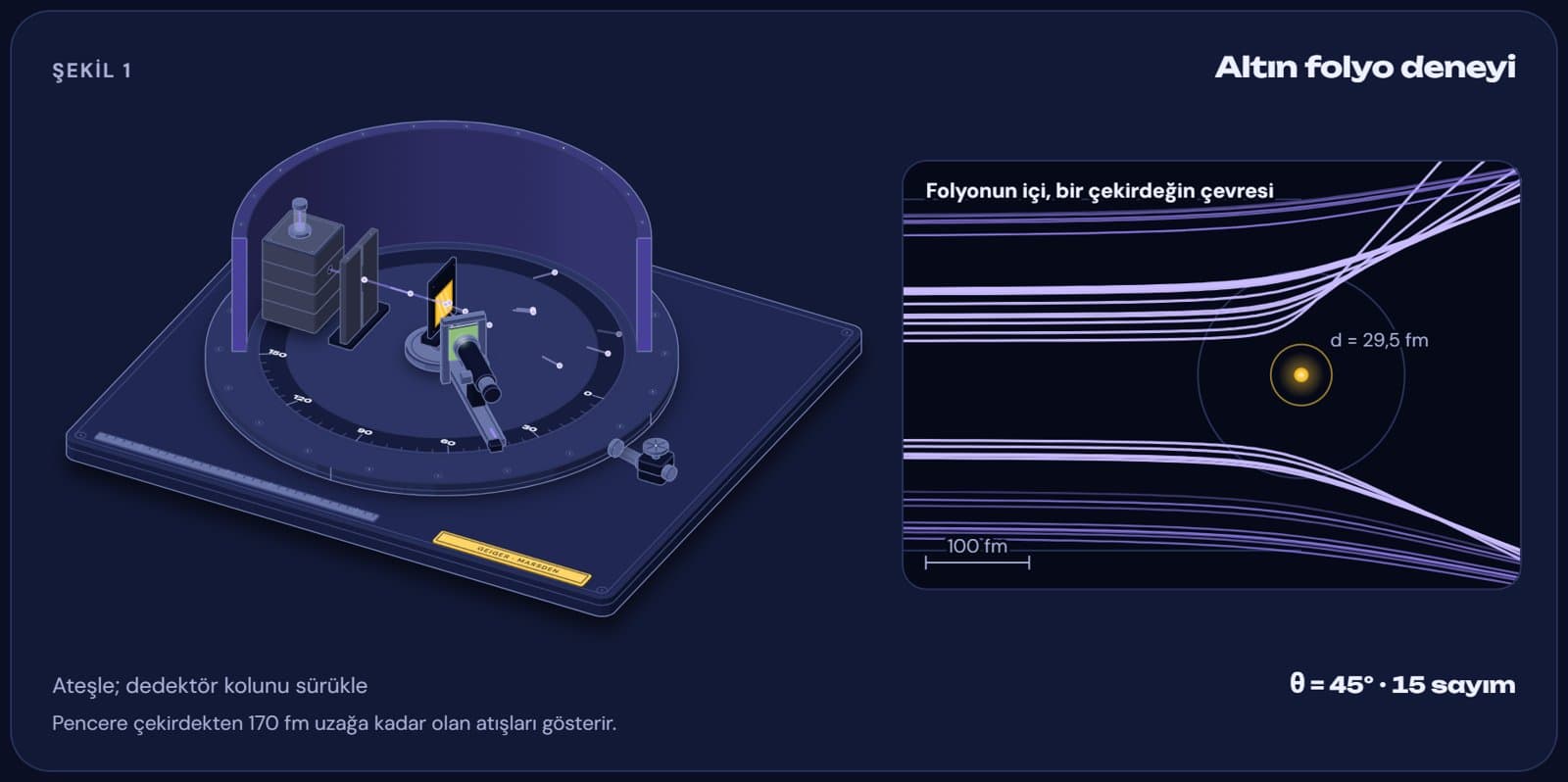
The apparatus used in Rutherford’s laboratory in Manchester had these parts:
- A radioactive source: alpha particles from a substance such as radium. An alpha particle is a helium nucleus made of two protons and two neutrons; its charge is positive and twice the size of the electron’s charge. It is about 7300 times heavier than an electron and moves at more than 15,000 kilometres per second.
- A lead shield and a slit: the source sits inside a thick lead block, and alphas can only leave through a narrow slit. This makes a thin beam.
- A thin metal foil: gold was chosen because it can be hammered into extremely thin leaves. The gold foil in Geiger’s measurements was about 0.4 micrometres thick, roughly fifteen hundred layers of atoms.
- A zinc sulfide screen and a microscope: when an alpha particle hits a screen coated with zinc sulfide, it makes a tiny flash of light (a scintillation). The researchers sat in a dark room and, once their eyes had adjusted, counted the flashes one by one through a microscope. The screen and microscope were mounted on an arm that could turn around the foil, so the number of alphas scattered at each angle could be measured.
- A vacuum chamber: air molecules would slow and deflect the alphas, so the apparatus sat in a chamber with the air pumped out.
The expectation: alphas should go almost straight through
If Thomson’s model were right, what should happen? An alpha particle gets a very small push from each atom in the foil. The tiny pushes from thousands of layers of atoms point in random directions and largely cancel. In the end most alphas should be deflected by less than a degree. In 1911 Rutherford calculated that the chance of these small deflections adding up to turn an alpha through more than 90° was unimaginably small. In short, a Thomson atom cannot send an alpha back.
The observation: most went straight, a few came back
In their 1909 paper, Geiger and Marsden did find that the great majority of alphas passed through the foil almost without deflection. But there was something unexpected too: some alphas were scattered through large angles, and some even came back the way they had come. In a measurement with a thick platinum plate, about 1 in 8000 of the incoming alphas was reflected.
That ratio may look small, but remember that the number Thomson’s model predicts cannot be told apart from zero. The problem was not a measuring error; it was the model itself.
Rutherford’s nuclear model (1911)
In 1911 Rutherford proposed a model that explained the result:
- All the positive charge of the atom and almost all of its mass are packed into a very small region at the centre: the nucleus.
- The electrons are around the nucleus, in the rest of the atom’s large volume. Most of the atom is empty space.
In this model most alphas pass far from any nucleus and are not deflected at all. But if an alpha passes very close to a nucleus, it meets a very strong electric repulsion, because all the positive charge is gathered at one point. The force falls off with the square of the distance (Coulomb’s law). So near the nucleus the alpha follows a hyperbola and turns through a large angle; if it comes almost head-on, it can bounce back. How close an alpha passes to a nucleus is a matter of chance, since nobody aims at a nucleus. Passing close is rare, so large angles are rare too.
In the simulation below you can compare the two models. In Thomson’s model every alpha goes straight through. In Rutherford’s model the window on the right shows the neighbourhood of one nucleus: the tracks of alphas passing close to the nucleus bend along hyperbolas. Change the foil metal, the alpha energy and the detector angle, and watch how the histogram settles onto the theoretical curve.
The scattering formula
Rutherford worked out how many alphas are scattered into a given angle by Coulomb repulsion from a single nucleus. The number of alphas landing on a unit area of the screen (more precisely, per unit solid angle) changes with the scattering angle like this:
Here is the charge of the nucleus (its number of protons) and is the kinetic energy of the alpha particle. The formula says three things:
- Angle: the term becomes very small at small angles, so a great many alphas are counted at small angles and very few at large ones. For example, comparing 10° with 150°, the count changes by about times.
- Nuclear charge: a nucleus with more charge deflects alphas more; the count grows as . Gold (Z = 79) scatters far more alphas back than aluminium (Z = 13).
- Energy: faster alphas are deflected less; the count falls as .
In 1913 Geiger and Marsden confirmed all three dependences with measurements at angles between 5° and 150°. Although the counts changed by a factor of hundreds of thousands, the measured values followed the curve the formula predicts.
Closest approach: how small is the nucleus?
If an alpha heads straight for a nucleus, it gets closer until all its kinetic energy has turned into electric potential energy, then stops and turns back. This distance of closest approach is:
Here MeV·fm; one femtometre (fm) is a millionth of a billionth of a metre ( m).
Example: for gold, Z = 79, and a 7.7 MeV alpha from radium’s decay products (polonium-214):
The alpha cannot get closer than about 30 fm to the centre of a gold nucleus, and the results of the experiment matched the formula exactly. So the gold nucleus must be smaller than that distance. Today we know that the radius of a gold nucleus is about 7 fm. The radius of a gold atom is about 0.14 nanometres, or about 144,000 fm. The nucleus is about 20,000 times smaller than the atom; for different atoms this ratio ranges from tens of thousands to a hundred thousand. If the atom were blown up to the size of a football stadium, its nucleus would be a marble on the centre spot.
If the alpha energy is very high or the nuclear charge is small (in aluminium, for example), the alpha can get close enough to touch the nucleus. Then nuclear forces join the electric repulsion, and Rutherford’s formula no longer holds exactly. These departures, seen with light nuclei at high energies, were later used to measure the size of the nucleus.
After Rutherford’s model
Rutherford’s model was a turning point in understanding the structure of the atom, but it did not explain everything. According to classical physics, electrons circling a nucleus should give off light, lose energy and fall into the nucleus. In 1913 Niels Bohr looked for an answer with a model in which electrons can exist only at certain energy levels. That the nucleus is made of protons and neutrons became clear only when James Chadwick discovered the neutron in 1932.
Common misconceptions
“Most of the alphas bounced back.” No. The great majority of alphas went through the foil almost without deflection. What was surprising was that a very small fraction was scattered through large angles.
“The alphas hit the nucleus and bounced off.” What turns the alphas back is not a collision but the electric repulsion of the nucleus’s positive charge, acting at a distance. In a gold foil the alpha stops and turns back well before it reaches the surface of the nucleus.
“The experiment was only done with gold.” Besides gold, Geiger and Marsden measured other metals such as silver, copper and aluminium. How scattering changes with the nuclear charge was an important test of the model.
“Rutherford also found the orbits of the electrons.” Rutherford’s experiment showed that the nucleus exists and how small it is; it did not explain how the electrons are arranged in the atom.
Summary
- In Thomson’s model the positive charge is spread through the whole atom; according to this model, alphas should pass through a foil almost without deflection.
- In 1909 Geiger and Marsden saw that most alphas went straight through, but a few were scattered through large angles and some even came back.
- In 1911 Rutherford proposed a model in which the positive charge and the mass are packed into a tiny nucleus.
- The number of alphas scattered into a given angle is proportional to ; Geiger and Marsden confirmed this in 1913.
- The nucleus is tens of thousands of times smaller than the atom; most of the atom is empty space.
For more on atoms and matter, have a look at our physics articles.
Frequently asked
5 questionsWhat was Rutherford's gold foil experiment?
What was observed in the gold foil experiment?
Why did the gold foil experiment disprove Thomson's model?
How much smaller is the nucleus than the atom?
What is Rutherford's scattering formula?
Sources
5 sources- 1.Geiger, H., Marsden, E. (1909) — On a Diffuse Reflection of the α-Particles, Proceedings of the Royal Society A, 82(557), 495–500
- 2.Rutherford, E. (1911) — The Scattering of α and β Particles by Matter and the Structure of the Atom, Philosophical Magazine, 21(125), 669–688
- 3.Geiger, H., Marsden, E. (1913) — The Laws of Deflexion of α Particles through Large Angles, Philosophical Magazine, 25(148), 604–623
- 4.Thomson, J. J. (1904) — On the Structure of the Atom, Philosophical Magazine, 7(39), 237–265
- 5.OpenStax, College Physics 2e — Chapter 30: Atomic Physics (30.2 Discovery of the Parts of the Atom: Electrons and Nuclei) (opens in a new tab)openstax.org
- #Rutherford
- #gold foil experiment
- #atomic nucleus
- #atomic models
- #alpha particle
- #Geiger and Marsden