Why is the sky blue? Rayleigh scattering made simple
Sunlight is white, so why is the sky blue and the sunset red? We explain Rayleigh scattering step by step, why we see blue rather than violet, and why clouds stay white.
By Kuazara Bilim EkibiPublished: Updated: 10 min read
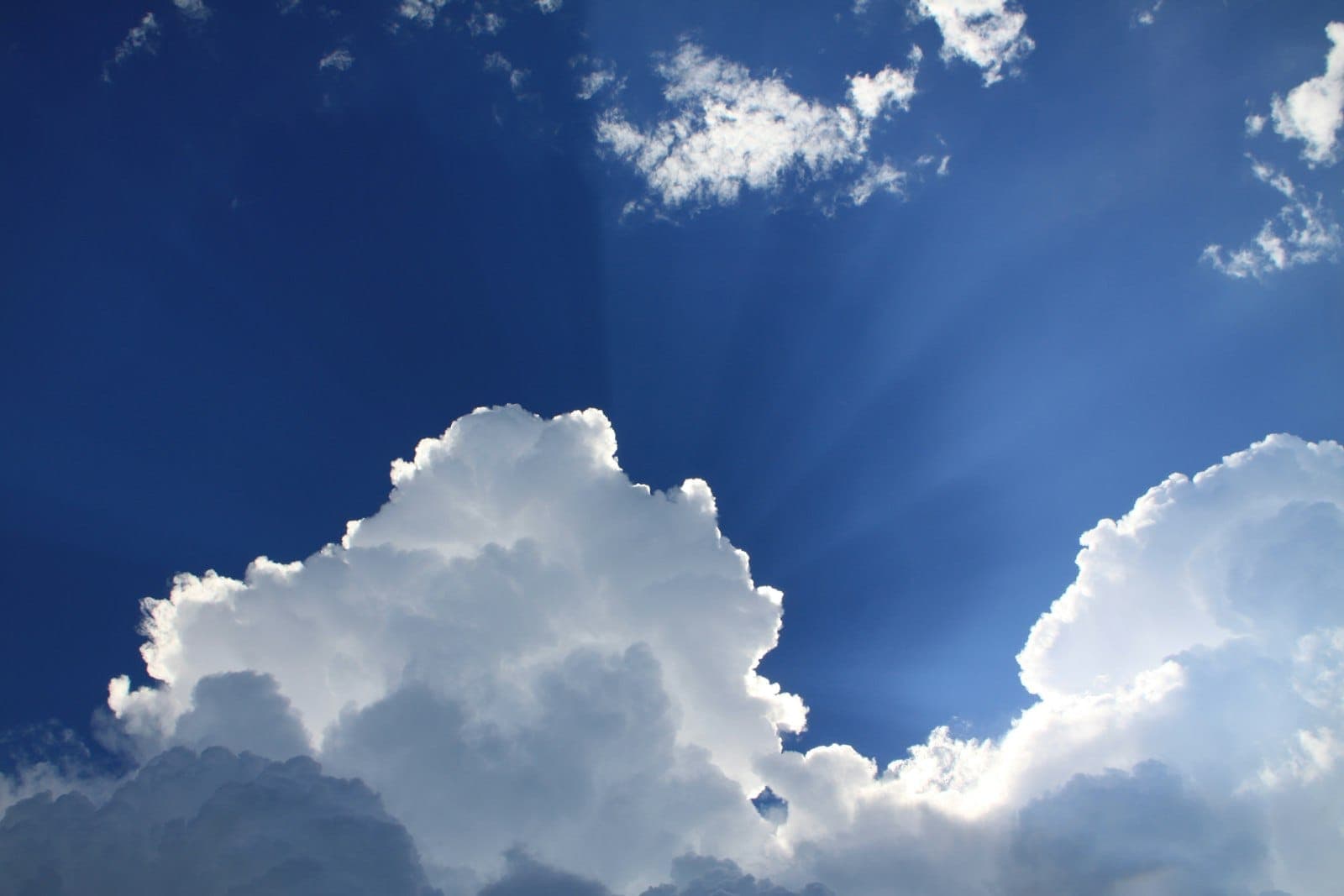
Photo: Sam Schooler / Unsplash
In this article · 7 sections
It is one of the oldest questions a child can ask: “Why is the sky blue?” Often it gets brushed off with something like “it reflects the colour of the sea”. But that is wrong: the sky is blue in the middle of a desert too, thousands of kilometres from any ocean. The real answer is much more interesting, and it rests on a tiny interaction between light and the billions of molecules in the air. In this article we explain that interaction, called Rayleigh scattering, without drowning you in formulas but without skipping the heart of it either.
White light is really a mixture of colours
The light from the Sun looks white to us, but it is not a single colour. Pass it through a prism, or look at a rainbow after the rain, and you will see white light split into a spread of colours running from red to violet. Each of these colours is a light wave with a different wavelength:
- Red light has a wavelength of roughly 620 to 750 nanometres.
- Green light is roughly 500 to 570 nanometres.
- Blue light is roughly 450 to 490 nanometres.
- Violet light is roughly 380 to 450 nanometres.
A nanometre is a billionth of a metre, so the waves we are talking about are unbelievably small. Yet the nitrogen () and oxygen () molecules in the atmosphere are much smaller still: about 0.3 nanometres across. That difference in size is the key to the whole story.
What is scattering?
When light meets a molecule, it makes the electrons inside the molecule vibrate. The vibrating electrons then act like tiny aerials and send the light back out in all directions. As a result, some of the light is turned away from its original path and spread out on every side. This is called scattering.
The light you see when you look at the sky is not light coming straight from the Sun. It is light that molecules in the air have scattered towards your eyes. Whenever you look at any part of the sky other than the Sun, you are seeing light that was scattered somewhere in that direction. Without an atmosphere, the sky away from the Sun would look pitch black even in daytime. That is exactly the situation on the Moon: because the Moon has no significant atmosphere, the sky in astronauts’ photographs is dark even when the Sun is high.
Rayleigh’s discovery: short waves scatter far more
In the 19th century the British physicist Lord Rayleigh worked out how light is scattered by particles much smaller than its wavelength. His result was surprisingly strong: the intensity of the scattered light is inversely proportional to the fourth power of the wavelength.
Here (lambda) is the wavelength. “Fourth power” means that a small difference in wavelength turns into a very large difference in scattering.
Let’s calculate: how much more is blue scattered than red?
Let’s see this with a concrete example. Take roughly nm for blue light and nm for red light. The ratio of their scattering intensities is:
So blue light is scattered about 6 times more than red light. The wavelengths differ by only a factor of 1.5, yet the scattering differs by almost a factor of 6. That is the power of the fourth power.
There is a subtle but lovely detail here. In a perfectly smooth medium with the same density everywhere, the waves scattered by neighbouring molecules would largely cancel each other out. What makes the sky bright is that air molecules move randomly, so at every moment the density flickers slightly in small regions. In the early 20th century Marian Smoluchowski and Albert Einstein published work linking scattering to these density fluctuations. The result still has the same dependence, but it enriches the picture to say that the blue of the sky is really a trace of the molecules’ disorderly motion.
That is why, as sunlight passes through the atmosphere, its blue component is spread in every direction and reaches our eyes from every corner of the sky. The red and yellow components, on the other hand, mostly keep going in their original direction. The result: the sky as a whole looks blue, while the Sun itself looks slightly yellowish.
So if violet has a shorter wavelength, why isn’t the sky violet?
This is a great question that everyone who really thinks about the topic asks at some point. According to the formula, violet light should be scattered even more than blue. So why don’t we see a violet sky? Several factors work together:
- The Sun does not give out equal amounts of every colour. Sunlight carries less energy in the violet region than in the blue and green regions. On top of that, the upper layers of the atmosphere absorb some of the short wavelengths close to ultraviolet.
- Our eyes are less sensitive to violet. The colour-sensing cells in our eyes (cone cells) are most sensitive to the green and yellow-green region; their sensitivity to violet light is clearly lower.
- The colour we see is a mixture. The light coming from the sky is not just blue; it is a mixture of violet, blue, some green and smaller amounts of other colours. Our brain combines the signals from the cone cells and interprets this mixture as “light blue”.
So physically the sky scatters violet light too, but when the Sun’s spectrum, the absorption in the atmosphere and the structure of our eyes come together, the colour we perceive is blue.
Why is the sunset red?
The same physics explains the orange and red colours of sunset. When the Sun is high, the path its light takes through the atmosphere is relatively short. As the Sun nears the horizon, the light reaches us along a much longer, slanting path through the atmosphere.
Along this long journey, blue light is scattered again and again and taken out of the beam. What reaches us directly is mostly the orange and red components. If there are many particles such as dust, sea salt or smoke in the air, the colours can become even more intense. This is one reason why, after large volcanic eruptions, sunsets in many parts of the world look unusually vivid.
It is also a nice mental exercise to picture that, while one place is watching the sunset, the blue light scattered out of that beam is colouring the sky blue somewhere else. In a sense, the colour of the sky is a map of how light is shared out across the atmosphere.
Why are clouds white?
Clouds are made of water droplets and ice crystals. These droplets are much larger than air molecules; their size is comparable to the wavelength of light or larger. In this case the Rayleigh approximation no longer holds and the scattering hardly depends on wavelength at all. This kind of scattering is usually called Mie scattering.
Because all colours are scattered in roughly equal amounts, clouds look white. When a cloud gets very thick, most of the light is scattered and absorbed inside it and less light reaches us from its base; that is why rain clouds look dark grey. The reason the sky looks pale and whitish in hazy, very humid or dusty weather is also the increase in large particles.
Try it at home: a sunset in a glass
You can see the logic of Rayleigh scattering for yourself with a simple experiment at home.
You will need: a clear glass or jug, water, a few drops of milk, a torch and a dark room.
- Fill the glass with water, add a few drops of milk and stir. The water should turn slightly cloudy, but not completely white.
- Darken the room and shine the torch at the glass from the side.
- Look at the glass from the side (at right angles to the beam): the liquid takes on a faint bluish tint.
- Now look at the torch light from the opposite side of the glass, along the direction the light passes through: the light looks orange-yellow.
Milk droplets are not as small as air molecules, so the experiment is not an exact model of the atmosphere; but it is enough to show roughly that short-wavelength light is scattered more to the sides and that long-wavelength light is left behind. The “sky” in the glass is blue, while the “Sun” seen from the other side is orange.
An important safety note: never look at the real Sun with the naked eye, through binoculars or through a telescope without a filter. Even at sunset this is risky for your eyes.
A little further: other planets and polarisation
What we have covered so far is enough to grasp the basic idea. But applying the same physics to different conditions, and seeing what comes out, is the best way to test whether you have really understood a concept. Let’s look at two examples.
What colour is the sky on other planets?
Rayleigh scattering is not unique to Earth, but its outcome depends on the make-up of the atmosphere and the dust in it. Mars has a very thin atmosphere, dominated by fine, iron-oxide-rich dust particles suspended in the air. That is why the daytime sky on Mars looks yellowish-brown. Interestingly, sunsets on Mars are bluish: the way this dust scatters light makes blue stand out around the Sun. Images taken by spacecraft show this clearly.
This comparison teaches us something important: “the sky is blue” is not a law of nature but an outcome produced jointly by a particular planet, a particular atmosphere and a particular star.
Skylight is polarised
For those who want to take the topic one step further, here is one more fact: light scattered by the atmosphere is polarised, meaning its vibrations are concentrated in a particular direction. The effect is strongest in the parts of the sky at 90 degrees from the Sun. If you wear polarised sunglasses and tilt your head to one side, you may notice some parts of the sky getting darker and lighter. Some bees and migrating animals are known to be able to use this polarisation pattern in the sky to find their way.
In short
- Sunlight is a mixture of many colours.
- Because air molecules are much smaller than the wavelength of light, Rayleigh scattering takes place, and the scattering is proportional to .
- Blue light is scattered about 6 times more than red; that is why the sky looks blue.
- Violet light is scattered too, but because of the Sun’s spectrum, absorption in the atmosphere and the sensitivity of our eyes, what we perceive shifts towards blue.
- At sunset, light travels a long path, the blue component is scattered away and the red tones are left.
- The large droplets in clouds scatter all colours in similar amounts, so clouds are white.
If you are curious to learn more about light and colour, you can browse the science topics or read our physics articles. In Kuazara’s interactive lessons on light you can change the wavelength yourself and see how the scattering changes; instead of memorising, see with your own eyes why it works that way.
Frequently asked
4 questionsIs the sky blue because it reflects the sea?
If violet light is scattered more, why doesn't the sky look violet?
Why are sunsets red or orange?
Why are clouds white rather than blue?
Sources
3 sources- 1.Feynman, R. P., Leighton, R. B., Sands, M. — The Feynman Lectures on Physics, Vol. I, Bölüm 32: Radiation Damping. Light Scattering (opens in a new tab)feynmanlectures.caltech.edu
- 2.OpenStax, College Physics 2e (opens in a new tab)openstax.org
- 3.Bohren, C. F., Clothiaux, E. E. — Fundamentals of Atmospheric Radiation, Wiley-VCH (2006)
- #light
- #rayleigh scattering
- #atmosphere
- #colours
- #optics