How does sound travel? Counting the seconds between lightning and thunder
Why do we see the lightning first and hear the thunder later? We explain how sound travels, how fast it moves through air, water and steel, and how a simple calculation tells you how many kilometres away a storm is.
By Kuazara Bilim EkibiPublished: Updated: 8 min read
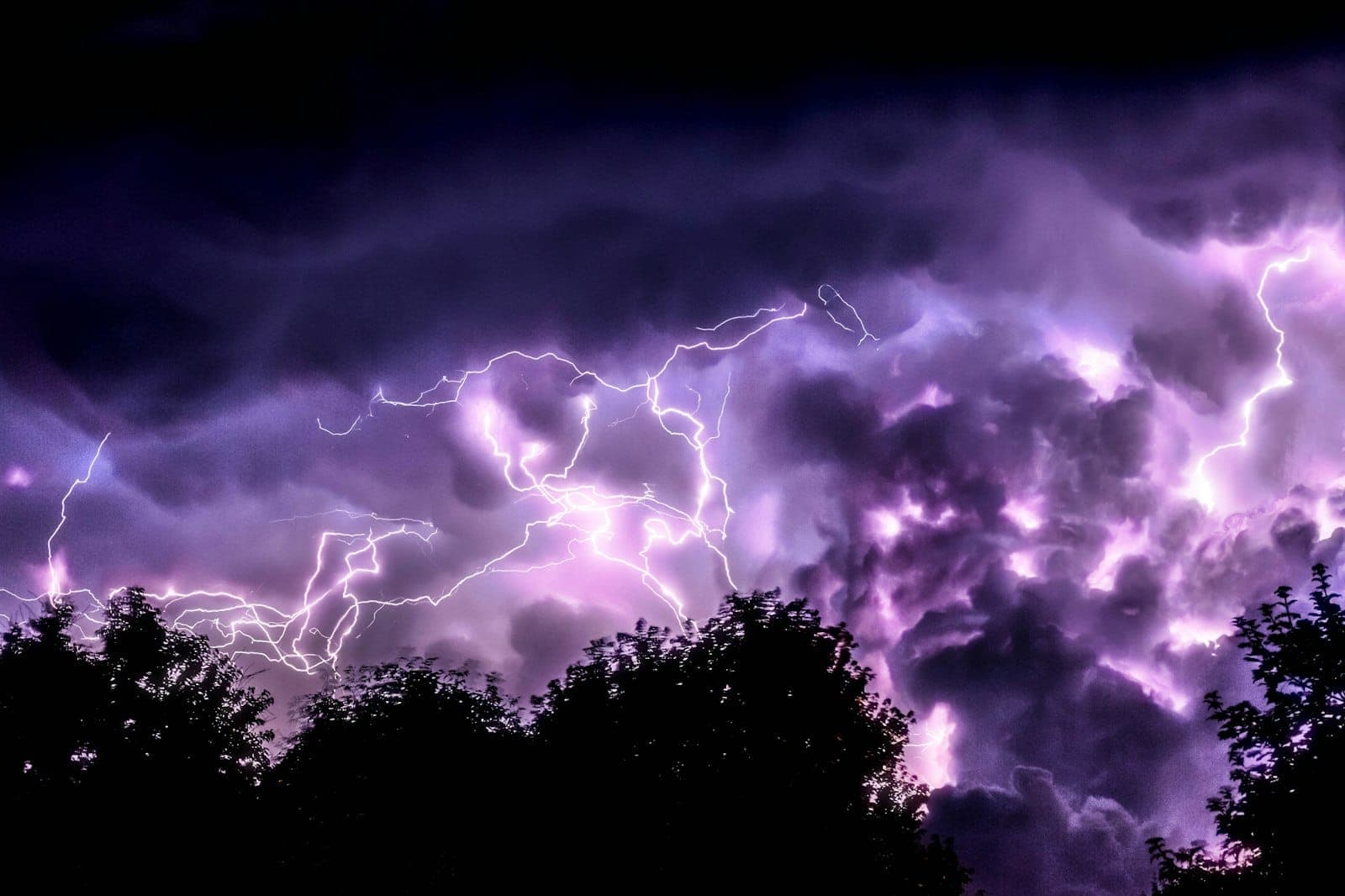
Photo: Jeremy Thomas / Unsplash
In this article · 8 sections
A summer evening, and a storm is coming. The sky suddenly lights up with a flash of lightning, but the thunder only arrives a few seconds later. Yet both come from the same bolt, at the same moment. So why the delay? Could we count that delay to find out how far away the storm is? The answer is yes, and all we need is to understand how sound travels. In this article we look at the nature of sound, its speed in different materials, and how to calculate the distance to lightning step by step.
What is sound?
Sound is energy that spreads out when a vibrating object makes the material around it vibrate. Pluck a guitar string and it vibrates back and forth. That vibration pushes and pulls the air particles next to the string. Those particles push their neighbours in turn. In this way the vibration is passed on from particle to particle until it reaches your eardrum. Your eardrum vibrates with the same rhythm, and your brain interprets this as sound.
Here is a very important point: the air particles do not travel from the source to your ear. Each particle only moves back and forth around its own position. What travels is not the particles themselves but the vibration, in other words the energy. Think of a Mexican wave in a stadium: each spectator only stands up and sits down, but the wave moves all the way round the stands.
In a sound wave, the air is squeezed together in some regions and spread out in others. Because the particles vibrate back and forth along the direction the wave travels, sound is classed as a longitudinal wave.
Can sound travel through a vacuum?
No. Sound needs a material medium (a solid, liquid or gas) to travel. In a vacuum there are no particles to pass the vibration along. That is why sound cannot travel through empty space. The noisy space explosions in science-fiction films may be a dramatic choice, but they are not realistic. Astronauts on a spacewalk talk to each other by radio; radio uses electromagnetic waves (radio waves) instead of sound, and these can travel through a vacuum.
A classic experiment shows this: a ringing bell is placed inside a glass jar that can be emptied of air. As the air is pumped out, the sound of the bell gets fainter and fainter until it can barely be heard, even though you can still see the bell ringing.
What is the speed of sound in m/s?
The speed of sound depends on the material it travels through. Approximate values:
| Medium | Approximate speed of sound |
|---|---|
| Air (20 °C) | 343 m/s |
| Water | about 1480 m/s |
| Steel | about 5900 m/s |
In general, sound travels faster in solids than in liquids, and faster in liquids than in gases. The reason is not only that the particles are closer together; it is how tightly the particles are bound to each other (the stiffness of the material) and the density of the material. In solids the bonds between particles are very strong, so the vibration is passed on very quickly.
In air, the speed of sound also changes with temperature. An approximate formula:
So the speed of sound, about 331 m/s at 0 °C, becomes about 343 m/s at 20 °C. In warm air the particles move faster, so they pass the vibration on more quickly.
Light, however, travels at a completely different speed: about 300,000 kilometres per second. That is roughly a million times the speed of sound. Over everyday distances, the time light takes to reach us can be treated as zero in practice.
Lightning and thunder: working out the distance
When lightning strikes, the light (the flash) and the sound (the thunder) are produced at the same moment. Thunder is a powerful sound wave created when the air in the lightning channel heats up to tens of thousands of degrees in a very short time and suddenly expands.
The light reaches us almost instantly. The sound, however, covers about 343 metres every second. So:
Here is the number of seconds between the moment you see the lightning and the moment you hear the thunder.
A practical rule: since metres, if you divide the seconds you count by 3 you get the approximate distance in kilometres.
Example 1: the thunder was heard 6 seconds after the lightning.
Example 2: the delay is 15 seconds.
If you keep counting the seconds for a few minutes, you can also tell whether the storm is coming towards you: if the gap is getting shorter, the storm is getting closer.
A safety note
This calculation is a fun bit of physics, but let’s be clear about safety: if you can hear thunder, you are within reach of a lightning strike. Lightning can strike kilometres away from the centre of a storm. Weather services advise going into an enclosed building, or a vehicle with its doors and windows shut, as soon as you hear thunder, and waiting at least 30 minutes after the last thunder. Don’t wait out in the open, under a lone tree or near water.
Everyday examples
- The stadium delay: in a big stadium, you can see the drummer in the stand opposite hit the drum a moment before you hear it.
- Echoes: when you shout in the valleys of Cappadocia or in an empty hall, the sound bounces off surfaces and comes back. To hear the echo as a separate sound, the reflecting surface has to be far enough away.
- Listening to the rails: characters in films who hear an approaching train by listening to the rail are right in terms of physics: sound travels much faster in steel than in air. But in real life, going near railway tracks is extremely dangerous; never try this.
- Dolphins and sonar: ships and dolphins measure distances underwater by sending out sound waves and listening for their echoes.
Common misconceptions
“In a sound wave, air flows from the source to your ear.” No. Air particles only vibrate in place; it is the energy that travels.
“Sound travels fastest in air.” The opposite. Among everyday materials, sound travels slowest in gases and fastest in solids.
“To find the distance you divide the seconds by 5.” That rule gives the distance in miles (a mile is about 1.6 km). For kilometres, you divide the seconds by about 3.
“Loud sounds travel faster.” The speed of sound depends on the medium, not on how loud or how high-pitched the sound is. In everyday conditions, low and high-pitched sounds travel at the same speed.
Try it at home: a string telephone
You will need: two paper or plastic cups, 5-10 metres of thin string, toothpicks, something pointed (let an adult make the holes).
- Make a small hole in the middle of the bottom of each cup.
- Thread the ends of the string through the holes and fix each one by tying it to a toothpick inside the cup.
- Move away from a friend until the string is pulled tight.
- One of you speaks into a cup while the other holds the other cup to their ear.
With the string tight, your voice reaches the other side surprisingly clearly. The bottom of the cup vibrates with the sound, the vibration travels along the string and makes the other cup vibrate. Let the string go slack, or pinch it with your finger: the sound stops. This shows that sound travels through a medium as vibration.
Summary
- Sound is vibration passed from particle to particle through a medium.
- Sound cannot travel through a vacuum; it needs a material medium.
- The speed of sound in air at 20 °C is about 343 m/s; it is faster in water and in solids.
- Divide the seconds between lightning and thunder by 3 to find the storm’s approximate distance in kilometres.
- If you can hear thunder, move to a safe enclosed space.
For more, take a look at our Science topics and our physics articles.
Frequently asked
4 questionsHow does sound travel?
Can sound travel through a vacuum?
What is the speed of sound in air in m/s?
How do you work out how far away lightning is?
Sources
3 sources- #sound
- #speed of sound
- #waves
- #lightning
- #thunder