How to calculate speed: distance, time, average speed and speed vs velocity
Does covering a longer distance always mean going faster? We explain the speed formula, converting between m/s and km/h, the surprising side of average speed and the difference between speed and velocity, with everyday examples and a small measuring activity.
In this article · 9 sections
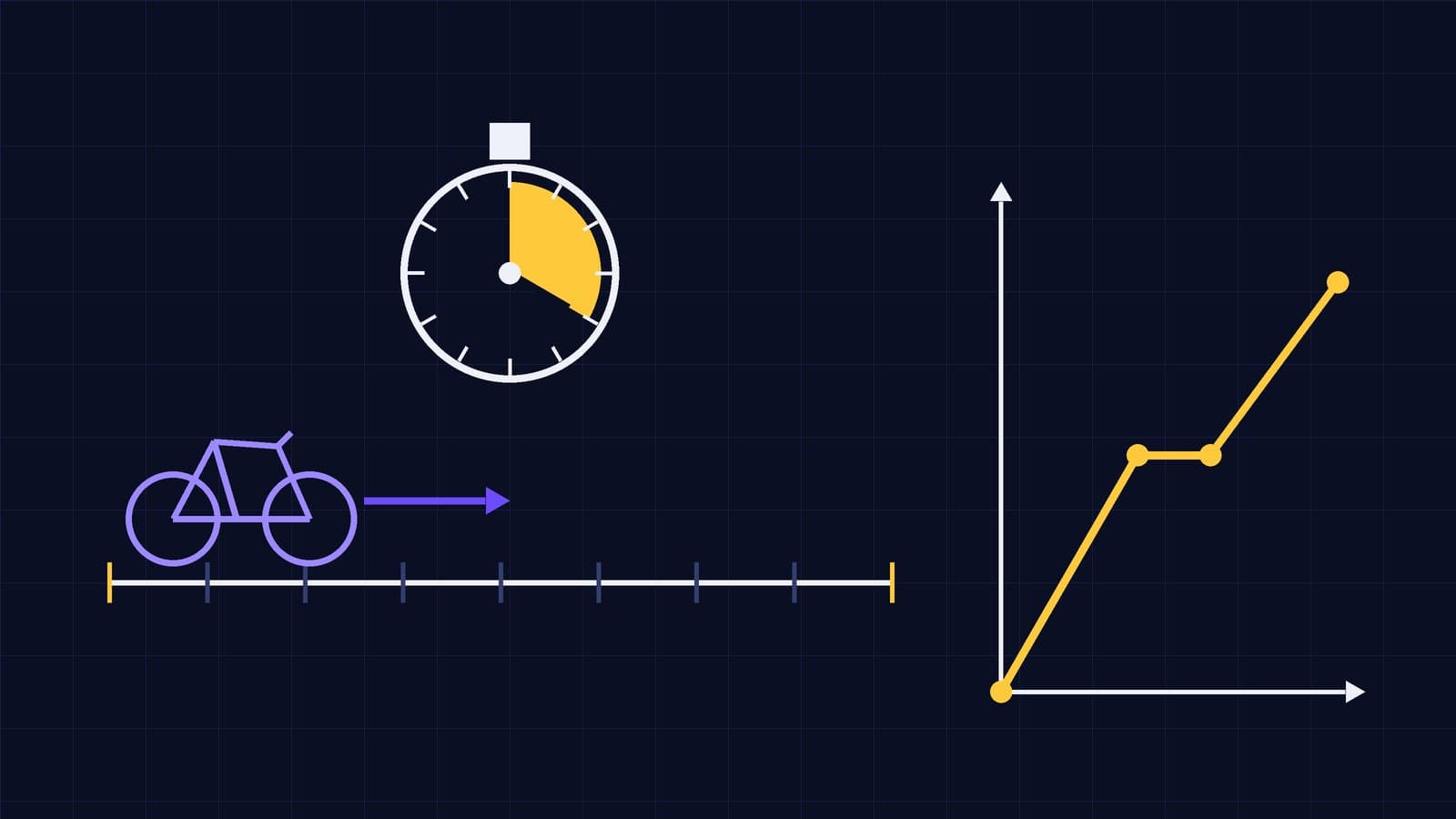
Elif cycles to school and Can walks. Elif lives further away, yet she still gets to school before Can. Who is faster? At first glance the answer seems obvious. But what exactly do we mean by “faster”? Is it enough to look only at the distance travelled, or only at the time taken?
In this article we work through what speed is and how to calculate it, step by step. We will see how to switch between m/s and km/h, why average speed sometimes gives surprising results, and how the words “speed” and “velocity”, which we often use interchangeably in everyday language, mean different things in science. At the end there is a small measuring activity you can try at home or at school.
What is speed? Thinking about distance and time together
The easiest way to compare two runners is to have them run the same distance and see who finishes in the shorter time. That is exactly how athletics races work: everyone runs 100 metres, and whoever finishes first wins.
Another way is to have them run for the same amount of time and see who covers the greater distance. For example, everyone runs for 1 minute, and whoever gets furthest is the fastest.
But what if both the distances and the times are different? That is exactly the situation with Elif and Can. In that case we work out how far each of them travels per unit of time — for example, every second:
- Can walks 600 metres in 400 seconds. Each second he covers metres.
- Elif cycles 1500 metres in 300 seconds. Each second she covers metres.
Elif covers more ground than Can every second, so she is faster. The distance travelled per unit of time is called speed. Speed is the numerical answer to the question “How quickly am I going?”
The key point in this comparison is this: looking at the distance alone, or the time alone, is not enough. Speed combines both into a single number.
The speed formula:
To calculate speed, we divide the distance travelled by the time taken:
In this formula:
- stands for speed,
- stands for the distance travelled,
- stands for the time taken.
In other books you may see or used for distance instead of . The letter changes, but the meaning stays the same: distance travelled divided by time taken.
Example: a runner completes one lap of a 400-metre track in 80 seconds. Their speed is:
So the runner covers 5 metres every second, on average.
Noticing that speed is a ratio makes things much easier. Because it is a ratio:
- Someone who covers the same distance in half the time has double the speed.
- Someone who covers twice the distance in the same time also has double the speed.
For example, someone who runs 400 metres in 40 seconds is running at 10 m/s. Someone who runs 800 metres in 80 seconds is also running at 10 m/s. You can explore this core idea with interactive examples in our Speed: distance and time lesson.
Units of speed: converting between m/s and km/h
The unit of speed depends on the units you use for distance and time:
- If distance is in metres (m) and time in seconds (s), speed is in metres per second (m/s). This is the unit used most often in physics calculations.
- If distance is in kilometres (km) and time in hours (h), speed is in kilometres per hour (km/h). Car speedometers and road signs in Turkey and much of Europe use this unit. (In the UK, road signs use miles per hour, mph.)
To switch between the two, you only need to remember two facts: 1 km = 1000 m and 1 hour = 3600 s.
An object moving at 1 m/s covers 3600 metres in 1 hour (that is, in 3600 seconds), which is 3.6 km. So:
This gives two handy rules:
- From m/s to km/h: multiply by 3.6. For example, km/h.
- From km/h to m/s: divide by 3.6. For example, m/s.
If you are not sure whether to multiply or divide, think about this: the same speed always gives a bigger number when written in km/h. 20 m/s is 72 km/h; it can never be the other way round.
The table below shows some approximate speeds. These values are only a rough guide; they vary with the person, the conditions and the surroundings.
| Motion | Approximate speed (m/s) | Approximate speed (km/h) |
|---|---|---|
| A person walking | 1.4 | 5 |
| Someone cycling in town | 4–6 | 14–22 |
| A car in a built-up area | 14 | 50 |
| Sound travelling through air (near room temperature) | 340 | 1200 |
Light, meanwhile, travels about 300,000 km every second in a vacuum. That is roughly 900,000 times faster than sound in air.
Rearranging the formula: finding distance and time
The formula links three quantities. If you know any two of them, you can find the third:
Finding distance: a car travels at a steady 80 km/h for 2.5 hours. How far does it go?
Finding time: your school is 1.2 km from home and you walk at 1.5 m/s. First, let’s make the units match: 1.2 km = 1200 m.
800 seconds is 13 minutes 20 seconds, so you can plan when to leave home.
The thunder example: you see a flash of lightning and hear the thunder 3 seconds later. Light is so fast that we see the flash almost instantly; nearly all of the delay comes from the sound’s journey. Using the fact that sound travels at about 340 m/s in air:
The lightning struck about 1 km away. The rule of thumb “every 3 seconds is roughly 1 kilometre” comes from this calculation.
To remember the formula, many people draw a small triangle: at the top corner, and at the bottom corners. Cover the letter you want to find with your finger and what is left tells you what to do: cover and you get ; cover and you get .
Average speed: looking at the whole journey
In real life, almost nothing moves at the same speed from start to finish. Cycling to school, you slow down uphill, speed up downhill and stop at red lights. That is why the speed we calculate with is usually the average speed:
Example: a cyclist first rides 3 km in 10 minutes, then waits 2 minutes at a red light, then covers the remaining 2 km in 8 minutes.
- Total distance: km
- Total time: minutes, which is of an hour
- Average speed: km/h
Notice that the 2 minutes spent waiting at the lights count towards the total time too. Average speed sums up the whole journey in a single number.
The value you see on a car’s speedometer, on the other hand, is the instantaneous speed: how fast you are going at that moment. The speedometer might show 50 km/h and then drop to 30 km/h a moment later. The average speed for the journey is still the total distance divided by the total time.
The there-and-back puzzle
This question surprises many people: a family drives to a city 120 km away at 60 km/h, but on the way back heavy traffic means they travel at 40 km/h. What is the average speed for the whole journey?
The answer that first springs to mind is km/h. Let’s work it out:
- Time there: hours
- Time back: hours
- Total distance: km; total time: hours
The result is 48 km/h, not 50. Why? Because the family spent more time on the road while going slowly. The slow part makes up a bigger share of the total time, so it pulls the average towards itself.
Speed on a distance–time graph
You can also show motion on a graph: time along the horizontal axis and distance travelled up the vertical axis. An object moving at a steady speed gives a straight line. The steeper the line, the greater the speed; the gradient of that straight line gives the speed. A flat section shows the object has stopped and is not covering any distance. The 2 minutes the cyclist spent waiting at the red light appear on the graph as a flat step.
The difference between speed and velocity
In everyday language we often use “speed” and “velocity” to mean the same thing. In science, though, there is a small but important difference:
- Speed only tells you how quickly something is moving. It is given as a number with a unit: 60 km/h.
- Velocity also tells you the direction of motion: 60 km/h due north.
“The bus is travelling at 60 km/h” is a statement about speed; “The bus is travelling north at 60 km/h” is a statement about velocity. In physics, quantities that have a direction are called vector quantities, and those that only have a size are called scalar quantities. Speed is a scalar; velocity is a vector.
The difference becomes really clear with averages. To work out average velocity, we use displacement instead of total distance. You can think of displacement as a straight arrow from the starting point to the finishing point: it shows how far away you ended up, and in which direction.
The track example: a runner does one lap of a 400-metre track and arrives back where they started after 80 seconds.
- Average speed: m/s
- Displacement: the start and finish are the same point, so it is zero. That means the average velocity is also zero.
The runner ran quite fast but ended up exactly where they began. Average speed describes how much ground they covered; average velocity describes where they ended up.
The roundabout example: a car goes round a roundabout with its speedometer showing a steady 30 km/h. Its speed is not changing, but because its direction keeps changing, its velocity is changing. Changing velocity requires a force; for a car going round a bend, that force comes from friction between the tyres and the road. You can see in detail how unbalanced forces change an object’s speed or direction in our Balanced and unbalanced forces lesson.
Common mix-ups
Speed looks like a simple topic, but a few points are often mixed up. Here are the most common ones:
1. “Whoever travels further is faster.” At first glance it looks that way, but speed depends not only on distance but also on how long it takes to cover it. A coach that travels 300 km in 5 hours has a speed of km/h. A car that travels 80 km in 1 hour has a speed of 80 km/h. The car covered less distance but was faster.
2. “Average speed is the average of the speeds.” This only holds when equal amounts of time are spent on each part of the journey. As we saw in the there-and-back puzzle, when equal distances are covered at different speeds, the average speed comes out lower than the simple average. The method that always works is the same: total distance divided by total time.
3. “1 hour 30 minutes = 1.30 hours.” Hours are not divided into tenths but into 60 minutes. 30 minutes is half an hour, so 1 hour 30 minutes = 1.5 hours. A vehicle that covers 120 km in 1 hour 30 minutes has a speed of km/h. Dividing by 1.30 would give a very different result of about 92 km/h. In the same way, 45 minutes is 0.75 hours and 20 minutes is of an hour.
4. Mixing up units. For someone who walks 600 metres in 5 minutes, , but that answer is in metres per minute, not m/s. For m/s, convert the time into seconds first: 5 minutes = 300 seconds, and m/s. Writing the units of distance and time next to the numbers before you start calculating keeps this from getting muddled.
5. Multiply by 3.6 or divide? The number in km/h is always bigger than the number in m/s. If your answer says otherwise, reverse the operation.
6. Are speed and velocity the same thing? In everyday conversation they are often used that way; in science they are kept apart. Velocity includes direction. So an object whose speed stays the same can still change its velocity simply by changing direction.
Try it yourself: measuring speed in a corridor
You can do this activity at school or in a large garden, with help from an adult. Educators can also run it with a whole class and collect the results in a shared table.
You will need: a tape measure, chalk or masking tape, a stopwatch (a phone stopwatch works fine), paper and a pen.
- On a flat, non-slippery floor, measure out a 10-metre stretch. Mark the start and finish lines with chalk or tape.
- Ask a friend to hold the stopwatch. Walk from the start line to the finish line at your normal walking pace. Record the time.
- Cover the same distance again, this time walking briskly (there is no need to run). Record the time again.
- For each attempt, calculate your speed in m/s using .
- Multiply the result by 3.6 to convert it to km/h. Is your normal walking speed close to the typical value of about 5 km/h?
- Repeat each measurement three times and take the average. Why might the measurements come out slightly different from each other? (Hint: think about the delay when you press the stopwatch button.)
You can record your results in a table like this:
| Attempt | Distance (m) | Time (s) | Speed (m/s) | Speed (km/h) |
|---|---|---|---|---|
| Normal walk | 10 | |||
| Brisk walk | 10 |
Safety: watch out for corners, doors and slippery floors in the corridor, and keep out of other people’s way.
A few quick questions
- Who is faster: a runner who covers 100 metres in 15 seconds, or a cyclist who covers 1 kilometre in 3 minutes?
- What is 54 km/h in m/s?
- A cyclist rides the first 10 km at 20 km/h and the next 10 km at 10 km/h. What is their average speed in km/h?
Answers:
- Runner: m/s. Cyclist: 3 minutes = 180 seconds, and m/s. The runner is slightly faster.
- m/s.
- The first part takes hours and the second part hour. The total distance is 20 km and the total time is 1.5 hours: km/h. This is lower than the simple average of 15 km/h, because more time was spent on the slower part.
Summary
- Speed is the distance travelled per unit of time: .
- Rearranging the formula lets you find distance () and time ().
- The units of speed are m/s and km/h; . To go from m/s to km/h, multiply by 3.6; to go the other way, divide by 3.6.
- Average speed is total distance divided by total time; a simple average of the speeds does not always give the same result.
- Speed only gives a size; velocity also includes direction. If the direction of motion changes, the velocity changes even when the speed stays the same.
- Make the units match before you start calculating; 1 hour 30 minutes = 1.5 hours.
To build on this step by step, have a look at the Speed: distance and time lesson, and to understand the forces that change motion, try the Balanced and unbalanced forces lesson. For more, visit our Science topics and our physics articles.
Frequently asked
5 questionsHow do you calculate speed?
Divide the distance travelled by the time taken: v = x / t. For example, someone who runs 400 metres in 80 seconds has a speed of 400 ÷ 80 = 5 m/s.
How do you convert m/s to km/h?
Since 1 m/s = 3.6 km/h, multiply a value in m/s by 3.6; to go from km/h to m/s, divide by 3.6. For example, 20 m/s = 72 km/h and 90 km/h = 25 m/s.
What is average speed and how do you find it?
Average speed is the total distance divided by the total time. Any stops along the way are included in the total time. For example, a cyclist who covers 5 km in a total of 20 minutes (1/3 of an hour) has an average speed of 15 km/h.
If you travel at 60 km/h on the way there and 40 km/h on the way back, why isn't the average speed 50 km/h?
Because more time is spent on the slower part. A 120 km stretch takes 2 hours at 60 km/h and 3 hours at 40 km/h. That is 240 km in 5 hours in total, so the average speed is 240 ÷ 5 = 48 km/h.
What is the difference between speed and velocity?
Speed is a scalar quantity that only tells you how quickly something is moving. Velocity is a vector quantity that also includes direction. A car going round a roundabout at a steady speed keeps the same speed, but its velocity changes because its direction changes.
Sources
4 sources- 1.OpenStax — College Physics 2e, Chapter 2: Kinematics (opens in a new tab)
- 2.OpenStax — University Physics, Volume 1, Chapter 3: Motion Along a Straight Line (opens in a new tab)
- 3.Khan Academy — Physics: One-dimensional motion
- 4.Wikipedia — Speed (opens in a new tab)
- #speed
- #velocity
- #average speed
- #unit conversion
- #motion
- #physics