Heat vs temperature: what's the difference? Internal energy and thermal equilibrium
Which carries more energy: a cup of hot tea or a bath full of lukewarm water? We explain temperature, heat and internal energy with the particle model, along with thermal equilibrium, Q = mcΔT and the points people most often confuse.
In this article · 10 sections
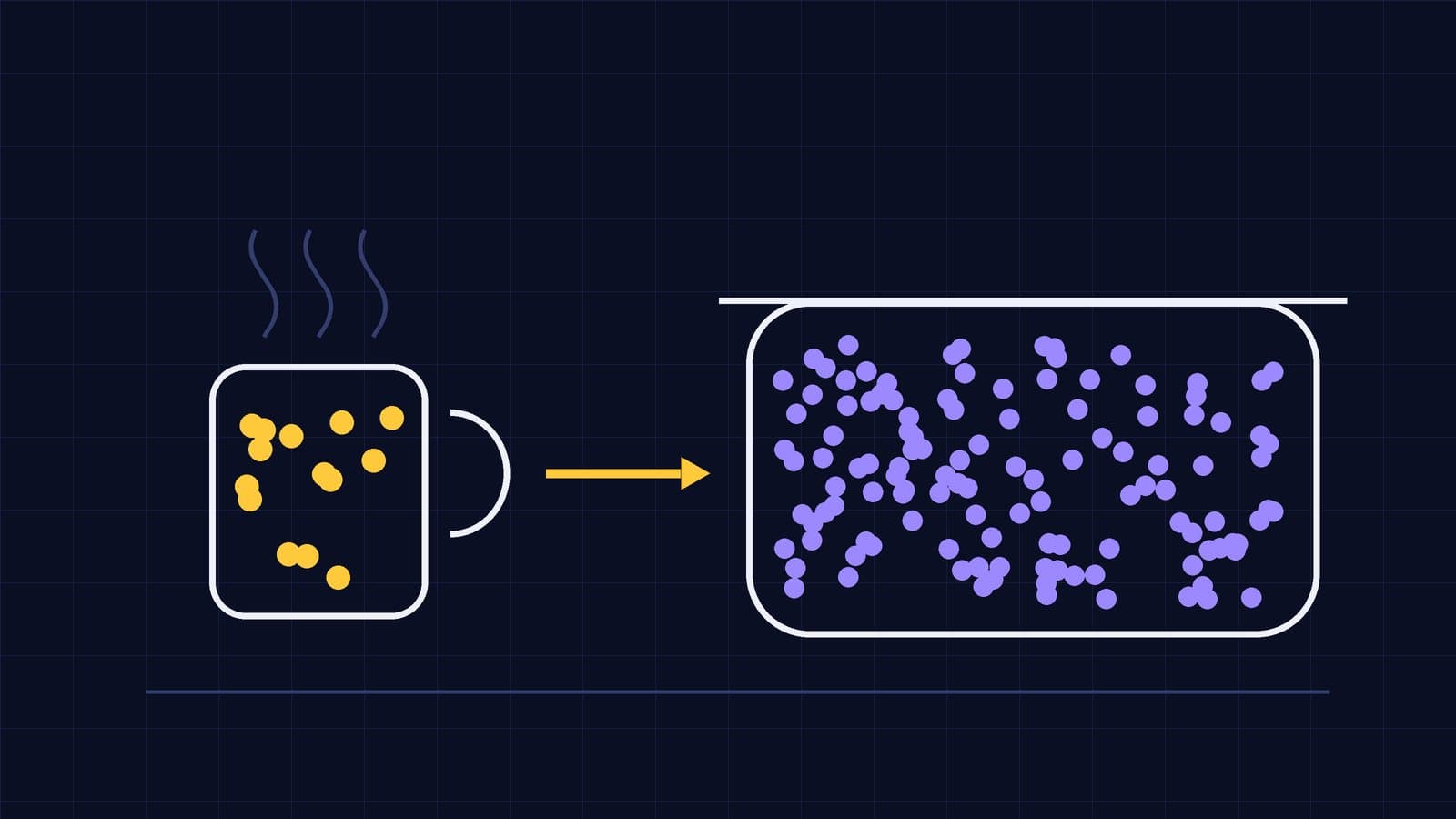
On a winter morning, the cup of tea in your hands is at roughly 80 °C. The lukewarm bath you run in the evening is perhaps 37 °C. Which is hotter? Easy: the tea. But which one carries more energy? This is where things get interesting, because the answer, by a long way, is the bath.
In everyday speech we often use “heat” and “temperature” as if they meant the same thing: “the heat today is 35 degrees”. In physics, though, the two words describe different ideas. In this article we start from the particle model to separate temperature, heat and internal energy, and then work through thermal equilibrium and some simple mixing calculations with examples.
Particles first: what is happening inside matter?
Everything around you is made of particles (atoms and molecules) far too small to see. These particles never stop moving:
- In gases, particles fly about in all directions, bumping into each other and the walls of their container.
- In liquids, they slide past one another and wander around.
- In solids, they hardly leave their places, but they vibrate where they are.
When you warm something up, its particles start moving faster on average. When you cool it down, they slow down. Temperature, heat and internal energy are all linked to this invisible motion; the difference lies in which aspect of the motion we are looking at.
Temperature: a measure of average motion
Temperature is a measure of the average kinetic (movement) energy of the particles in a substance. The faster the particles are moving on average, the higher the temperature.
The word “average” really matters here. The particles in a glass of water do not all move at the same speed; some are fast and some are slow. Temperature does not look at individual particles but at the average of the whole crowd. That is why temperature does not depend on the amount of substance: a pan of boiling water and a spoonful taken from it are at the same temperature.
Temperature is measured with a thermometer. In everyday life we use degrees Celsius (°C); in science we often use kelvin (K):
In calculations, 273 is usually close enough. The kelvin scale starts at the lowest temperature, called absolute zero, so every temperature you meet in everyday life corresponds to a positive number of kelvin.
A handy detail: a change of 1 °C is the same size as a change of 1 K. So water that warms from 20 °C to 30 °C has warmed by 10 K.
Heat: energy on the move
Heat is energy transferred between two substances at different temperatures, because of that temperature difference. On its own, heat always flows from the hotter one to the colder one.
There is a subtle point here: heat is not something a substance “has”. Saying “this tea contains so much heat” isn’t quite how physicists talk, because energy is only called heat while it is passing from one place to another.
Think of a bank transfer. Money sits in accounts; a transfer is money moving between two accounts. You don’t have “a transfer” sitting in your account, you have money. In the same way, a substance contains internal energy, and heat is energy travelling between two substances.
Because heat is a form of energy, its unit is the joule (J). The calorie (cal) is sometimes used as well:
The “calories” on food labels are actually kilocalories (1 kcal = 1000 cal).
Heat is transferred in three ways:
- Conduction: between particles that are touching. Think of the handle of a metal spoon warming up when you leave it in hot tea.
- Convection: by the fluid itself moving. Think of air warmed by a radiator rising and circulating round the room.
- Radiation: by rays that can travel even through empty space. Think of the Sun warming your face.
Internal energy: the total energy of all the particles
Our third idea is internal energy. The internal energy of a substance is the total of the kinetic energies of all its particles plus the (potential) energy that comes from the interactions between them.
Putting the three ideas side by side makes the picture clear:
| Idea | What does it describe? | Depends on amount of substance? | Unit |
|---|---|---|---|
| Temperature | Average kinetic energy of the particles | No | °C, K |
| Internal energy | Total energy of all the particles | Yes | J |
| Heat | Energy transferred because of a temperature difference | Yes; depends on mass, type of substance and temperature difference | J, cal |
When you give heat to a substance, its internal energy goes up; when it gives heat to its surroundings, its internal energy goes down.
Heat is not the only way to change internal energy. When you rub your hands together, or pump air quickly with a bicycle pump, the work you do also increases internal energy and raises the temperature. In these examples the warming comes not from a temperature difference but from mechanical energy you have put in.
A cup of tea or a bath of water?
Back to our opening question. The amount of heat needed to change the temperature of a substance is given by:
- : heat gained or given out (J)
- : mass (kg)
- : specific heat capacity, the heat needed to change the temperature of 1 kg of the substance by 1 °C (J/(kg·°C))
- : change in temperature (°C or K)
The specific heat capacity of water is about 4180 J/(kg·°C), which is quite high compared with most everyday materials. For comparison, iron’s is about 450 J/(kg·°C). So to raise the temperature of equal masses of water and iron by the same amount, you need to give the water a little over nine times as much heat.
Now let’s calculate with some example values. We’ll treat the tea as water and assume both cool down in a room at 20 °C. (The masses here are rounded example figures.)
Tea: 250 g (0.25 kg), cooling from 80 °C to 20 °C ( °C):
Bath: 150 kg of water, cooling from 37 °C to 20 °C ( °C):
The heat the bath can give to its surroundings is about 170 times that of the tea! Even though its temperature is lower, the bath contains vastly more particles, so the energy it can hand over as it cools is much greater.
In short, temperature answers “how hot?”, while heat answers “how much energy was transferred?”. To see this comparison step by step, have a look at our lesson Heat and temperature: the difference. In the Lab’s Same heat, different temperature figure, you can give the same amount of heat to different masses and watch the thermometers show different readings.
Thermal equilibrium: when does the flow stop?
When two substances at different temperatures are in contact, heat flows from the hotter to the colder. The hotter one cools down and the colder one warms up. As the temperature difference shrinks, the flow slows, until eventually the two temperatures are equal.
This state, in which the temperatures have become equal, is called thermal equilibrium. In thermal equilibrium there is no net flow of heat between the two substances.
This is exactly how a thermometer works. When you put a thermometer into a glass of water, the thermometer is really showing its own temperature. After a while the thermometer and the water reach thermal equilibrium; now that they are at the same temperature, the reading tells you the temperature of the water. That is why you should wait for the reading to settle rather than reading it straight away.
In physics this idea is known as the zeroth law of thermodynamics: if body A is in thermal equilibrium with body C, and body B is also in thermal equilibrium with C, then A and B are in thermal equilibrium with each other. The thermometer plays the part of C.
The way the liquid rises up the tube of a liquid thermometer is down to expansion; you can explore that in our lesson Thermal expansion in everyday life.
Mixing calculations: when water meets water
If we assume no heat is lost to the surroundings, the heat given out by the hotter substance equals the heat taken in by the colder one:
Example 1 – equal masses: if 1 kg of water at 20 °C is mixed with 1 kg of water at 60 °C, the final temperature is exactly halfway:
Example 2 – different masses: mix 1 kg of water at 20 °C with 3 kg of water at 60 °C. Call the final temperature :
Both sides contain the specific heat capacity of water, , so it cancels:
The final temperature is closer to that of the larger mass. A simple average only works when you mix equal masses of the same substance.
Example 3 – different substances: drop a 200 g piece of iron at 80 °C into 200 g of water at 20 °C. Take iron’s specific heat capacity as about 450 J/(kg·°C). This time the masses are equal, but the specific heat capacities are very different:
Solving gives °C. The iron cools by about 54 °C, while the water warms by only about 6 °C. The heat given out by the iron is the same as the heat taken in by the water, but that heat changes the temperature of the water, with its high specific heat capacity, far less. A lovely example of why heat and temperature are not the same thing!
Why can temperature stay the same while heat goes in?
You see the difference between heat and temperature most strikingly during changes of state. Leave a glass of iced water in a warm room. The room keeps giving heat to the glass, yet until all the ice has melted, the iced water stays at around 0 °C.
Where does that heat go? It isn’t used to make the particles move faster; it is used to pull them out of the ordered arrangement of the ice. The average kinetic energy, and so the temperature, does not change, but the interaction energy between the particles goes up. The result: heat went in, internal energy increased, and the temperature stayed the same.
This is no small amount of energy. Melting 1 g of ice at 0 °C takes about 334 J. The same energy would be enough to warm 1 g of liquid water by about 80 °C.
Boiling water behaves in a similar way. At sea level, water in an open pan boils at around 100 °C; turning the hob up does not make the water any hotter, it just makes it boil faster. The extra heat goes into turning the water into steam.
To look at melting, boiling, evaporation and condensation in detail, see our lesson Changes of state.
Try it yourself: three bowls and two mugs
Activity 1: can your hands be thermometers?
You will need: three bowls, cold tap water, lukewarm water, and hot tap water that you can comfortably put your hand in.
- Put cold water in one bowl, lukewarm in another and hot in the third; place the lukewarm bowl in the middle.
- Put your right hand in the cold water and your left hand in the hot water, and wait for about a minute.
- Then put both hands into the lukewarm water in the middle at the same time.
What did you feel? Most likely your right hand finds the lukewarm water warm, while your left hand finds it cool. Yet both hands are in the same water!
Our skin doesn’t measure temperature directly; it senses the direction and rate of heat flowing into or out of our hands. The right hand, coming from cold water, takes in heat from the lukewarm water; the left hand, coming from hot water, gives heat to it. This is why we use a thermometer to measure temperature reliably.
Activity 2: which mug cools first?
You will need: two large mugs or jars of the same kind, a kitchen thermometer, hot tap water and a measuring jug.
- Pour about 100 mL of hot tap water into one mug and about 300 mL into the other.
- Measure and note the starting temperature of both.
- Measure both temperatures again after 15 minutes.
You should find that, starting from the same temperature, the smaller amount of water cools faster. The larger amount has more internal energy, so it must give out more heat to its surroundings for the same drop in temperature. On top of that, it has to give out that heat through a surface that is smaller relative to its mass.
Safety note: an adult should prepare the hot water and check its temperature first. Don’t use boiling water; hot tap water is enough.
Quick calculation questions
- Equal masses of water at 30 °C and 70 °C are mixed. What is the final temperature?
- 2 kg of water at 10 °C is mixed with 1 kg of water at 70 °C. What is the final temperature?
- Roughly how much heat is needed to raise the temperature of 2 kg of water by 15 °C?
Answers: 1) 50 °C. 2) Since , we get , so °C. 3) J, or about 125 kJ.
Commonly confused points
“Cold passes from the ice into my hand.” It seems that way at first, but there is no such thing as “cold” flowing anywhere. When you touch ice, heat flows from your hand into the ice; your hand feels cold because it is losing energy.
“Heat and temperature are two names for the same thing.” Temperature is a measure describing the state of a substance at a given moment; heat is energy transferred between two substances. The “30 degrees” on the weather forecast is a temperature, not heat.
“Something at a higher temperature always gives out more heat.” How much heat can be given out depends not only on temperature but also on the mass and type of substance. A bath of lukewarm water can give out far more heat than a cup of hot tea.
“A metal railing is colder than a wooden bench.” Metal and wood that have been in the same place for a long time are at the same temperature as the air. Metal feels colder because it carries heat away from your hand much faster. The reverse happens somewhere hotter than your body, such as a sauna: there, metal feels much hotter than wood, which is why sauna benches are usually made of wood.
“A jumper warms us up.” A jumper doesn’t produce heat. Your body produces the heat; the jumper slows down how quickly it escapes. Wrap an ice cube in a jumper and it will melt more slowly than one left in the open.
“A thermometer shows the water’s temperature straight away.” A thermometer always shows its own temperature. To read the temperature of the water, you need to wait for the thermometer to reach thermal equilibrium with it.
“If I keep heating boiling water, its temperature keeps rising.” The temperature of water boiling in an open pan stays the same; the extra heat goes into evaporation.
Summary
- Temperature is a measure of the average kinetic energy of particles; it doesn’t depend on the amount of substance and is measured with a thermometer (°C, K).
- Heat is energy transferred from a hotter substance to a colder one because of a temperature difference (J, cal); it is not something a substance “has”.
- Internal energy is the total energy of all the particles in a substance; at the same temperature, it grows with the amount of substance.
- The relationship tells you how much heat a temperature change needs; the specific heat capacity of water is about 4180 J/(kg·°C).
- Heat keeps flowing until the temperatures are equal, that is, until thermal equilibrium is reached.
- During changes of state, temperature can stay constant even while heat goes in; what increases is the internal energy.
For more on heat, temperature and states of matter, explore our Science topics and our physics articles.
Frequently asked
5 questionsWhat is the difference between heat and temperature?
Temperature is a measure of the average kinetic energy of the particles in a substance and doesn't depend on how much of it there is. Heat is energy transferred from a hotter substance to a colder one because of a temperature difference. A cup of tea is hotter than a lukewarm bath, but the bath can give out far more heat as it cools.
What are the units of heat and temperature?
Temperature is measured in degrees Celsius (°C) or kelvin (K); T(K) = T(°C) + 273.15. Heat is a form of energy, so its unit is the joule (J); the calorie is also used, and 1 cal is about 4.18 J.
What is thermal equilibrium?
When two substances at different temperatures are in contact, heat flows from the hotter to the colder. Once their temperatures are equal, the net flow of heat stops; this state is called thermal equilibrium. A thermometer gives a reliable reading once it has reached thermal equilibrium with what it is measuring.
What is internal energy?
Internal energy is the total of the kinetic energies of all the particles in a substance plus the energy from the interactions between them. At the same temperature, more substance means more internal energy. Giving a substance heat, or doing work on it, increases its internal energy.
Why doesn't the temperature of melting ice change even though it takes in heat?
During melting, the heat taken in is used to pull the particles out of the ordered arrangement of the ice rather than to make them move faster on average. So internal energy increases, but the temperature stays at around 0 °C until all the ice has melted. Melting 1 g of ice takes about 334 J.
Sources
4 sources- 1.OpenStax — College Physics 2e, Chapters 13–14: Temperature, Kinetic Theory, and the Gas Laws; Heat and Heat Transfer Methods (opens in a new tab)
- 2.OpenStax — University Physics, Volume 2, Chapter 1: Temperature and Heat (opens in a new tab)
- 3.Encyclopaedia Britannica — Heat (opens in a new tab)
- 4.Wikipedia — Zeroth law of thermodynamics (opens in a new tab)
- #heat
- #temperature
- #internal energy
- #thermal equilibrium
- #specific heat capacity
- #particle model