Balanced and unbalanced forces: understanding motion with Newton's first two laws
In a tug of war, why does the rope stay still while both teams pull as hard as they can? Are there really no forces on a book lying on a table? We explain balanced and unbalanced forces, resultant force and Newton's first and second laws step by step, with everyday examples.
In this article · 9 sections
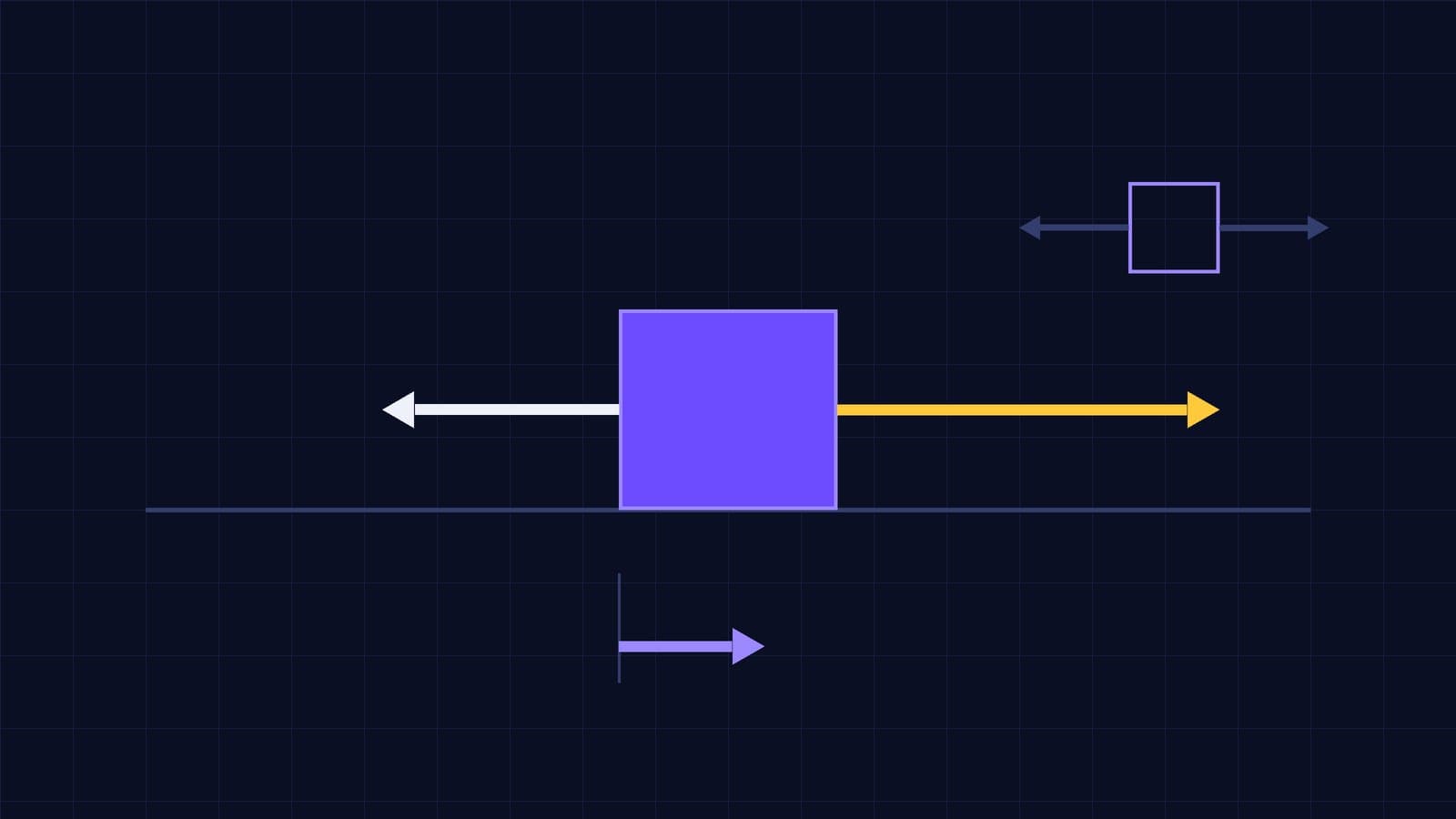
In a tug of war, both teams are pulling as hard as they can, yet for a while the rope doesn’t budge. Then one team pulls a little harder and suddenly the rope starts sliding their way. Forces were acting on the rope the whole time, so why didn’t it move at first? And what about a book lying quietly on a table: are there really no forces acting on it?
The answer to both questions lies in one of the most basic ideas in physics: an object’s motion is decided not by individual forces but by their resultant. In this article we look at balanced and unbalanced forces through everyday examples, then put numbers to the idea with Newton’s first and second laws. At the end you’ll find a small activity you can do at home in a few minutes and a list of points that are easy to mix up.
A quick reminder first: force and resultant force
A force is a push or a pull. When you push a door, pull a drawer or kick a ball, you are applying a force. The unit of force is the newton (N), and forces are measured with a spring balance (also called a newton meter), which has a spring inside. If you’d like to see this in more detail, have a look at the Force and the spring balance lesson. In the Lab’s Spring balance figure you can also hang masses on the hook and read how many newtons it shows.
A force has a size and a direction. Saying ‘10 N’ isn’t enough on its own; we also need to know whether the force acts to the right, to the left, upwards or downwards. That’s why we draw forces as arrows: the direction of the arrow shows the direction of the force, and its length shows the size. A simple drawing that shows every force on an object as an arrow is called a force diagram.
Most of the time, more than one force acts on an object at once. The single force that would have the same overall effect as all of them together is called the resultant force (or net force). For forces along the same line there are two simple rules:
- Forces in the same direction are added; the resultant points the same way.
- For two forces in opposite directions, the sizes are subtracted; the resultant points in the direction of the larger force.
For example, if you push a wardrobe with 100 N and a friend pushes in the same direction with 80 N, the resultant force is
In a tug of war, if one team pulls to the right with 350 N and the other pulls to the left with 280 N, then
If the forces are at an angle to each other, the calculation works differently and is done with vectors; in this article we’ll stick to forces along the same line.
Balanced forces: when the resultant is zero
If the resultant of all the forces acting on an object is zero, the forces are called balanced forces. The forces haven’t disappeared; they simply cancel each other’s effect exactly.
Let’s go back to the book on the table. The Earth pulls the book downwards; this force is the book’s weight. The table pushes the book upwards; this is called the support force (or normal contact force). A book with a mass of 1 kg has a weight of about 9.8 N on Earth, and the table pushes it up with about 9.8 N:
So there are forces acting on the book, but they are balanced. That’s why the book stays where it is.
There are plenty of examples of balanced forces around you:
- A lamp hanging from the ceiling: its weight acts downwards and the tension in the cable acts upwards.
- A boat floating on water: its weight acts downwards and the upthrust from the water acts upwards.
- A rope pulled equally hard: if both teams pull with 300 N, the resultant is zero and the rope stays put.
- A car travelling at a steady speed on a straight road: the driving force forwards equals air resistance plus rolling resistance.
- A parachutist descending at a steady speed with the parachute open: air resistance has become equal to their weight.
Notice the last two examples: the objects are moving, yet the forces are still balanced. Balanced forces don’t stop motion; they simply don’t change it. An object at rest stays at rest, and a moving object carries on at the same speed in the same direction, along a straight line. To explore this idea interactively, you can move on to the Balanced and unbalanced forces lesson.
Unbalanced forces: when motion changes
If the resultant force is not zero, the forces are unbalanced. In that case, the object’s motion always changes. The change can show up in three ways:
- An object at rest starts moving. When you kick a football lying on the ground, nothing balances the force from your foot, so the ball sets off.
- The speed increases or decreases. You speed up by pedalling a bicycle; when you brake, the backward forces win and you slow down.
- The direction of motion changes. When you head a ball coming towards you, it flies off in a different direction.
The third point can seem surprising at first. Imagine whirling a ball on the end of a string at a steady speed. The speed isn’t changing, but the ball’s direction is changing all the time. What makes this happen is the string constantly pulling the ball towards the centre of the circle. So even an object going round at a steady speed has an unbalanced force acting on it. The moment you let go, the pull of the string disappears and the ball leaves its circular path, shooting off in the direction it was travelling at that instant.
The answer to the tug-of-war question is now clear: while the teams were pulling equally hard, the forces were balanced and the rope didn’t move. Once one team’s pull rose to 350 N while the other’s stayed at 280 N, there was a resultant force of 70 N and the rope started sliding that way.
A ball rolling along the floor and eventually coming to a stop is another example of unbalanced forces. What slows it down is friction and air resistance, both acting against the motion. You can find out more about these forces in the Friction lesson.
Newton’s first law: inertia
Isaac Newton brought his laws of motion together in his book Principia, published in 1687. The first law sums up everything we’ve said about balanced forces in a single sentence:
If the resultant force on an object is zero, an object at rest stays at rest, and a moving object keeps moving at a steady speed in a straight line.
The tendency of objects to keep their state of motion is called inertia, which is why the first law is also known as the law of inertia. Objects with a larger mass have more inertia: it’s much easier to get an empty shopping trolley moving than one that’s piled high.
You feel inertia every day:
- When a bus brakes suddenly, your body lurches forwards. The bus slows down, but your body tends to keep moving. A seat belt provides the force that slows you down together with the bus.
- When a bus pulls away suddenly, you feel as if you’re being pushed backwards; in fact, your body is simply tending to stay where it was.
- Space probes keep travelling even when their engines are switched off. In space there is almost no friction or air resistance to slow them down; their motion is changed mainly by the gravitational pull of the Sun and the planets.
At first this idea seems to go against our everyday experience, because everything that moves on Earth slows down sooner or later. That’s why, for a long time, many people thought a force was needed all the time to keep something moving. Through his work with inclined planes, Galileo concluded that, without friction, a ball rolling on a level surface would keep going indefinitely. Newton turned this thinking into a general law.
Newton’s second law: resultant force, mass and acceleration
The first law answers the question ‘What happens if the resultant force is zero?’ The second law answers ‘If the resultant force isn’t zero, how much does the motion change?’
We measure how quickly motion changes with acceleration. Acceleration tells you how much the speed (more precisely, the velocity, which includes direction) changes each second. Its unit is metres per second squared (). For example, a bicycle that goes 2 m/s faster every second has an acceleration of .
Newton’s second law is written as:
Here is the resultant force in newtons, is the mass in kilograms and is the acceleration in . We can also rearrange the formula to find the acceleration:
These two lines tell us three important things:
- The bigger the resultant force, the bigger the acceleration. Kick a ball harder and its speed changes more quickly.
- The bigger the mass, the smaller the acceleration. A full trolley pushed with the same force speeds up more slowly than an empty one.
- The acceleration is in the direction of the resultant force. If the resultant force points the same way as the motion, the object speeds up; if it points the opposite way, the object slows down.
The definition of the newton comes from this law too: 1 N is the force that gives a 1 kg mass an acceleration of .
The second law also contains the first: if , then , so neither the speed nor the direction changes.
Weight is closely linked to this law as well. Near the Earth’s surface, weight is calculated with
where is about on Earth (it’s often rounded to 10 to make calculations easier). Someone with a mass of 50 kg has a weight of about N. On the Moon, is about , so the same person would weigh about 80 N; their mass, however, would still be 50 kg.
Step-by-step example: a shopping trolley
Now let’s bring everything together in one example. The numbers below are example values chosen to keep the arithmetic simple; with a real trolley, friction will vary with the wheels and the floor.
1. Empty trolley. Say the trolley has a mass of 20 kg. You push it forwards with 50 N; friction is 10 N, acting backwards.
The forces are unbalanced; the trolley speeds up.
2. Full trolley. After your shopping, the total mass is 40 kg. Because the trolley presses down harder on the floor, friction has gone up too; say it’s now 20 N. You push with 50 N again:
With the same push, the trolley now speeds up much more slowly. There are two reasons: the resultant force is smaller and the mass is larger.
3. You reach a comfortable walking speed. You reduce your push to 20 N:
The forces are balanced. The trolley doesn’t stop; it carries on at a steady speed. This is exactly what the first law says.
4. You let go of the trolley. Now only the 20 N friction force acts, against the motion:
The trolley slows down by 0.5 m/s every second and eventually stops. Once it has stopped, the friction force disappears too and the trolley stays where it is.
These four steps show how the same trolley can speed up, travel at a steady speed and slow down, depending on the balance of forces.
Try it yourself: card, cup and coin
A few minutes are all you need to see inertia with your own eyes.
You will need: a plastic cup, a stiff card big enough to cover the top of the cup (a postcard or thick cardboard), and a coin.
- Place the card over the top of the cup and put the coin in the middle of the card.
- Flick the card quickly and horizontally with your finger so that it shoots off the cup.
- Watch where the coin lands.
- Set it all up again and this time pull the card away slowly. What’s different?
What did you see? With a quick flick, the coin will most likely drop into the cup. The card can only apply a friction force to the coin for a very short time; in that time the coin hardly gains any sideways speed, and because of its inertia it tends to stay where it is. Once the card has gone, nothing is holding the coin up any more; its weight is now unbalanced and the coin falls. With a slow pull, friction acts for long enough that the coin is dragged along with the card.
Safety note: use a plastic cup rather than a glass, and don’t flick the card towards anyone’s face.
Quick practice (answers below):
- One person pushes a box at rest to the right with 120 N, and another pushes it to the left with 120 N. What happens to the box?
- Two forces of 30 N and 20 N act on a box to the right, and a force of 15 N acts to the left. What is the resultant force, and in which direction?
- A resultant force of 6 N acts on a toy car with a mass of 2 kg. What is its acceleration?
- What is the resultant force on a car travelling at a steady 90 km/h along a straight road?
Answers: 1) The forces are balanced; the box stays at rest. 2) N, to the right. 3) . 4) Zero; since neither the speed nor the direction changes, the forces are balanced.
Points that are easy to mix up
‘If an object is moving, there must be a resultant force acting in the direction of motion.’ It looks that way at first, but the resultant force on an object moving at a steady speed in a straight line is zero. A resultant force is needed to change motion, not to keep it going.
‘When the force runs out, the object stops.’ In everyday life, things stop not because a force ‘runs out’ but because of forces acting against the motion, such as friction and air resistance. Without them, the object would keep going.
‘No forces act on an object at rest.’ Forces act on objects at rest too, like the book on the table or the lamp hanging from the ceiling; they are simply balanced.
‘Balanced forces mean the object is standing still.’ An object acted on by balanced forces may be at rest, or it may be moving at a steady speed. A parachutist descending at a steady speed is a good example.
‘Any object whose speed doesn’t change is in balance.’ Even if the speed stays the same, the forces are unbalanced if the direction is changing. A bicycle going round a bend at a steady speed, or a ball whirled on a string, are examples.
‘The book’s weight and the table’s push form an action–reaction pair.’ These two forces are equal in size and opposite in direction, but both act on the same object, the book, which is why they balance each other. The action–reaction forces in Newton’s third law, on the other hand, act on different objects. The partner of the table pushing the book up is the book pushing the table down; the partner of the book’s weight is the book pulling the Earth towards it. Forces acting on different objects don’t balance each other.
‘Mass and weight are the same thing.’ Mass (kg) is the amount of matter and is the same everywhere; weight (N) is the force of gravity and depends on which planet or moon you’re on.
Summary
- Resultant force: forces in the same direction are added, forces in opposite directions are subtracted; the resultant points in the direction of the larger force.
- If the resultant force is zero, the forces are balanced: an object at rest stays at rest, and a moving object carries on at a steady speed in a straight line.
- If the resultant force isn’t zero, the forces are unbalanced: the object starts moving, speeds up, slows down or changes direction.
- Newton’s first law describes inertia: objects tend to keep their state of motion.
- Newton’s second law, , tells you how much the motion changes; the acceleration is in the direction of the resultant force.
- Weight is found with ; mass and weight are different ideas.
If you’d like to work through the topic interactively, start with the Balanced and unbalanced forces lesson, then carry on with Force and the spring balance and Friction. For more topics, explore our Science topics, and for more articles, browse our physics posts.
Frequently asked
5 questionsWhat are balanced forces?
When the resultant of all the forces acting on an object is zero, the forces are called balanced. For example, a book's weight and the table's upward push on it are equal in size and opposite in direction, so the book stays where it is.
Can an object acted on by balanced forces be moving?
Yes. Balanced forces don't stop motion; they just don't change it. A moving object with a zero resultant force carries on at a steady speed in a straight line, like a parachutist descending at a steady speed.
What does Newton's first law say?
If the resultant force on an object is zero, an object at rest stays at rest, and a moving object keeps moving at a steady speed in a straight line. This tendency of objects is called inertia.
How do you calculate acceleration with Newton's second law?
Divide the resultant force by the mass: a = F_net ÷ m. For example, if a resultant force of 40 N acts on a 20 kg trolley, its acceleration is 40 ÷ 20 = 2 m/s².
Do action–reaction forces balance each other?
No. Action–reaction forces are equal in size and opposite in direction, but they act on different objects. For forces to balance, they have to act on the same object.
Sources
4 sources- 1.OpenStax — College Physics 2e, Chapter 4: Dynamics: Force and Newton's Laws of Motion (opens in a new tab)
- 2.Newton, I. (1687) — Philosophiæ Naturalis Principia Mathematica, the laws of motion (Axiomata, sive Leges Motus)
- 3.Encyclopaedia Britannica — Newton's laws of motion
- 4.Wikipedia — Newton's laws of motion (opens in a new tab)
- #balanced forces
- #unbalanced forces
- #resultant force
- #Newton's laws of motion
- #inertia
- #acceleration