ScienceMiddle school
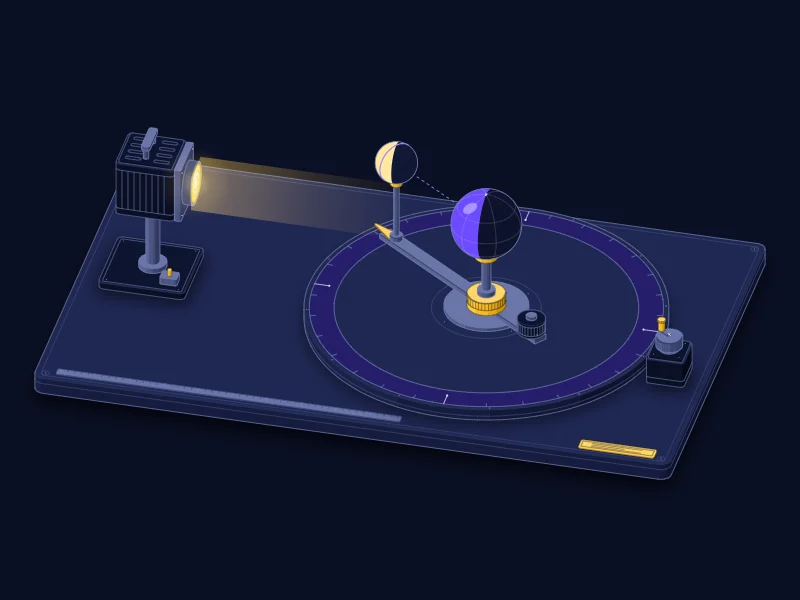
Phases of the Moon
Move the Moon around the Earth and see how much of its sunlit half we can see from here.
Science · Middle school
Hang masses on the hook, read how far the spring stretches and how many newtons it shows; compare three springs.
In the learning section below the figure, predict, try, complete the tasks and check yourself with short questions.
ScienceMiddle school
Move the Moon around the Earth and see how much of its sunlit half we can see from here.
ScienceMiddle school
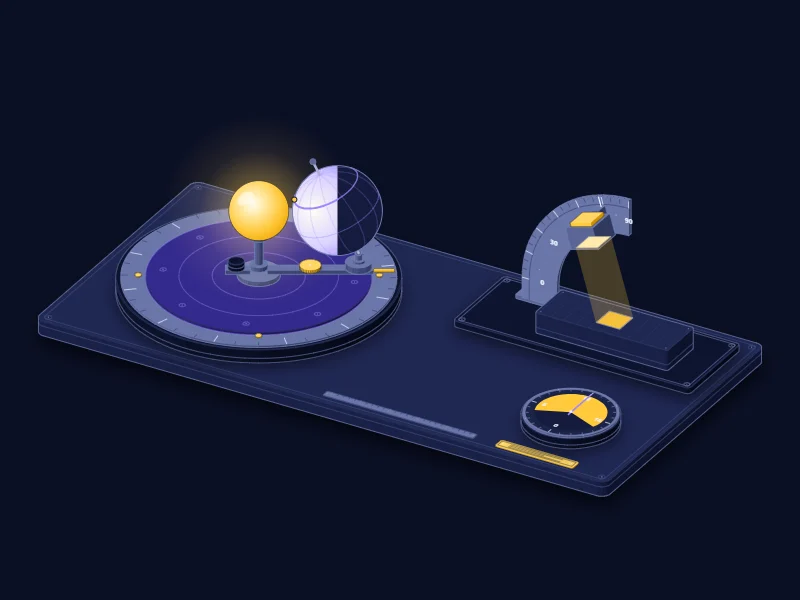
Change the date and the latitude: how does the axial tilt change the angle of sunlight and the length of the day?
ScienceMiddle school
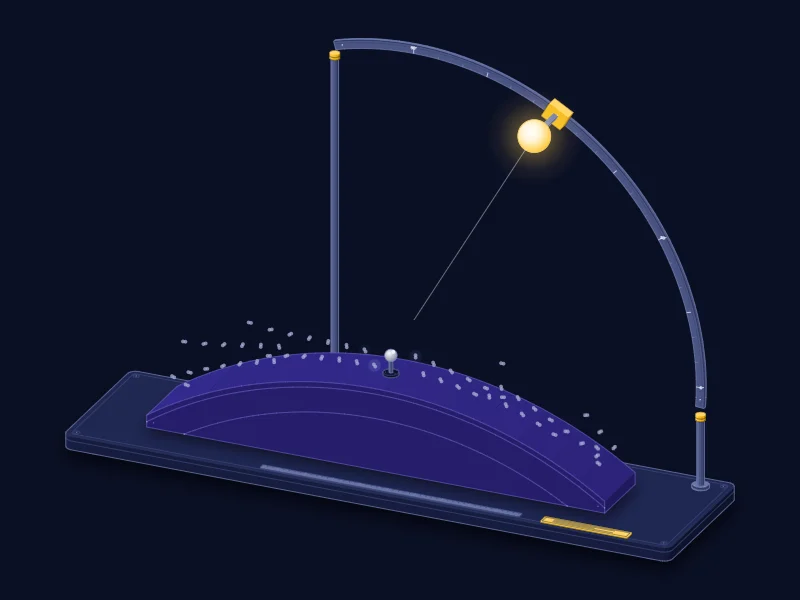
Lower the lamp: air scatters blue light far more than red, giving a blue sky at noon and a red Sun at dusk.
Drag a mass onto the hook, or use the buttons
0.00 N · 0.0 cm
Keyboard: ↓ hangs the next mass, ↑ takes the last one off, 1–3 pick the spring, Esc takes them all off.
With the balance apart, hover over a part, tap it or pick it from the list; the arrow keys move through the list.
Pick a part to see what it does and why a real spring balance is made that way.
0.00 N
It stays the same whatever you hang: the stretch is directly proportional to the force. That is why the scale can turn the stretch straight into newtons.
The dots are the loads you measured. They all lie on one straight line.
Change the spring: the ruler shows a different stretch, but the scale is drawn for that spring, so the force you read stays the same.
With 200 g on the soft spring, the balance reads 1.96 N. If you swap in the stiff spring and hang the same 200 g, what will it read?
The hook is empty: the force is 0 N and the pointer sits at zero.