
ScienceMiddle school
Phases of the Moon
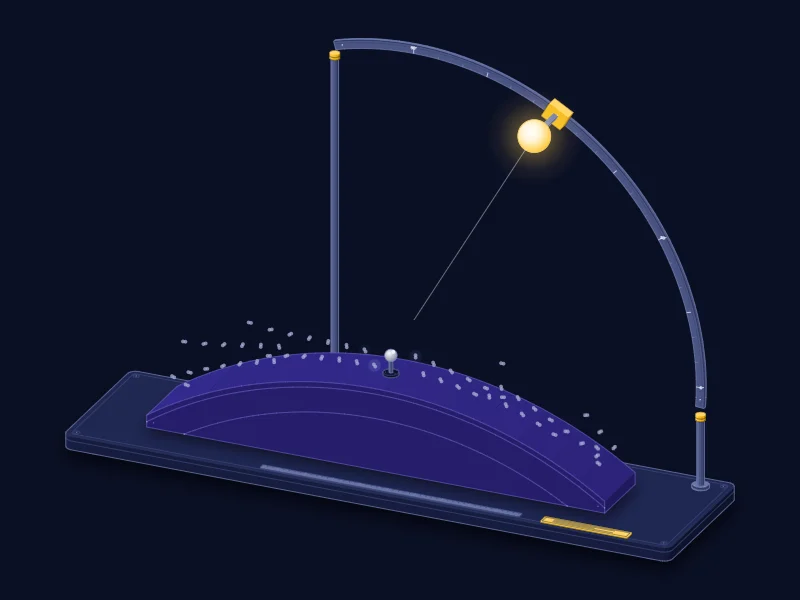
Move the Moon around the Earth and see how much of its sunlit half we can see from here.
Science · Middle school
Change the date and the latitude: how does the axial tilt change the angle of sunlight and the length of the day?
In the learning section below the figure, predict, try, complete the tasks and check yourself with short questions.
ScienceMiddle school
Move the Moon around the Earth and see how much of its sunlit half we can see from here.
ScienceMiddle school
Lower the lamp: air scatters blue light far more than red, giving a blue sky at noon and a red Sun at dusk.

ScienceMiddle school
The same bulbs on two boards: close a switch, remove a bulb and measure how the current changes in series and parallel.
Today is the summer solstice in Ankara.
Change the axial tilt: at the same place, how do the noon Sun, the length of daylight and polar night change?
With today’s tilt the Sun passes overhead somewhere between the two tropics. 40% of the Earth’s surface sees the Sun straight overhead on at least one day a year, and 8% lies inside the polar circles. In Ankara the noon Sun swings between 26.7° – 73.5°, and daylight lasts 9 h 20 min – 15 h 0 min. No polar night: for the Sun to stay down all day here, the tilt would have to pass 50.9°.
With today’s tilt the Sun passes overhead somewhere between the two tropics. 40% of the Earth’s surface sees the Sun straight overhead on at least one day a year, and 8% lies inside the polar circles. In Ankara the noon Sun swings between 26.7° – 73.5°, and daylight lasts 9 h 20 min – 15 h 0 min. No polar night: for the Sun to stay down all day here, the tilt would have to pass 50.9°.
In reality: Mars is tilted 25.2°, very close to the Earth: it has seasons too, but a Martian year lasts 687 days, so each season is on average about twice as long.
Assumptions: The orbit, the year and the distance to the Sun stay as they are today; only the axis tilts. Atmosphere, temperature and climate are not modelled, only the geometry of the light. Area shares come from geometry without refraction: the overhead-Sun belt is sin ε, the polar caps 1 − cos ε. The year is scanned at the 365 noons of 2026.
If the Earth’s axis were not tilted at all (0°), what would happen to the difference between summer and winter in Ankara?
21 June, Ankara: noon Sun height 73.5°, daylight 15 h 0 min.