ScienceMiddle school
Seasons: tilt and the angle of light
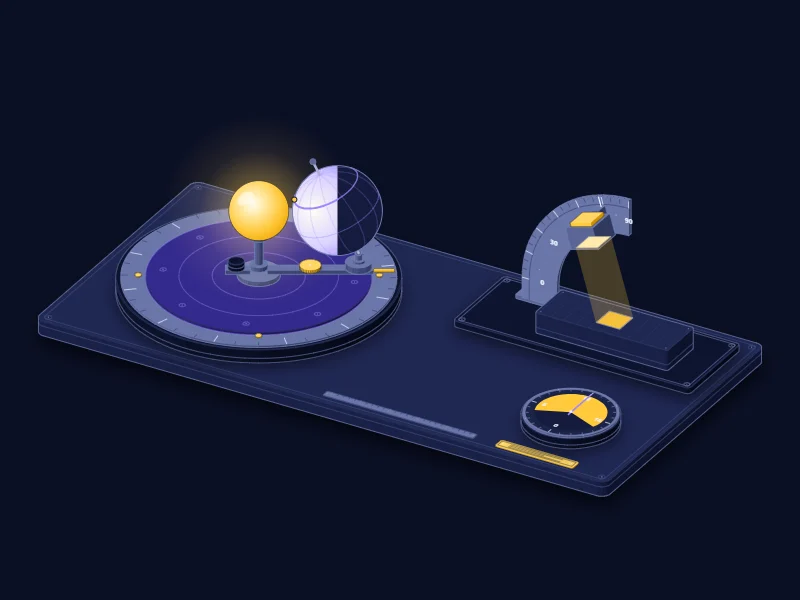
Change the date and the latitude: how does the axial tilt change the angle of sunlight and the length of the day?
Science · Middle school
Move the Moon around the Earth and see how much of its sunlit half we can see from here.
In the learning section below the figure, predict, try, complete the tasks and check yourself with short questions.
ScienceMiddle school
Change the date and the latitude: how does the axial tilt change the angle of sunlight and the length of the day?
ScienceMiddle school
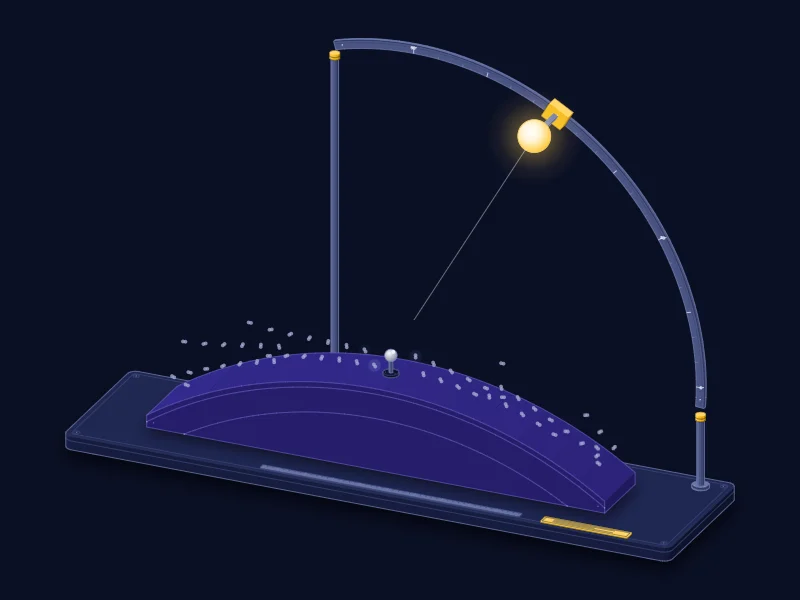
Lower the lamp: air scatters blue light far more than red, giving a blue sky at noon and a red Sun at dusk.

ScienceMiddle school
The same bulbs on two boards: close a switch, remove a bulb and measure how the current changes in series and parallel.
Drag the Moon or use the slider
Move the Moon closer or farther: how big does it look, how much stronger are the tides, how long do the phases take?
Today the Moon is on average 384,400 km away and looks 0.52° wide; the Sun looks 0.53°. The Sun is 400 times as wide as the Moon and 389 times as far: by this coincidence the two look almost the same size.
Today the Moon is on average 384,400 km away and looks 0.52° wide; the Sun looks 0.53°. The Sun is 400 times as wide as the Moon and 389 times as far: by this coincidence the two look almost the same size.
In reality: The Sun’s tidal pull is 46% of the Moon’s: at new and full moon the two pull the same way and the tides grow. The Moon moves away by about 3.8 cm a year; in the very far future there will be no total solar eclipses.
Assumptions: Circular orbit; the Moon’s mass, the Earth’s spin and the distance to the Sun stay the same. For the tides only the ratio of the force is worked out (∝ 1/d³); how high the sea actually rises depends on the coast and the ocean basin. Brightness is taken as proportional to the Moon’s apparent area. Apparent size and eclipses are worked out as seen from the Earth’s centre (geocentric). Numbers come from the radii, masses and distances in NASA’s fact sheets.
From the Earth, half of the Moon’s disc looks lit (first quarter). How much of the Moon is the Sun lighting at that moment?
Waxing crescent, 10% lit.