How do the phases of the Moon happen? From crescent to full moon, step by step
Why does the Moon change shape every night? We show that the phases come from our viewing angle, not Earth's shadow, and explain the order of crescent, quarter and full moon and moonrise times with a simple experiment.
By Kuazara Bilim EkibiPublished: Updated: 10 min read
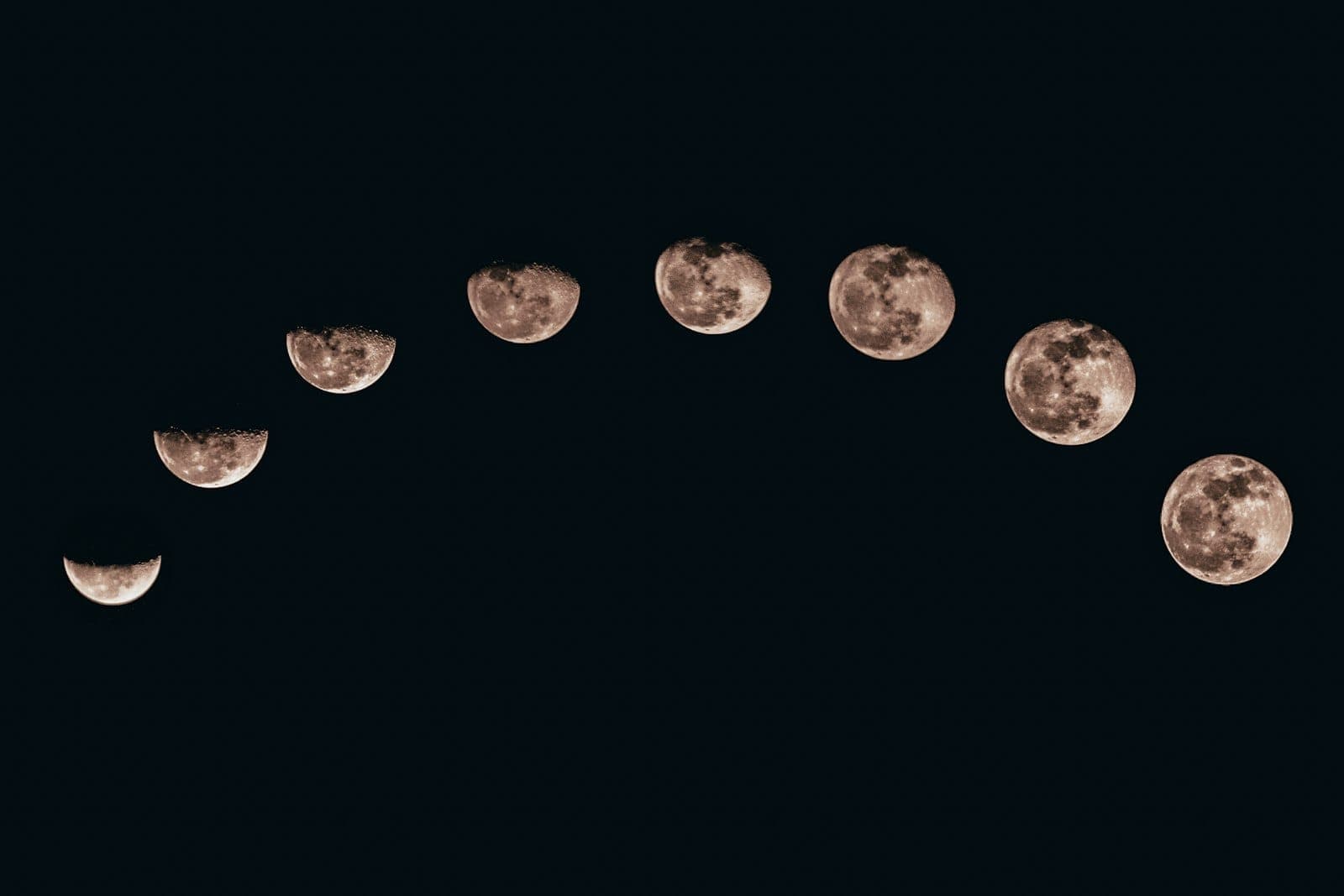
Photo: Sanni Sahil / Unsplash
In this article · 7 sections
One evening you see a thin crescent in the sky; a week later the Moon has become a half disc, and two weeks later a huge full moon. Then it slowly thins again and for a few nights it can’t be seen at all. Throughout human history this cycle has shaped calendars, festivals and the timing of farming. But the most common answer to the question “How do the phases of the Moon happen?” is, unfortunately, wrong: “The Earth’s shadow falls on the Moon.” In this article we explain the real cause of the phases, the order they come in and why the Moon is sometimes seen in the daytime sky, along with a simple experiment you can do at home.
The basic idea: half of the Moon is always lit
The Moon does not make its own light; it reflects light from the Sun. When you light a ball with a single light source, the half of the ball facing the source is always lit and the other half is dark. The same is true of the Moon: at any given moment, exactly half of the Moon is in sunlight.
What changes is not the size of the Moon’s lit half but how much of that half we can see. As the Moon orbits the Earth, the angle between the Sun, the Earth and the Moon changes. Depending on this angle, we see sometimes all of the lit half, sometimes half of it, sometimes a thin sliver and sometimes none of it.
In short, the phases are a matter of viewing angle. They have nothing to do with shadow.
When does Earth’s shadow come into play?
There is, of course, an event in which the Earth’s shadow falls on the Moon: a lunar eclipse. But a lunar eclipse happens only at full moon, when the Sun, the Earth and the Moon line up almost exactly. During a lunar eclipse the edge of the shadow on the Moon is curved, and the Moon often turns a coppery red. The phases, by contrast, happen regularly every month, and the boundary between the lit and dark parts looks quite different.
So why isn’t there an eclipse at every full moon? Because the Moon’s orbit is tilted by about 5 degrees relative to the plane of Earth’s orbit around the Sun. So at most full moons the Moon passes slightly above or below the Earth’s shadow. Eclipses happen only when a full moon falls close to the points where the Moon’s orbit crosses that plane.
The order and names of the phases
It takes the Moon on average 29.5 days (more precisely, about 29.53 days) to complete one cycle of phases, that is, to go from one new moon to the next. This period is called the synodic month. The phases, in order, are:
- New moon: The Moon is between the Earth and the Sun. Its lit face is turned away from us; the Moon is invisible or lost in the Sun’s glare.
- Waxing crescent: A few days after new moon, a thin crescent appears low in the west after sunset.
- First quarter: About a week later, half of the Moon looks lit. It is called a “quarter” because the Moon has completed a quarter of its orbit.
- Waxing gibbous: The lit part is more than half and keeps growing.
- Full moon: The Earth is between the Sun and the Moon. The whole of the Moon’s lit half faces us.
- Waning gibbous: The lit part starts to shrink.
- Last quarter: Again we see a half Moon, but this time the lit side is the opposite of the first quarter.
- Waning crescent: A thin crescent is seen low in the east before dawn; then the cycle starts again with the new moon.
Seen from the Northern Hemisphere, the waxing Moon is lit on its right side and the waning Moon on its left side. In the Southern Hemisphere, in Australia for example, these directions are reversed, because observers there look at the sky “upside down” compared with us. In places near the equator the crescent often lies on its back, like a boat.
Calculating the illuminated fraction
For those who like a little maths: let’s call the angle between the Sun and the Moon, as seen from Earth, (psi). At new moon , and at full moon . To a good approximation, the illuminated fraction of the Moon’s visible disc is:
Let’s check:
- New moon, : . We see no lit part at all.
- Quarter, : . We see half of it.
- Full moon, : . We see all of it.
- When : . A crescent with a quarter of it lit.
This formula neatly shows that the phases are a result of geometry, not of a shadow.
Try it at home: a lamp, a ball and you
The most effective way to understand the phases of the Moon is to make them with your own hands.
You will need: a desk lamp whose shade you can remove (or a powerful torch), a white ball or polystyrene sphere stuck on the end of a pencil, and a dark room.
- Put the lamp in a corner of the room, close to eye level, and switch it on. The lamp represents the Sun.
- Stand in the middle of the room. You are the Earth; your head is an observer on Earth.
- Hold the ball at arm’s length, a little above your head. The ball is the Moon.
- Face the lamp and bring the ball in front of it: the side of the ball facing you is dark. This is the new moon. (Holding the ball a little above your head stops your head’s shadow from falling on it; this mimics the 5-degree tilt of the Moon’s orbit.)
- Keeping your arm outstretched, slowly turn to your left on the spot. You will see a thin lit crescent appear on the right edge of the ball.
- When you have turned a quarter of the way round, half of the ball looks lit: first quarter.
- When your back is to the lamp, the whole side of the ball facing you is lit: full moon.
- Keep turning and watch the last quarter, then the waning crescent.
You will notice something striking in this experiment: the half of the ball that is actually lit never changed. Only the angle you were looking from changed. This experiment is one of the most instructive astronomy activities that teachers can do in class and families can do together at home.
Why is the Moon sometimes visible in the daytime?
Many people think the Moon is visible only at night. In fact there is a close link between the phase and the time the Moon rises:
- The new moon rises and sets at about the same time as the Sun. It is in the daytime sky, but we can’t see it.
- The first quarter rises around midday, is near its highest point in the sky at sunset and sets around midnight. That is why it is easy to see in the daytime sky in the afternoon.
- The full moon rises around sunset and sets around sunrise. It is in the sky all night.
- The last quarter rises around midnight and can be seen in the daytime sky in the morning.
The reason is simple: at full moon the Moon is exactly opposite the Sun, as seen from Earth. As the Sun sets, the point opposite it rises. Each day the Moon moves about 12 to 13 degrees eastwards along its orbit relative to the Sun. So each day the Moon rises on average about 50 minutes later than the day before.
We always see the same face
Even though the Moon’s phases change, the patterns we see on its surface, the dark “seas” and the bright highland regions, are always the same. This is because the Moon completes one turn on its axis in the same time it takes to complete one orbit of the Earth. This is called synchronous rotation, or tidal locking. A common mistake is to call the Moon’s far side its “dark side”. In fact the far side also receives sunlight as the phases go by; at new moon the far side is entirely lit. We can’t see that side not because it is dark, but because it never turns towards us.
Earthshine: why does the dark part of a crescent glow faintly?
If you look carefully at a thin crescent on a clear evening, you may see that the dark part of the Moon is not completely black but shows up with a faint, ashen glow. This light is called earthshine. Sunlight bounces off Earth’s clouds, oceans and land, reaches the Moon, and from there comes back to us. So the light we see in the dark part of the crescent is, in a sense, Earth’s own reflection.
The correct explanation of this effect appears in Leonardo da Vinci’s notebooks from the early 16th century. For an observer on the Moon during the crescent phase, the Earth looks almost “full”; that is why earthshine is most noticeable during thin crescent phases.
Moon phases and calendars
The fact that the synodic month lasts about 29.5 days formed the basis of humanity’s first calendars. Twelve synodic months make about 354 days, which is about 11 days shorter than a solar year. This is why, in calendars based only on the Moon, festivals move about 11 days earlier each year. Some calendars instead add an extra month at regular intervals to keep the lunar and solar cycles in step.
There is one more small detail here: one lap of the Moon around the Earth, measured against the stars, takes about 27.3 days. This is called the sidereal month. So why is the cycle of phases longer? Because while the Moon makes one lap, the Earth also moves along its orbit around the Sun. For the Moon to return to the same position relative to the Sun, say to new moon again, it has to travel for a little more than two extra days.
In short
- Half of the Moon is always lit by the Sun.
- The phases depend on how much of this lit half we see; they have nothing to do with Earth’s shadow.
- Earth’s shadow falls on the Moon only during lunar eclipses, and this does not happen at every full moon because the Moon’s orbit is tilted by about 5 degrees.
- One cycle of phases takes about 29.5 days.
- Phase and rising time are linked: the full moon rises at sunset, the first quarter around midday.
This month, try taking a notebook and drawing the Moon’s shape and its position in the sky every evening; after two weeks you will have worked out the logic of the phases from your own observations. For more, take a look at our astronomy articles, and in Kuazara’s interactive lessons you can move the Sun, the Earth and the Moon yourself and see how the phases come about.
Frequently asked
4 questionsAre the phases of the Moon caused by Earth's shadow?
How many days does one cycle of the Moon's phases take?
Why can the Moon be seen in the daytime?
Is the dark side of the Moon really always dark?
Sources
3 sources- 1.OpenStax, Astronomy 2e (opens in a new tab)openstax.org
- 2.NASA Science — Moon Phases
- 3.Ridpath, I. (ed.) — A Dictionary of Astronomy, Oxford University Press
- #moon
- #moon phases
- #full moon
- #crescent
- #skywatching