What is Posidonia seagrass? The Mediterranean's underwater forest
Posidonia oceanica is not a seaweed but a flowering plant that lives in the sea. We explain how slowly this Mediterranean plant grows, the carbon that builds up beneath it over thousands of years, its place in the food web and how marine heatwaves affect it, with sources.
In this article · 8 sections
The theme of COP31’s 15 November is A Breath in Antalya (COP31 thematic days). Beneath the sea off the coast of Antalya lives an organism found only in the Mediterranean. This article is about it: Posidonia seagrass.
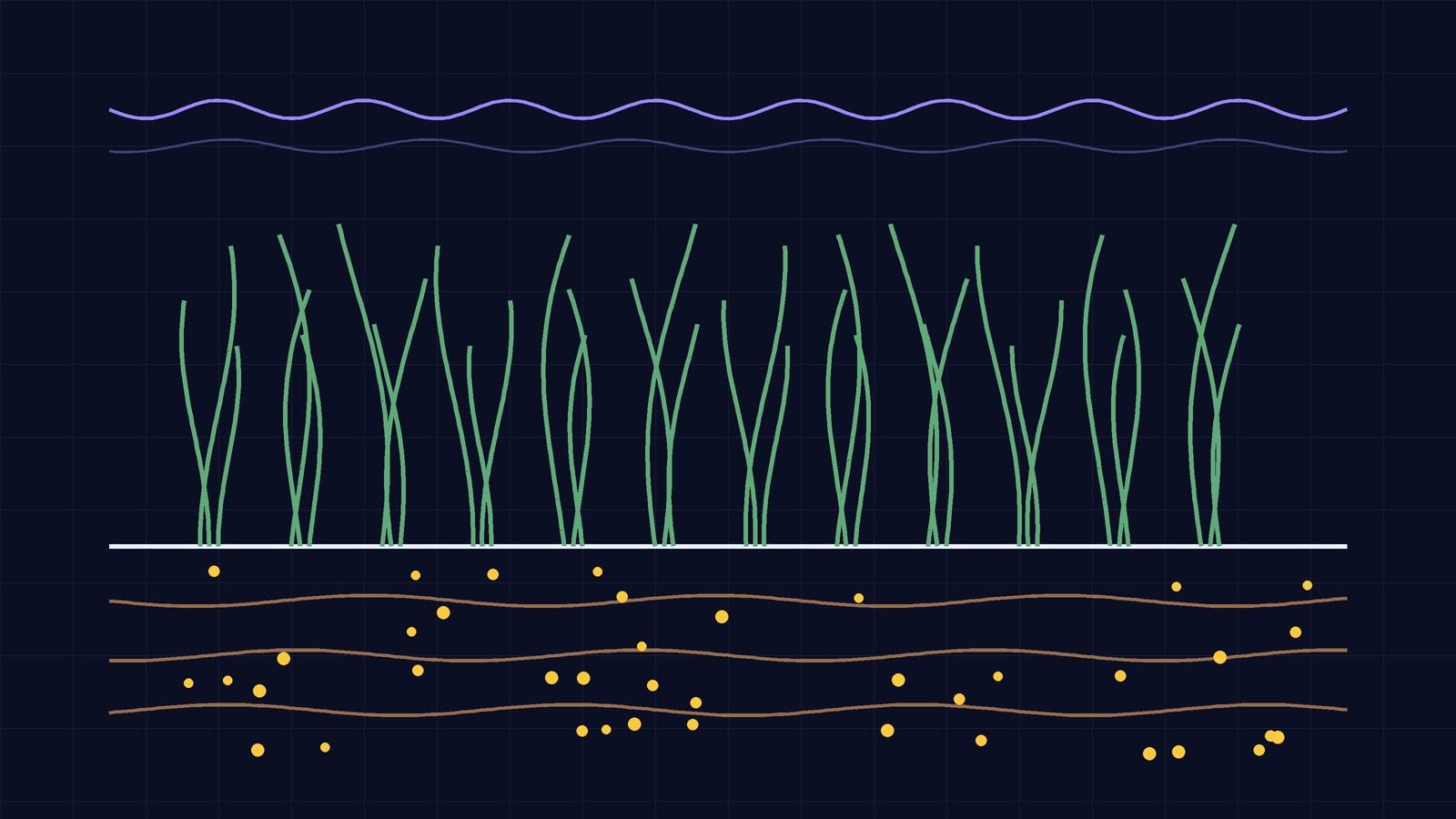
Imagine putting on a mask in a clear Mediterranean cove and looking down. Where the sand ends, a meadow begins: long, dark green, ribbon-like leaves swaying with the waves. At first glance it looks like a bed of seaweed. But this organism has roots, stems, flowers and seeds. It is the marine relative of the meadows on land.
Not a seaweed, a flowering plant
Posidonia oceanica is a seagrass: a flowering plant that evolved on land and later returned to the sea. Unlike seaweeds (algae), it has true roots, creeping underground stems (rhizomes) and vascular tissue.
According to a Mediterranean-wide mapping study published by Telesca and colleagues in 2015, Posidonia oceanica:
- is endemic to the Mediterranean, meaning that in nature it is found only in this sea.
- can form meadows from shallows near the surface down to 40–45 m.
- has a known extent of 1,224,707 hectares (about 12,247 km²).
According to the same study, most of the meadows along Turkey’s coasts had not yet been mapped in detail; there were mostly point records, and the mapped area was only 287 hectares. The species was confirmed along the Aegean coast and at a few places on the southern coast. The known eastern limit along the mainland coast was at 36° 09’ north, 33° 26’ east; the Antalya coast lies west of this limit, close to the eastern edge of the species’ range.
Very slow growth
Posidonia spreads very slowly. Its rhizomes grow only a few centimetres a year. A 2012 genetic study by Arnaud-Haond and colleagues uses horizontal growth of 4 cm a year in its calculations.
Let’s calculate at this rate:
- To spread 1 m takes years.
- To spread 1 km takes years.
The same study found genetically identical plant parts (the same clone) in meadows kilometres apart. Calculations assuming they spread only by growing showed that some of these clones must be at least about 12,500 years old. The authors also calculated ages of 80,000–200,000 years for more distant matches, but considered that scenario unlikely because of sea level changes during the last ice age. These figures are estimates that show how slowly Posidonia meadows change compared with a human lifetime.
For the same reason, Telesca and colleagues write that the full recovery of a lost meadow is usually considered irreversible on a human time-scale.
The carbon building up beneath it
With its leaves and rhizomes, Posidonia turns carbon in seawater into organic matter through photosynthesis. Dead rhizomes, roots and particles trapped by its leaves build up on the seabed. In this low-oxygen seabed, decay is very slow. Over centuries a thick layer rich in organic matter forms; this is called matte.
According to a global review by Fourqurean and colleagues in Nature Geoscience in 2012:
- Based on measurements from 946 seagrass meadows around the world, seagrass ecosystems could store up to 19.9 PgC of organic carbon. A more conservative approach gives 4.2–8.4 PgC.
- Mediterranean Posidonia oceanica meadows have the largest documented stores of organic carbon and form matte layers rich in organic carbon that have not been reported for other seagrass species.
Carbon stored in marine and coastal ecosystems is often called blue carbon. We described its counterpart on land in What is soil carbon?
Its place in the food web: keystone or foundation species?
Two ideas in ecology are often mixed up:
- A keystone species is one whose effect on its ecosystem is disproportionately large relative to its abundance. This is the definition given by Power and colleagues in 1996. A predator that is rare but reshapes a whole community is an example.
- A foundation species is one whose effect comes from its abundance, building habitat with its own body. A 2005 paper by Ellison and colleagues describes this idea for forest trees.
Posidonia is closer to the second group: its effect comes from forming meadows that stretch for kilometres. The long leaves slow the waves, trap particles on the seabed and clear the water; the spaces between leaves and rhizomes give shelter to many small organisms.
Posidonia takes part in the food web in several ways:
- Leaf surfaces: small algae and animals live on the leaves. These are food for many small invertebrates.
- Grazers: some sea urchins and fish eat the leaves themselves. Direct measurements by Prado and colleagues in 2007 showed that this grazing matters more in Mediterranean meadows than had been thought.
- Dead leaves: shed leaves go to decomposers and to organisms that feed on detritus; some wash up on the shore.
When a meadow is lost, it is not just one plant species that goes; many organisms that depend on the habitat it builds are affected too. The richness we call biodiversity lives in this web of connections.
Marine heatwaves
As on land, the sea has unusually hot spells. Under the widely used definition proposed by Hobday and colleagues in 2016, a marine heatwave is when sea temperature stays above the warmest tenth of the 30-year record for that place and season for at least five days.
A 2010 study by Marbà and Duarte monitored Posidonia for six years at Cabrera National Park in Spain’s Balearic Islands:
- Between 2002 and 2006, the average annual maximum sea temperature was 1 °C higher than in 1988–1999 (26.6 °C).
- There were two heatwaves: the seawater reached 28.83 °C in 2003 and 28.54 °C in 2006.
- The median annual death rate of the plant’s shoots rose from 0.067 in 2002 to 0.123 in 2003, and deaths exceeded new shoot growth at almost every station and in almost every year measured.
What do these rates mean? An annual death rate of 0.067 means that about 67 out of every 1,000 shoots die within a year; 0.123 means about 123. If new shoots do not make up for this loss, the meadow thins out from year to year.
Protection
According to the review by Telesca and colleagues, an estimated 34% of Posidonia meadows across the Mediterranean have regressed over the last 50 years; the authors attribute this mainly to the combined effect of many local pressures (such as coastal development, anchoring, bottom trawling and dredging). The European Union’s Habitats Directive lists Posidonia beds among its priority habitats, and under the Barcelona Convention, to which Mediterranean countries are party, there is a dedicated action plan for seagrasses.
Common mix-ups
“Posidonia is a seaweed.” Posidonia is a flowering plant with roots, stems, flowers and seeds. Seaweeds (algae) are a different group of organisms.
“If seagrass is lost, it comes back in a few years.” Posidonia spreads only a few centimetres a year; scientists usually do not consider full recovery possible on a human time-scale.
“The leaves washed up on the beach are pollution.” These are leaves that Posidonia sheds naturally; they are part of the plant’s life cycle.
In short
- Posidonia oceanica is a flowering marine plant endemic to the Mediterranean; it forms meadows down to 40–45 m.
- It grows very slowly, a few centimetres a year; some of its clones are estimated to be thousands of years old.
- The matte layer that builds up beneath it is among the largest documented seagrass carbon stores.
- As a foundation species it provides habitat and food for many organisms.
- Marine heatwaves can increase shoot deaths; the meadows have declined markedly in the Mediterranean over the last 50 years.
You can study how a leaf turns light into food in our lesson Photosynthesis and light, and try it yourself by changing light and carbon dioxide in the Lab figure The leaf factory. You can find the physics that warms the sea in What is the greenhouse effect? and how to measure temperature yourself in How do you measure weather and climate at home?
Frequently asked
4 questionsWhat is Posidonia oceanica?
It is a flowering marine plant endemic to the Mediterranean, meaning that in nature it lives only in the Mediterranean. It has roots, underground stems called rhizomes and long ribbon-like leaves, and can form meadows from shallows near the surface down to 40–45 m.
Is Posidonia a seaweed?
No, it is a seagrass: a flowering plant that evolved on land and later returned to the sea. Unlike seaweeds, it has true roots, stems, flowers and seeds.
Why does Posidonia store carbon?
Part of the carbon it fixes by photosynthesis builds up on the low-oxygen seabed as dead roots, rhizomes and leaves, where it decays very slowly. Over centuries this forms a thick, organic-rich layer called matte. According to Fourqurean and colleagues, Posidonia meadows have the largest documented seagrass carbon stores.
How fast does Posidonia grow?
Its rhizomes grow only a few centimetres a year; one genetic study used 4 cm a year. At that rate, spreading 1 km takes about 25,000 years. That is why full recovery of lost meadows is usually not considered possible on a human time-scale.
Sources
9 sources- 1.COP31 Türkiye: Thematic days announced (opens in a new tab)
- 2.Telesca et al. (2015). Seagrass meadows (Posidonia oceanica) distribution and trajectories of change. Scientific Reports 5, 12505 (opens in a new tab)
- 3.Arnaud-Haond et al. (2012). Implications of Extreme Life Span in Clonal Organisms: Millenary Clones in Meadows of the Threatened Seagrass Posidonia oceanica. PLoS ONE 7(2), e30454 (opens in a new tab)
- 4.Fourqurean et al. (2012). Seagrass ecosystems as a globally significant carbon stock. Nature Geoscience 5, 505–509 (opens in a new tab)
- 5.Marbà and Duarte (2010). Mediterranean warming triggers seagrass (Posidonia oceanica) shoot mortality. Global Change Biology 16, 2366–2375 (opens in a new tab)
- 6.Hobday et al. (2016). A hierarchical approach to defining marine heatwaves. Progress in Oceanography 141, 227–238 (opens in a new tab)
- 7.Power et al. (1996). Challenges in the Quest for Keystones. BioScience 46(8), 609–620 (opens in a new tab)
- 8.Ellison et al. (2005). Loss of foundation species: consequences for the structure and dynamics of forested ecosystems. Frontiers in Ecology and the Environment 3(9), 479–486 (opens in a new tab)
- 9.Prado et al. (2007). Extensive direct measurements of Posidonia oceanica defoliation confirm the importance of herbivory in temperate seagrass meadows. Marine Ecology Progress Series 340, 63–71 (opens in a new tab)
- #Posidonia
- #seagrass
- #blue carbon
- #biodiversity
- #Mediterranean
- #COP31