What is the greenhouse effect and how does it work? Light gets in, heat is held back
Without the greenhouse effect, Earth's average temperature would be well below freezing. We explain why sunlight passes through the atmosphere, why the infrared radiation Earth gives off is held back, which gases are involved and how Venus and Mars differ, with the calculations.
In this article · 8 sections
The theme of COP31’s 10 November is Energy and Transport (COP31 thematic days). Fossil fuels burned for energy and transport release carbon dioxide into the air; this article explains the physics that makes that carbon dioxide matter: the greenhouse effect.
Imagine getting into a car with the windows shut on a sunny day. Inside it is much hotter than outside. Sunlight came in through the glass and warmed the seats and dashboard, but the hot air inside could not get out. Earth’s atmosphere also lets incoming energy in easily and makes it harder for energy to leave. But it does so in a different way. To understand how, we first need to look at the colours of light.
Hot objects give off light
Every object gives off radiation that depends on its temperature. The hotter it is, the shorter the wavelength at which its radiation is strongest. This relationship is called Wien’s law:
- According to NASA, the Sun’s surface temperature is about 5772 K. , which falls in the middle of the light our eyes can see.
- Earth’s average surface temperature is about 288 K (15 °C). , which is in the infrared, where our eyes cannot see.
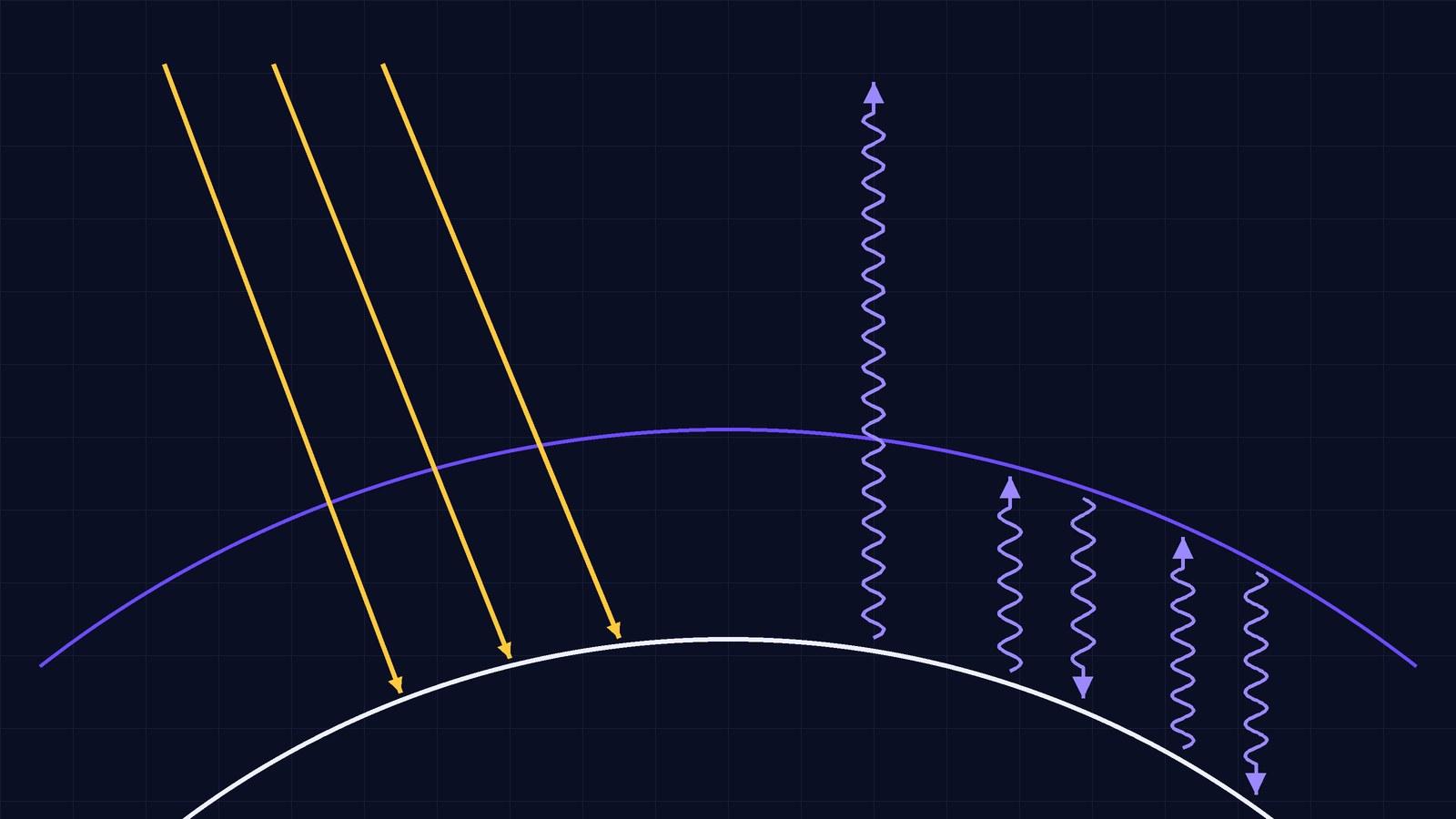
So the energy coming from the Sun is mostly visible light and wavelengths close to it, while the energy Earth sends back to space is infrared. This difference is the key to the greenhouse effect.
Which gases hold back infrared?
According to the IPCC’s frequently asked question on the greenhouse effect, the two most abundant gases in the atmosphere, nitrogen (78% of dry air) and oxygen (21%), exert almost no greenhouse effect. The greenhouse effect comes from more complex and much rarer molecules: water vapour, carbon dioxide, methane, nitrous oxide and ozone.
These molecules let most visible light through, but absorb certain infrared wavelengths. They give the absorbed energy off again in all directions, including back towards the ground. As a result, part of the heat leaving the surface returns to it before escaping to space, and the surface settles at a warmer balance.
How is the effect shared between gases and clouds? According to a 2010 calculation by Schmidt and colleagues at NASA’s Goddard Institute for Space Studies, about 50% of today’s total greenhouse effect comes from water vapour, 25% from clouds and 20% from carbon dioxide; the rest is from gases such as methane and from small particles.
Water vapour has the largest share, but temperature controls how much of it is in the air: warmer air can hold more water vapour. As the IPCC explains, when a gas such as CO₂ increases, the air warms, which increases water vapour and strengthens the warming. This water vapour feedback may be strong enough to roughly double the direct effect of CO₂.
Let’s calculate: without the greenhouse effect
We can work out how warm Earth would be without the greenhouse effect using an energy balance. A planet in balance in space must give off as much energy as it absorbs.
In: According to NASA, the intensity of sunlight reaching Earth is W/m². Earth catches this light over its cross-section () and reflects about 29.4% of it (albedo ).
Out: Earth gives off heat from its whole surface (). By the Stefan–Boltzmann law, the power radiated per unit area is , with W/(m²·K⁴).
Setting the two equal:
That is about −18 °C. NASA’s table gives 254 K for Earth; the small difference comes from details such as the albedo value used. Yet Earth’s real average surface temperature is about 288 K, or 15 °C. The difference of about 33–34 °C is the contribution of the greenhouse effect. In the IPCC’s words, without the natural greenhouse effect the average temperature at Earth’s surface would be below the freezing point of water.
Three neighbours: Venus, Earth and Mars
Let’s compare the same calculation for three planets using NASA’s planetary fact sheets. The “no greenhouse” column is the temperature from the balance calculation above.
| Planet | Balance temperature without greenhouse effect | Actual average temperature | Surface pressure | CO₂ in the atmosphere |
|---|---|---|---|---|
| Venus | 226.6 K | 737 K (464 °C) | 92 bar | 96.5% |
| Earth | 254.0 K | 288 K (15 °C) | about 1 bar | trace |
| Mars | 209.8 K | about 214 K | 0.006 bar | 95.1% |
This table tells us something interesting. Although Venus is closer to the Sun, its clouds reflect most of the light, so its balance temperature is even lower than Earth’s. But its thick CO₂ atmosphere warms its surface by more than 500 K. Mars’s atmosphere is also mostly CO₂, but it is so thin that its greenhouse effect is only a few degrees. So what matters is not only the type of gas but its total amount.
A short history
The idea that the atmosphere holds in heat goes back to the 19th century. In experiments published in 1861, the Irish physicist John Tyndall measured that gases such as water vapour and carbon dioxide absorb heat radiation while nitrogen and oxygen absorb very little. In 1896 the Swedish chemist Svante Arrhenius published one of the first detailed calculations of how changes in the amount of carbon dioxide in the air would affect the temperature of the ground.
What is changing today?
According to the IPCC Sixth Assessment Report, the atmospheric concentration of CO₂ has risen by 47% since 1750 and reached an annual average of 410 ppm in 2019, a level not seen for at least 2 million years. In measurements by the US National Oceanic and Atmospheric Administration (NOAA) at Mauna Loa in Hawaii, the annual average for 2025 was 427.35 ppm.
The main source of this rise is the burning of fossil fuels. According to the IPCC, in 2019 about 34% of total net human greenhouse gas emissions came from energy supply (such as electricity and heat generation) and about 15% from transport. That is why this day’s theme sits at the centre of climate discussions.
Common mix-ups
“The greenhouse effect is a bad thing.” Without the natural greenhouse effect, Earth’s average temperature would be below freezing. What is being discussed is human activity strengthening the effect.
“The atmosphere works like the glass of a greenhouse.” As the IPCC notes, in a real greenhouse the glass walls warm the air inside by reducing airflow. The atmosphere reaches a similar result through a different physical process: by absorbing infrared radiation and giving it off again.
“Greenhouse gases trap sunlight.” Greenhouse gases let most incoming visible light through. What they hold back is the infrared radiation Earth gives off.
“If water vapour has the largest share, CO₂ doesn’t matter.” The amount of water vapour depends on temperature and does not start a lasting change on its own. CO₂ stays in the atmosphere for a long time, and the warming it causes also increases water vapour.
In short
- Sunlight is mostly at visible wavelengths, while Earth gives off infrared. Wien’s law gives the difference.
- Nitrogen and oxygen hold back almost no infrared; water vapour, CO₂, methane, nitrous oxide and ozone do.
- An energy balance shows that without the greenhouse effect Earth would be about 255 K (−18 °C); the real average is 288 K.
- On Venus a thick CO₂ atmosphere creates a very strong greenhouse effect; on Mars a thin atmosphere creates a very weak one.
- CO₂ concentration has risen by 47% since 1750; the main source is fossil fuel burned for energy and transport.
You can read about the carbon held in soil in What is soil carbon? and about how light interacts with the atmosphere in Why is the sky blue?. Study the difference between heat and temperature in our lesson Heat and temperature, and try it yourself in the Lab figures Same heat, different temperature and Why is the sky blue?.
Frequently asked
4 questionsWhat is the greenhouse effect?
It is the way gases in the atmosphere such as water vapour, carbon dioxide and methane absorb part of the infrared radiation given off by Earth's surface and give it off again, partly back towards the ground, keeping the surface warmer. Most of the visible light coming from the Sun passes through these gases.
How warm would Earth be without the greenhouse effect?
A simple energy balance gives about 255 K, or −18 °C; NASA's table gives 254 K. Earth's real average surface temperature is about 288 K (15 °C), so the greenhouse effect contributes about 33–34 °C.
Which gases are greenhouse gases?
The main ones are water vapour, carbon dioxide, methane, nitrous oxide and ozone. Nitrogen and oxygen, the two most abundant gases in the atmosphere, exert almost no greenhouse effect.
Why is Venus so hot?
Venus's atmosphere is 96.5% carbon dioxide and its surface pressure is about 92 times Earth's. The greenhouse effect of this thick atmosphere raises the surface far above its no-greenhouse balance temperature (226.6 K), to an average of 737 K (464 °C).
Sources
14 sources- 1.COP31 Türkiye: Thematic days announced (opens in a new tab)
- 2.IPCC (2007). AR4 WG1, Frequently Asked Question 1.3: What is the Greenhouse Effect? (opens in a new tab)
- 3.NASA NSSDCA: Earth Fact Sheet (opens in a new tab)
- 4.NASA NSSDCA: Venus Fact Sheet (opens in a new tab)
- 5.NASA NSSDCA: Mars Fact Sheet (opens in a new tab)
- 6.NASA NSSDCA: Sun Fact Sheet (opens in a new tab)
- 7.NIST CODATA: Wien wavelength displacement law constant (opens in a new tab)
- 8.NIST CODATA: Stefan-Boltzmann constant (opens in a new tab)
- 9.Schmidt et al. (2010). Attribution of the present-day total greenhouse effect. Journal of Geophysical Research 115, D20106 (opens in a new tab)
- 10.Tyndall (1861). On the absorption and radiation of heat by gases and vapours. Philosophical Transactions of the Royal Society 151, 1–36 (opens in a new tab)
- 11.Arrhenius (1896). On the influence of carbonic acid in the air upon the temperature of the ground. Philosophical Magazine 41, 237–276 (opens in a new tab)
- 12.IPCC (2021). AR6 WG1, Summary for Policymakers (A.1.1, A.2.1) (opens in a new tab)
- 13.IPCC (2022). AR6 WG3, Summary for Policymakers (B.2.1) (opens in a new tab)
- 14.NOAA Global Monitoring Laboratory: Mauna Loa CO₂ annual means (opens in a new tab)
- #greenhouse effect
- #infrared
- #carbon dioxide
- #energy balance
- #Venus
- #COP31