What is soil carbon? The great carbon store under your feet
Soil holds more carbon than plants and the atmosphere put together. We explain how carbon gets into soil through roots, how microbes send it back to the air, how to work out the carbon stock of a field, and how farming is linked to the climate, with sources.
In this article · 8 sections
The theme of COP31’s 9 November is Food, Agriculture and Health (COP31 thematic days). This article is about the largest and least visible store linking farming and climate: the carbon in soil.
Imagine picking up a handful of dark soil from the garden. One of the main things that makes it dark is organic matter: rotted leaves, bits of dead root, microbes themselves and what they leave behind. About half of this organic matter is carbon. The carbon under your feet is constantly trading places with the carbon dioxide in the air.
What is soil organic carbon?
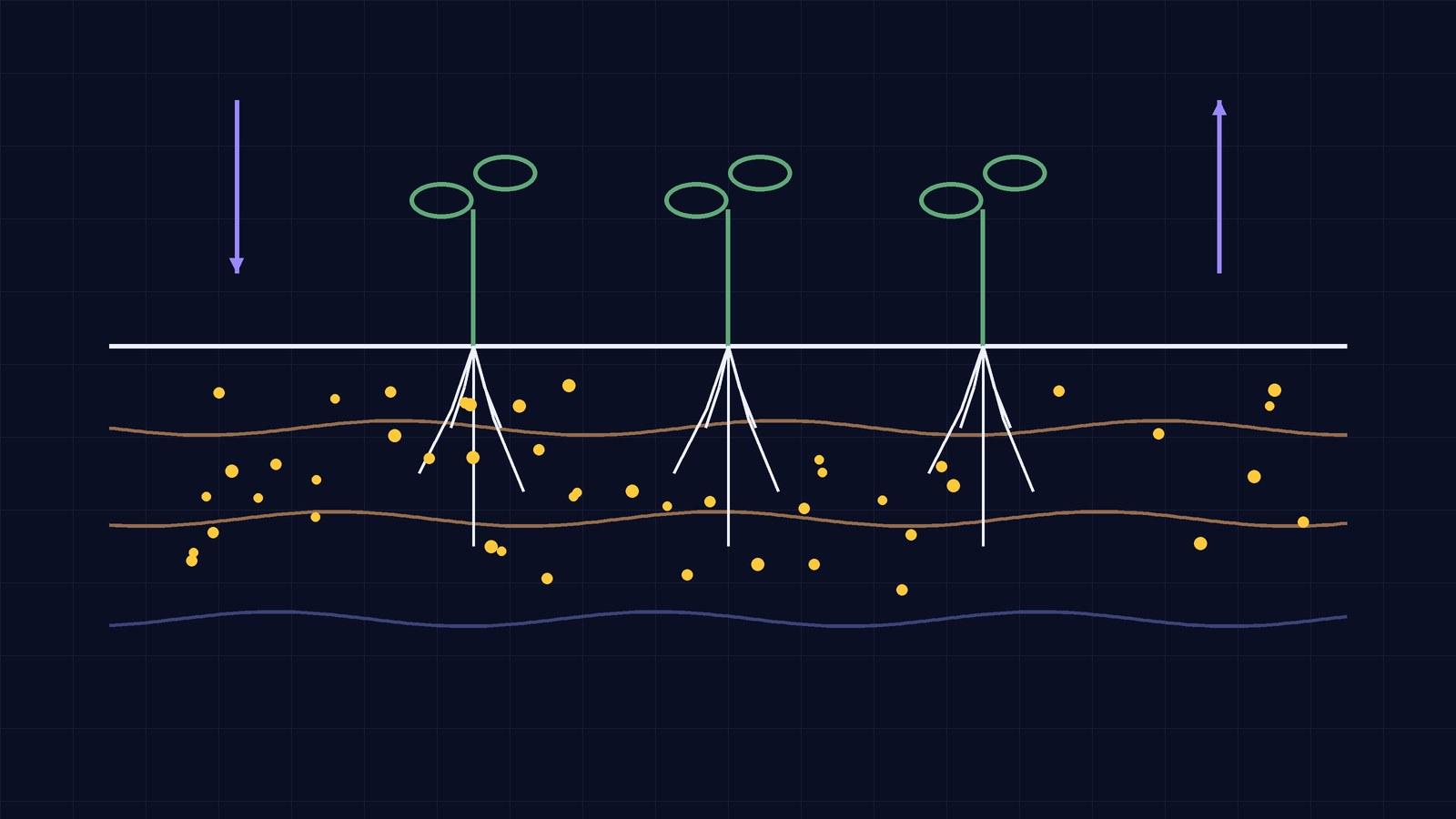
Soil organic carbon is the carbon in the material of living origin in soil. Its source is almost always the same: photosynthesis. A plant turns CO₂ from the air into sugar; some of that sugar goes to the roots, roots die or release substances into the soil, and leaves fall. Soil organisms eat this material and break it down. (Our article What lives in a handful of soil? introduces these organisms.)
Part of the material that is broken down returns to the air as CO₂ through microbial respiration. Part of it stays in the soil: dead microbial cells and resistant leftovers cling to clay and mineral particles, where they can stay for years or even centuries.
A 2017 review by Jackson and colleagues gives two important details:
- Roots are better than leaves at locking carbon into soil. The same mass of root input is about five times more likely to become stable soil organic matter than leaf litter falling from above.
- In the upper part of the soil, microbes and soil animals drive decomposition. Below about 30 cm, the main thing protecting organic matter is its attachment to mineral surfaces.
How big is the store?
According to the same review, soil organic matter holds more carbon than plants and the atmosphere combined. The authors estimate that the top 2 metres of the world’s soils hold about 2,270 PgC of organic carbon, and the top 3 metres about 2,770 PgC; because of uncertainties these figures could be up to 700 PgC smaller.
1 PgC (petagram of carbon) is a billion tonnes of carbon. For comparison: according to the Intergovernmental Panel on Climate Change (IPCC) Sixth Assessment Report, the soils of the northern frozen ground (permafrost) region alone store 1,460–1,600 PgC of organic carbon.
The estimates are so wide because measuring is hard. Soil varies everywhere in depth, density and carbon content, and the extent of wetlands, peatlands and frozen soils is not known exactly.
Let’s calculate: how much carbon is in a field?
The mass of carbon in a soil layer is worked out from three measurements:
- Carbon content: what percentage of the dry soil mass is organic carbon?
- Bulk density: how many tonnes does a cubic metre of dry soil weigh?
- Depth: how thick a layer are we counting?
A hectare is 10,000 m². The volume of the layer is area times depth; its mass is volume times density; and its carbon is mass times carbon content:
Example (the values are round numbers chosen to show the calculation): carbon content 1.5%, density 1.3 t/m³, a 30 cm layer.
If all of this carbon went into the air as CO₂, how much CO₂ would that be? The molar mass of carbon is 12 and that of CO₂ is 44 g/mol, so:
Now imagine the carbon content rises from 1.5% to 1.6%, an increase of just 0.1 percentage points. If the density stays the same, the new stock is t C/ha. The difference is 3.9 t C/ha, or about tonnes of CO₂. A percentage change that looks small means a large mass over a large area.
Real measurements are not this simple: when soil is ploughed or compacted its density also changes, stones are removed, and samples are taken from different parts of the field. That is why careful sampling is needed to tell whether the difference between two measurements is a real change.
How does farming affect soil carbon?
When people turned forests and grasslands into fields, part of the carbon in the soil went into the air. Ploughing exposes organic matter to more air so it breaks down faster, and at harvest most of the plant leaves the field.
According to an estimate cited by the IPCC (Sanderman and colleagues, corrected value), about 116 PgC has been lost from soils since farming and grazing began, of which about 70 PgC was lost before 1750.
Can some of this loss be recovered? According to soil scientist Rattan Lal’s 2004 assessment in Science, the carbon sink capacity of the world’s agricultural and degraded soils is 50–66% of the historic loss (42–78 billion tonnes of carbon). The methods Lal lists include no-till farming, cover crops, nutrient management, manuring, improved grazing, water harvesting, efficient irrigation and agroforestry.
The IPCC’s special report on climate change and land (SRCCL, 2019) stresses two limits:
- Carbon build-up in soil or vegetation does not continue indefinitely. When the soil reaches a new balance, the build-up slows and stops.
- Soil carbon that has been lost may take a long time to recover. In other words, carbon stored in soil can return to the air if a practice is stopped.
Farming’s other links with climate
Farming is not linked to climate through soil carbon alone. According to the SRCCL, in 2007–2016 agriculture, forestry and other land use (AFOLU for short) accounted for about 13% of human CO₂ emissions, 44% of methane and 81% of nitrous oxide (N₂O). That is about 23% of total net human greenhouse gas emissions (12.0 ± 2.9 billion tonnes of CO₂ equivalent a year).
Most nitrous oxide comes from microbes transforming nitrogen in the soil. Nitrogen fertiliser feeds this process. Legumes, on the other hand, can fix nitrogen from the air with bacteria in their roots, which is why they have an important place in crop rotation. (Our article Do legumes fix nitrogen from the air? explains this partnership.)
Common mix-ups
“Soil is lifeless material.” Soil is a system of minerals, water, air, organic matter and countless living things. Those living things largely run the journey of carbon in soil.
“Carbon that gets into soil stays there for good.” Some of it returns to the air within months, some within centuries. If practices change, stored carbon can be lost again.
“Soil carbon is only at the surface of a field.” A large share of it is deep down. That is why the estimates above are given for depths of 2 and 3 metres.
Try it yourself
- How many tonnes of carbon per hectare are there in a 20 cm layer with a carbon content of 2% and a density of 1.2 t/m³?
- What is the CO₂ equivalent of that carbon in tonnes?
- A garden is 0.05 hectares (500 m²). If the soil in question 1 is in this garden, how many tonnes of carbon are there in total?
Answers: 1) t C/ha. 2) t CO₂/ha. 3) t C.
In short
- Soil organic carbon is the part of the carbon that plants take from the air by photosynthesis and that passes into the soil through roots and leftovers.
- Soils hold more organic carbon than plants and the atmosphere combined; estimates are wide because measuring is hard.
- Root inputs are locked into soil much more easily than leaf litter; deeper down, mineral surfaces protect organic matter.
- A carbon stock is the product of carbon content, density, depth and area; a small change in content means a large change in mass.
- Farming has caused soil carbon losses through history; part can be recovered, but build-up is limited and can be reversed.
You can study the living world inside soil in our lesson Soil is alive and the nitrogen partnership of legumes in our lesson Crop rotation and legumes. Try the place where carbon’s journey begins, the leaf, in the Lab figure The leaf factory.
Frequently asked
4 questionsWhat is soil carbon?
It is the carbon in soil organic matter: rotted plant parts, root remains, microbes and what they leave behind. Its source is the carbon dioxide that plants take from the air by photosynthesis.
How much carbon is there in soil?
According to a 2017 estimate by Jackson and colleagues, the top 2 metres of the world's soils hold about 2,270 billion tonnes of organic carbon and the top 3 metres about 2,770 billion tonnes; because of uncertainty the figures could be smaller. That is more than the carbon in plants and the atmosphere combined.
How do you work out the soil carbon in a field?
Multiply the layer's carbon content (as a percentage, divided by 100), its bulk density (t/m³), its depth (m) and the area of a hectare (10,000 m²). For example, a 30 cm layer with 1.5% carbon and a density of 1.3 t/m³ holds 58.5 tonnes of carbon per hectare.
Can storing carbon in soil solve climate change?
According to the IPCC, soil carbon management can be applied on many kinds of land, but the build-up does not continue indefinitely and carbon can be lost again if a practice is stopped. So it is considered alongside other emission cuts, not instead of them.
Sources
6 sources- 1.COP31 Türkiye: Thematic days announced (opens in a new tab)
- 2.Jackson et al. (2017). The Ecology of Soil Carbon: Pools, Vulnerabilities, and Biotic and Abiotic Controls. Annual Review of Ecology, Evolution, and Systematics 48, 419–445 (opens in a new tab)
- 3.IPCC (2021). AR6 WG1, Chapter 5: Global Carbon and Other Biogeochemical Cycles and Feedbacks (Box 5.1 and the land-use loss estimate) (opens in a new tab)
- 4.Sanderman, Hengl and Fiske (2017). Soil carbon debt of 12,000 years of human land use. PNAS 114, 9575–9580 (and 2018 correction) (opens in a new tab)
- 5.Lal (2004). Soil Carbon Sequestration Impacts on Global Climate Change and Food Security. Science 304, 1623–1627 (opens in a new tab)
- 6.IPCC (2019). Climate Change and Land (SRCCL), Summary for Policymakers (A.3, B.1.4, B.4.3) (opens in a new tab)
- #soil carbon
- #organic matter
- #farming
- #carbon cycle
- #nitrogen
- #COP31