COP31 diary, 17 November: Ocean, Seas, Nature and Land Use
The theme of COP31's ninth day was ocean, seas, nature and land use. We bring together the pledges announced to the Global Environment Facility and the Rio Synergies Group for Action, with sources, and explain where Posidonia seagrass meadows hold their carbon.
In this article · 3 sections
COP31, the 31st Conference of the Parties to the UN Framework Convention on Climate Change, takes place in Antalya, Türkiye, from 9 to 20 November 2026. The COP31 diary brings together the decisions, announcements, reports and initiatives announced each day. We report only what primary sources say and give the source next to each item. The theme of 17 November, the conference’s ninth day, is Ocean, Seas, Nature and Land Use, with Rio Synergy as the day’s sub-heading (COP31 thematic days).
17 November in Antalya
- 200 million dollars for GEF funds: According to a Global Environment Facility (GEF) press release dated 17 November, four governments pledged 200 million US dollars to the GEF family of funds that day at COP31 in Antalya; according to the release, the additional resources will support integrated action on climate, nature and pollution through the GEF Trust Fund, and dedicated adaptation finance through the GEF’s Least Developed Countries Fund (LDCF) and Special Climate Change Fund (SCCF). (GEF)
- GEF-9 pledges: According to the same release, Denmark and the Republic of Korea announced contributions of 800 million Danish kroner (a planned contribution) and 4.5 million SDR respectively to the ninth replenishment of the GEF Trust Fund (GEF-9), bringing total pledges to more than 4.5 billion US dollars for the 2026–2030 funding period. (GEF)
- First pledges to the adaptation funds: According to the release, Belgium pledged 50 million euros and Germany 18 million euros to the LDCF and SCCF; according to Belgium’s statement in the release, its 50 million euros go to the LDCF; according to Germany’s statement, its contribution (10 million euros to the LDCF, 8 million euros to the SCCF) remains subject to approval by the German Bundestag, with finalisation hoped for by the GEF Council meeting in January. According to the release, these are the first pledges to the two funds since the GEF Programming Strategy on Adaptation to Climate Change for 2026–2030 took effect on 1 July, and they launch a resource mobilisation drive for the two funds that will continue towards COP32 in Addis Ababa. (GEF)
- Rio Synergies Group for Action: According to the text of the remarks dated 17 November by the Executive Secretary of the UN Convention to Combat Desertification (UNCCD) at the Rio Synergies High Level Dialogue at COP31, the Executive Secretary welcomed that day’s launch of the Rio Synergies Group for Action and described it as a voluntary, country-led group. (UNCCD)
200million US$
Pledged by four governments to the GEF family of funds
4.5+billion US$
Total GEF-9 pledges, 2026–2030 period
50million €
Belgium’s pledge to the LDCF
Source: GEF, 17 November 2026
According to the GEF release, the pledges were announced at a high-level event bringing together the COP31 and incoming COP32 presidencies, contributor and recipient governments to the GEF, the UNFCCC, implementing partners and the private sector; during the meeting, Japan, the Netherlands, Nigeria, Norway and Spain also reaffirmed their support for adaptation finance through the GEF’s adaptation funds. According to the release, the LDCF and SCCF are the GEF’s dedicated adaptation funds under the UN Framework Convention on Climate Change, established in 2001: the LDCF provides grant-based support to the 44 Least Developed Countries, and the SCCF includes dedicated support for the 29 Small Island Developing States that are not LDCs, as well as support for innovation, technology and private-sector approaches, including blended finance. Since 2001, the two funds have provided nearly 3 billion dollars for more than 580 adaptation projects. Negotiations are continuing; the conference runs until 20 November.
Theme of the day: Ocean, Seas, Nature and Land Use
In the COP31 Presidency’s Thematic Days programme, the sub-topics for 17 November are ocean and marine ecosystems, inland water ecosystems, coastal resilience, blue economy, biodiversity and ecosystem services, and forest and ecosystem restoration.
In a text dated 16 November, the COP31 Presidency presented the Antalya Ocean and Seas Compact. According to the text, the Compact seeks to accelerate implementation of ocean-based climate action through stronger partnerships and improved access to finance, without establishing new obligations or mechanisms. The text notes that COP31 is the first UN Climate Change Conference held on the Mediterranean coast and describes the Mediterranean as a climate change hotspot where heatwaves, wildfires, droughts and floods threaten food security, biodiversity, coastal resilience and livelihoods. The Compact also recognises the establishment of the Regional Activity Centre on Climate Change (CC/RAC) in Istanbul within the UNEP Mediterranean Action Plan and Barcelona Convention system. According to the text, only a limited share of climate finance reaches ocean-related priorities.
In remarks of 17 November, the UNCCD Executive Secretary said that each of the three Rio Conventions has its own mandate, but on the ground there is only one landscape. The remarks give the restoration of degraded rangelands as an example: bringing back native grasses can protect soils, provide habitat for wildlife and help herders keep their livestock fed when rainfall falls short. According to the Executive Secretary, what really matters is what is done after Antalya; the Executive Secretary asked that the group be measured not by the number of dialogues it convenes, but by the cooperation it enables, the investments it helps unlock and the results it brings on the ground.
Seagrass and carbon
The Antalya Ocean and Seas Compact encourages climate action that supports the protection, conservation and restoration of mangrove forests, seagrass meadows, coastal wetlands, coral reefs and other vulnerable marine and coastal ecosystems, in order to advance climate adaptation and resilience and support carbon storage and biodiversity (COP31 Presidency); the text does not cite the studies below. Scientific data on seagrass meadows: according to a Mediterranean-wide mapping study published by Telesca and colleagues in Scientific Reports in 2015, Posidonia oceanica is the most important endemic seagrass species of the Mediterranean Sea and can form meadows extending from the surface down to 40–45 m depth. The study gives the species’ known area as 1,224,707 hectares (Telesca et al., 2015).
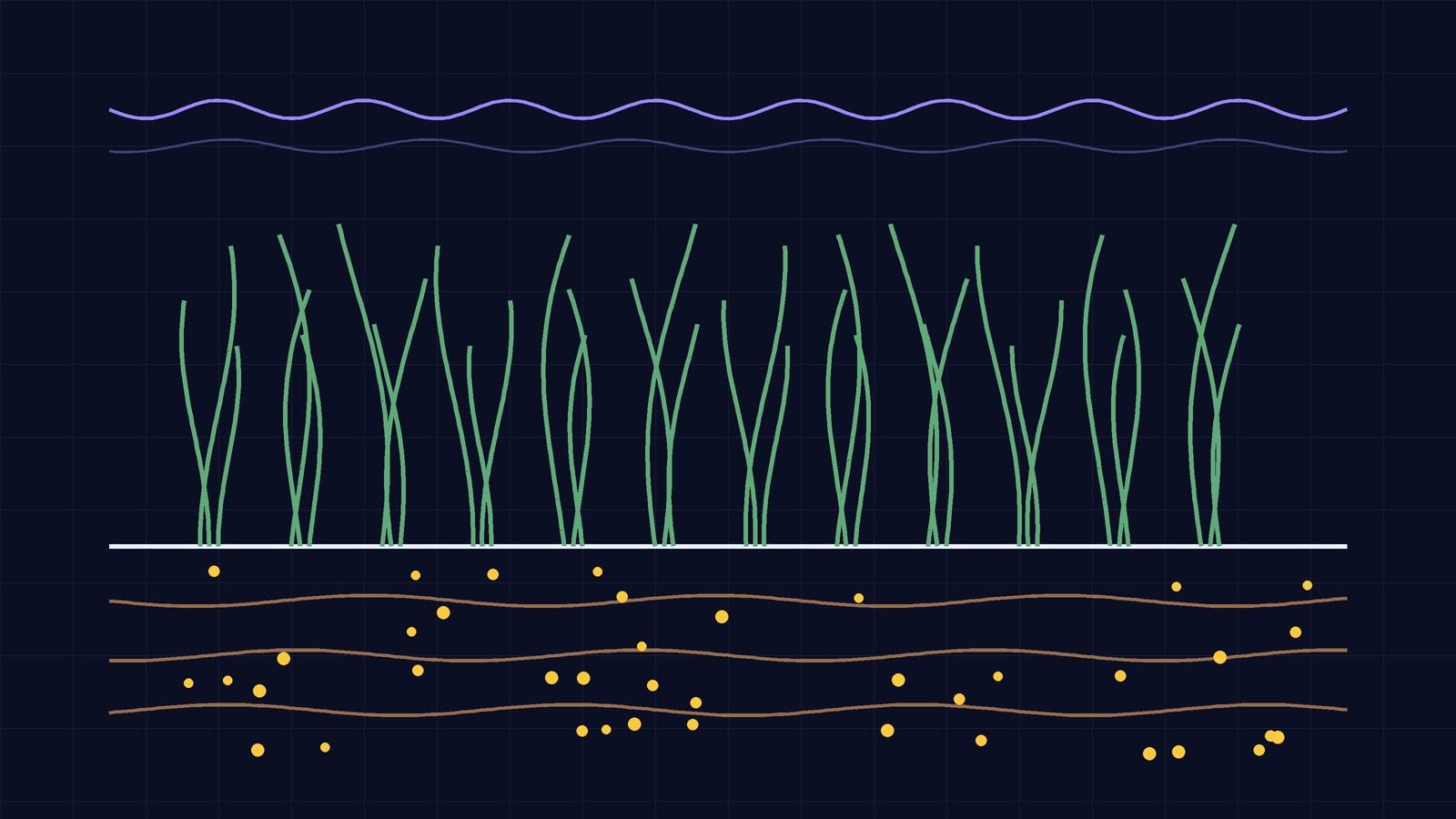
Meadows down to 40–45 m
Posidonia oceanica can form meadows from the surface down to 40–45 m depth.
Carbon in plants and soil
In seagrass meadows, organic carbon sits in living plant biomass and in the soil beneath.
Carbon can be released
If a meadow is lost and this organic carbon is broken down, carbon can be released.
Source: Telesca et al. (2015), Fourqurean et al. (2012)
A study published by Fourqurean and colleagues in Nature Geoscience in 2012 compiled measurements of the organic carbon content of living seagrass biomass and underlying soils in 946 distinct seagrass meadows across the globe. According to the authors, seagrass ecosystems could store as much as 19.9 Pg (petagrams) of organic carbon globally; with a more conservative approach, the pool lies between 4.2 and 8.4 Pg. According to the same study, Mediterranean Posidonia oceanica meadows have the largest documented organic carbon stores and can form “mattes” rich in organic carbon that have not been reported for other seagrass species. Assuming that all of the organic carbon in seagrass biomass and the top metre of soils is broken down, the authors estimated that present rates of seagrass loss could release up to 299 Tg (teragrams) of carbon per year (Fourqurean et al., 2012).
According to Telesca and colleagues, mainly point information on Posidonia was available along the Turkish coasts, and the few mapped meadows covered a total of 287 hectares. The study estimates that, in areas with historical data, meadows regressed by 34% over the last 50 years; according to the authors, full recovery of the meadows is usually considered irreversible on a human time scale because the species grows slowly and has a low recovery rate.
The day’s science post, What is the carbon cycle? A carbon atom’s journey from the air to the sea, follows carbon from the air into the ocean and explains ocean acidification. You can read why Posidonia is a flowering plant rather than a seaweed, and about the carbon that builds up beneath its roots, in What is Posidonia seagrass? The Mediterranean’s underwater forest.
Sources
7 sources- 1.GEF (17 November 2026). Governments announce additional $200 million to GEF family of funds at COP31 (opens in a new tab)
- 2.UNCCD (17 November 2026). Remarks by UNCCD Executive Secretary at Rio Synergies High Level Dialogue at UNFCCC COP31 (opens in a new tab)
- 3.COP31 Presidency (16 November 2026). Antalya Ocean and Seas Compact (Turkish) (opens in a new tab)
- 4.COP31 Presidency (16 November 2026). Antalya Ocean and Seas Compact (opens in a new tab)
- 5.COP31 Presidency: Thematic Days (opens in a new tab)
- 6.Telesca et al. (2015). Seagrass meadows (Posidonia oceanica) distribution and trajectories of change. Scientific Reports 5, 12505 (opens in a new tab)
- 7.Fourqurean et al. (2012). Seagrass ecosystems as a globally significant carbon stock. Nature Geoscience 5, 505–509 (opens in a new tab)
- #COP31
- #COP31 diary
- #ocean
- #seagrass
- #Posidonia
- #Antalya