How does the body cool down in hot weather? Sweat, evaporation and wet-bulb temperature
Even at rest, our body constantly produces heat and has to get rid of it. We explain the ways heat leaves through the skin, why sweat only cools when it evaporates, how humidity makes this harder and what wet-bulb temperature tells us, with the calculations.
In this article · 10 sections
The theme of COP31’s 18 November is Human and Social Development (COP31 thematic days). Hot weather is a climate topic that touches many sides of human life. This article explains the physiology and physics of how the body keeps its heat balance in the heat.
This article is for educational purposes and is not health advice. Questions about health should be taken to a health professional.
Imagine climbing a hill in midsummer. Your face goes red and your forehead sweats. On a dry day at the same temperature, the sweat dries quickly and you feel cooler; on a humid day the sweat drips off but no relief comes. The difference between the two days rests on one of the oldest topics in physics: the evaporation of water.
The body constantly produces heat
The human body keeps its internal temperature at about 37 °C. According to a 2015 review by Tansey and Johnson, keeping this temperature relatively constant, which is called thermoregulation, is critical to survival.
This comes at a cost: the body constantly produces heat through chemical reactions in its cells. According to a 2010 paper by Sherwood and Huber, a resting person produces about 100 W of heat, which has to be carried away together with any absorbed solar heat.
How much is 100 W? The heat produced in one day is:
If this heat built up in the body, its internal temperature would rise quickly. The body’s job is to pass the heat it produces on to its surroundings.
Heat leaves the skin in four ways
- Radiation: like every warm object, skin gives off infrared radiation. If surrounding surfaces are cooler than the skin, heat flows out overall. (Our article What is the greenhouse effect? explains infrared radiation.)
- Conduction: skin passes heat directly to a cooler surface or to the air it touches.
- Convection: air touching the skin warms up and makes way for cooler air. Wind or a fan speeds up this flow.
- Evaporation: sweat on the skin takes energy from the skin as it evaporates.
The first three have one condition in common: the surroundings must be cooler than the skin. According to Sherwood and Huber, skin temperature is normally held at 35 °C or below, because the skin must be cooler than the body’s core for heat from inside to flow out to it. When the air is above 35 °C, these three routes reverse: heat flows from the air into the skin. Only one route remains: evaporation.
The cooling power of sweat: let’s calculate
Evaporating water takes a lot of energy. According to the value in the OpenStax physics textbook, at body temperature (37 °C) the heat of vaporisation of water is 2,430 kJ/kg, or about 2.43 kJ per gram. (Our article Why does evaporation cool things down? explains why at the level of particles.)
Question: if all 100 W of heat produced by a resting person were removed by evaporation alone, how much sweat would need to evaporate each hour?
The energy to remove each second is 100 J:
In one hour:
That is about 150 grams, a little more than a small glass of water. As you move, you produce more heat, and more evaporation is needed.
There is an important detail here: the cooling comes from sweat that evaporates. As OpenStax notes, high humidity slows evaporation; sweat stays on the brow without evaporating, and body temperature can rise. Sweat that drips off leaves without taking energy from the skin.
How does the body carry heat to the skin?
Thermoregulation is run by control centres in the brain. As described in the review by Tansey and Johnson, the body responds to heat in several ways:
- Widening of blood vessels: blood vessels in the skin widen, so more blood, and therefore more heat, is carried from the core to the skin. This is why your face goes red in the heat.
- Sweating: sweat glands release water onto the skin; as this water evaporates, it cools the skin.
- Behaviour: moving into the shade, choosing light clothes and moving less are also part of the heat balance.
Why does humidity make a difference?
How fast evaporation happens depends on how much more water vapour the air can take. If the air is already close to full of water vapour, evaporation from the skin slows down. As Vecellio and colleagues note, air can hold about 7% more water vapour for every 1 °C it warms; that is why hot and humid conditions make the most effective way of shedding heat harder.
What is wet-bulb temperature?
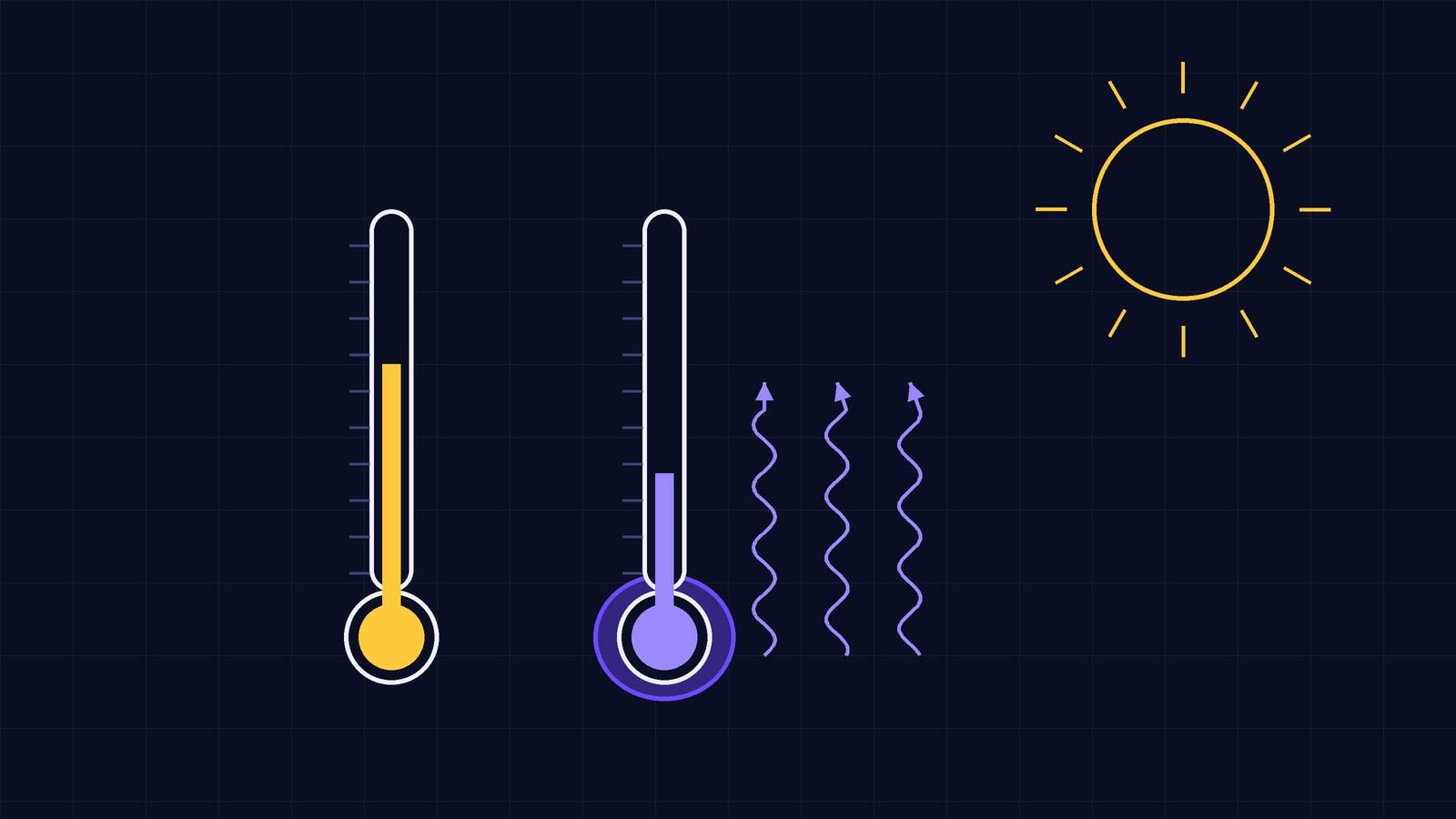
Imagine wrapping a thermometer’s bulb in a wet cloth and keeping air flowing over it. As the cloth dries, the thermometer cools. After a while the heat taken by evaporation balances the heat coming from the air, and the thermometer settles at a steady value. This value is called the wet-bulb temperature (T_w). That is Sherwood and Huber’s definition: the temperature shown by a standard thermometer covered with a wetted cloth and fully ventilated.
Wet-bulb temperature describes the lowest temperature that can be reached by evaporation. If the air is dry, the difference between the dry and wet thermometers is large; if the air is saturated with water vapour (100% relative humidity), both thermometers show the same value. Wet-bulb temperature is never higher than the air temperature.
Calculation: in 2011 the meteorologist Roland Stull published a formula that estimates the wet-bulb temperature at sea-level pressure from the air temperature (, °C) and relative humidity (, %):
(The angles are in radians.) The formula looks complicated, but it is easy to work out with a calculator or spreadsheet. The example in Stull’s paper: for °C and , °C. Some values from the same formula:
| Air temperature | Relative humidity | Wet-bulb (approx.) |
|---|---|---|
| 35 °C | 30% | 22.1 °C |
| 35 °C | 50% | 26.6 °C |
| 35 °C | 75% | 31.1 °C |
| 40 °C | 50% | 30.9 °C |
In the same 35 °C air, when humidity rises from 30% to 75%, the wet-bulb temperature rises by about 9 °C. That is how much the cooling power of evaporation falls.
Is there a limit?
Sherwood and Huber calculated that a wet-bulb temperature above 35 °C for an extended period would make it physically impossible to shed metabolic heat, because skin is at around 35 °C and under that condition evaporation cannot remove heat either. In the observational data in their paper, wet-bulb temperature did not exceed 31 °C.
In 2022 Vecellio and colleagues tested this theoretical limit in the laboratory. In experiments with 24 young, healthy volunteers, in humid environments of 36–40 °C the critical wet-bulb temperature at which the body could no longer keep its heat balance averaged 30.55 ± 0.98 °C; in hot, dry environments it was lower still. The authors concluded that in humid environments the real threshold is well below 35 °C.
The two studies complement each other: one gives the upper limit set by physics, the other the measured limit of the body. Both explain why we look not just at temperature but at humidity together with temperature.
Try it at home: your own wet-bulb thermometer
You will need: two identical thermometers, a thin cotton cloth or some cotton wool, a bowl of room-temperature water, a fan or a small electric fan.
- Put the two thermometers side by side in the shade. Wrap the bulb of one in the wet cloth.
- Keep air flowing over the wet cloth for a few minutes.
- Read both thermometers and note the difference.
- Repeat the experiment on different days, for example a rainy day and a dry day.
Predict: on which day will the difference between the two thermometers be larger? Why?
Safety note: do the experiment in the shade and at room conditions. Take care not to break a glass thermometer.
Common mix-ups
“Sweating always cools you down.” What cools you is sweat evaporating. Sweat that drips off without evaporating takes no energy from the skin.
“Humidity is just a feeling of discomfort.” Humidity physically sets how fast evaporation happens; at the same temperature, humid air is harder on the body.
“Wet-bulb temperature can be higher than air temperature.” It cannot. At most it equals the air temperature, which happens when the air is saturated with water vapour.
“A fan cools the air.” A fan does not change the air temperature; by replacing the air touching the skin, it speeds up convection and evaporation.
In short
- The body keeps its internal temperature at about 37 °C and produces about 100 W of heat at rest.
- Heat leaves the skin by radiation, conduction, convection and evaporation; if the air is warmer than the skin, only evaporation remains.
- At 37 °C the heat of vaporisation of water is 2,430 kJ/kg; removing 100 W by evaporation alone takes about 150 g of sweat evaporating per hour.
- Humidity slows evaporation; wet-bulb temperature captures the combined effect of temperature and humidity.
- The theoretical limit is a wet-bulb temperature of 35 °C; laboratory measurements showed the real threshold is lower in humid conditions.
You can study changes of state in our lesson Changes of state: melting, freezing, evaporation and the difference between heat and temperature in the article The difference between heat and temperature. In the Lab figure Same heat, different temperature, try how much the same energy warms different masses. You can find why cities are warmer in What is an urban heat island? and how to measure temperature properly in How do you measure weather and climate at home?
Frequently asked
4 questionsHow does the body cool down in hot weather?
Skin gives off heat by radiation, conduction, convection and the evaporation of sweat. Blood vessels in the skin widen to carry heat from the core to the skin. When the air is warmer than the skin, the first three routes stop working and cooling depends largely on sweat evaporating.
Why does sweat cool you down?
Evaporating water takes energy, and that energy is taken from the skin. At body temperature the heat of vaporisation of water is about 2,430 kJ/kg. Cooling comes only from sweat that evaporates; sweat that drips off takes no energy from the skin.
What is wet-bulb temperature?
It is the temperature shown by a thermometer whose bulb is wrapped in a wet cloth and fully ventilated. It describes the lowest temperature that can be reached by evaporation, combining the effects of temperature and humidity in one number. It is never higher than the air temperature.
Why does humid weather feel more oppressive?
The closer the air is to saturation, the more slowly sweat evaporates from the skin. Because evaporation is the main way of shedding heat in hot weather, the body finds it harder to get rid of heat in humid air.
Sources
6 sources- 1.COP31 Türkiye: Thematic days announced (opens in a new tab)
- 2.Sherwood and Huber (2010). An adaptability limit to climate change due to heat stress. PNAS 107(21), 9552–9555 (opens in a new tab)
- 3.Vecellio et al. (2022). Evaluating the 35°C wet-bulb temperature adaptability threshold for young, healthy subjects (PSU HEAT Project). Journal of Applied Physiology 132(2), 340–345 (opens in a new tab)
- 4.Stull (2011). Wet-Bulb Temperature from Relative Humidity and Air Temperature. Journal of Applied Meteorology and Climatology 50, 2267–2269 (opens in a new tab)
- 5.Tansey and Johnson (2015). Recent advances in thermoregulation. Advances in Physiology Education 39(3), 139–148 (opens in a new tab)
- 6.OpenStax, College Physics 2e, §14.3 Phase Change and Latent Heat (opens in a new tab)
- #heat balance
- #sweating
- #evaporation
- #wet-bulb temperature
- #humidity
- #COP31