How was zero invented? The long road that turned nothing into a number
Today we can't imagine life without zero, yet for thousands of years people did their sums without it. We tell the story of zero, from a gap marker in Babylon to a true number in India, and from Baghdad to Europe.
By Kuazara Bilim EkibiPublished: Updated: 7 min read
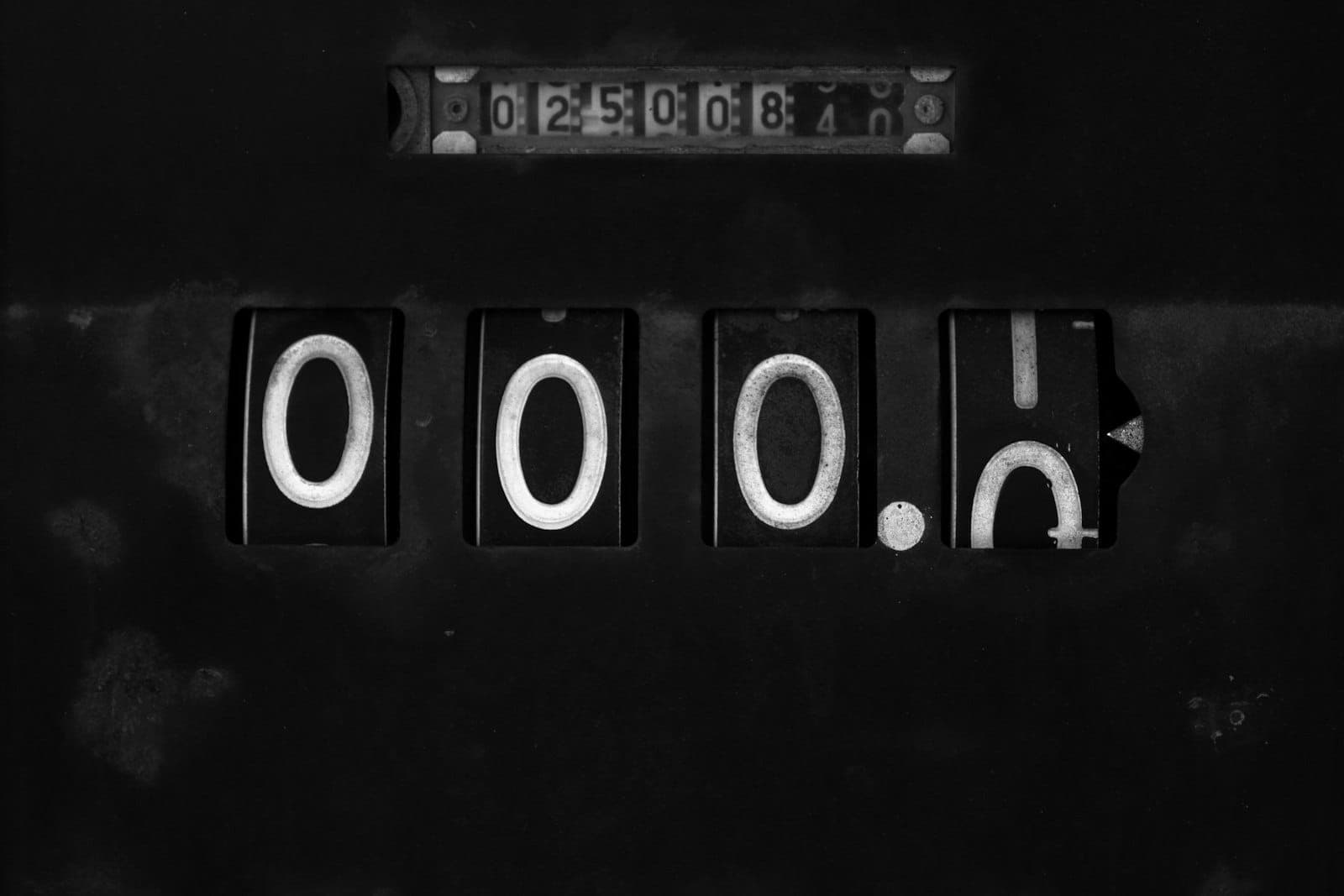
Photo: Scott Rodgerson / Unsplash
In this article · 8 sections
You have 3 apples and you eat them all. How many apples do you have left? It’s easy to say “none”. But writing this “none” as a number, adding and multiplying with it, and placing it on a number line like any other number took humanity thousands of years. Zero, which we see everywhere today, from phone numbers and bank accounts to the 0s and 1s inside computers, is actually one of the most revolutionary ideas in mathematics, and one of the last to be accepted.
Calculating in a world without zero
Think of Roman numerals: I, V, X, L, C, D, M. There is no zero in this system, and no need for one. You write the year 2026 as MMXXVI. But try multiplying two large numbers in this system using long multiplication; it is almost impossible. In the ancient world, big calculations were usually done with tools such as the abacus or a counting board, and the result was written down afterwards.
The heart of the problem is this: in Roman numerals, the value of a symbol does not depend on where it stands. X is 10 wherever it is. In the system we use, however, position is everything. The 2 in 205 really means 200, because it is in the hundreds place. This is where zero becomes unavoidable: to tell 205 apart from 25, you need a sign in the tens place that says “there is nothing here”.
The first step: a gap marker in Babylon
One of the first civilisations to use a place-value number system was the Babylonians, who lived in what is now Iraq. The Babylonians used a base-60 system. The fact that an hour has 60 minutes and a minute has 60 seconds is a legacy of this system that survives today.
For a long time the Babylonians had no sign for an empty place; they showed it only by leaving a small gap. This led to confusion. On tablets from the last few centuries BC, a sign shaped like two slanting wedges began to be used to mark an empty place. But this sign was only a placeholder; it was not used as a number in its own right. Nobody did a calculation like “zero plus five”.
On the other side of the ocean, the Maya of Central America also developed a sign for zero independently, for their calendar calculations. This is a lovely example of how the idea of zero could appear in different cultures that knew nothing of each other.
The real revolution: zero becomes a number in India
The step that turned zero from a mere gap marker into a real number was taken in India. Indian mathematicians developed the decimal place-value system, in which nine digits and a zero are enough to write any number. In Sanskrit, zero was called “shunya”, meaning “empty”.
In 628 the Indian mathematician Brahmagupta clearly set out the rules for calculating with zero in his work Brahmasphutasiddhanta. In today’s notation, some of these rules are:
These rules look very natural to us, but writing them down for the first time was a big step. Brahmagupta also calculated with negative numbers, thinking of them as “debts” and of positive numbers as “fortunes”. He was wrong on one point, though: he gave the result of as 0. Today we know that this operation is undefined.
One of the most famous early examples of zero written as a round sign is an inscription in a temple in the Indian city of Gwalior, dated to 876. In it, the number “270” is written with a circle that looks very much like our zero. There are other examples that may be older; the date of the text known as the Bakhshali manuscript, for instance, is still debated among researchers.
From Baghdad to Europe
The Indian number system reached the Islamic world in the 8th and 9th centuries. Al-Khwarizmi, who worked in Baghdad, wrote a book explaining this system, and Latin translations of the book reached Europe centuries later. The Sanskrit “shunya” was translated into Arabic as “sifr”, which also means “empty”. The Turkish word sıfır comes from here too.
In 1202 the Italian mathematician Leonardo Fibonacci introduced these numerals to Europeans in his book Liber Abaci, calling zero zephirum, a word he derived from its Arabic name. Over time this word was shortened in Italian and became the English word zero we use today. Another word from the same Arabic root is the English cipher; it first meant “zero”, then “digit”, and later “secret code”.
The new numerals were not accepted in Europe straight away. In 1299 a bankers’ guild in Florence is said to have banned their use in its records. The reason given was that these numerals could easily be altered: it was simple to turn a 0 into a 6 or a 9. Even so, the convenience they brought to trade and calculation won out, and Hindu-Arabic numerals gradually spread all over the world.
Why can’t you divide by zero?
This is the most frequently asked question about zero. The answer lies in what division means. We say because . In other words, division answers the question “which number do I multiply by 2 to get 6?”
Now let’s try : “Which number do I multiply by 0 to get 6?” No number at all! Because any number multiplied by 0 gives 0. So this operation has no result.
What about ? “Which number do I multiply by 0 to get 0?” This time every number works: 5, 17, a million... Since there is no single answer, we can’t give this operation a value either. That is why mathematicians treat division by zero as undefined.
Myth or fact?
- “Zero was invented by a single person.” False. Zero developed through different stages in the Babylonian, Maya and Indian cultures. Brahmagupta was one of the first people to write down rules for calculating with zero, but calling him “the inventor of zero” would be an exaggeration.
- “The Arabs invented zero.” The concept of zero developed in India; the great contribution of mathematicians in the Islamic world was to develop this system further and spread it. That is why these numerals are called “Hindu-Arabic numerals” today.
- “Zero is neither positive nor negative.” True. Zero is the point on the number line that separates the positive numbers from the negative ones. Zero is also an even number, because it can be divided by 2 with no remainder.
Connection to today
Computers express everything using just two digits, 0 and 1. This binary system is also a place-value system, and it couldn’t work without zero. Zero degrees on a thermometer, the origin of a coordinate system, the moment a race starts... All of these are reference points that zero gives us. Turning nothing into a number made mathematics and technology what they are today.
Summary
- Place-value number systems need zero to show an empty place.
- The Babylonians and the Maya used zero as a placeholder sign.
- In India zero became a real number; Brahmagupta wrote down the rules for calculating with zero in 628.
- Zero reached Europe by way of the Islamic world; the word “zero” comes from the Arabic “sifr”.
- Division by zero is undefined, because the question division asks has either no answer at all or infinitely many answers.
Frequently asked
4 questionsWho invented zero?
Where does the word zero come from?
Why is dividing by zero undefined?
Is zero an even number?
Sources
3 sources- 1.MacTutor History of Mathematics — A history of Zero (opens in a new tab)mathshistory.st-andrews.ac.uk
- 2.MacTutor History of Mathematics — Brahmagupta (opens in a new tab)mathshistory.st-andrews.ac.uk
- 3.Kaplan, R. — The Nothing That Is: A Natural History of Zero, Oxford University Press (1999)
- #zero
- #history of numbers
- #brahmagupta
- #decimal system
- #history of mathematics