What is the golden ratio? Myths and facts from the Mona Lisa to the sunflower
The golden ratio is said to be hidden in the pyramids, the Parthenon, the Mona Lisa and the human face. Most of these claims aren't based on measurements. We sort out the real maths of the golden ratio and where it truly appears in nature.
By Kuazara Bilim EkibiPublished: Updated: 7 min read
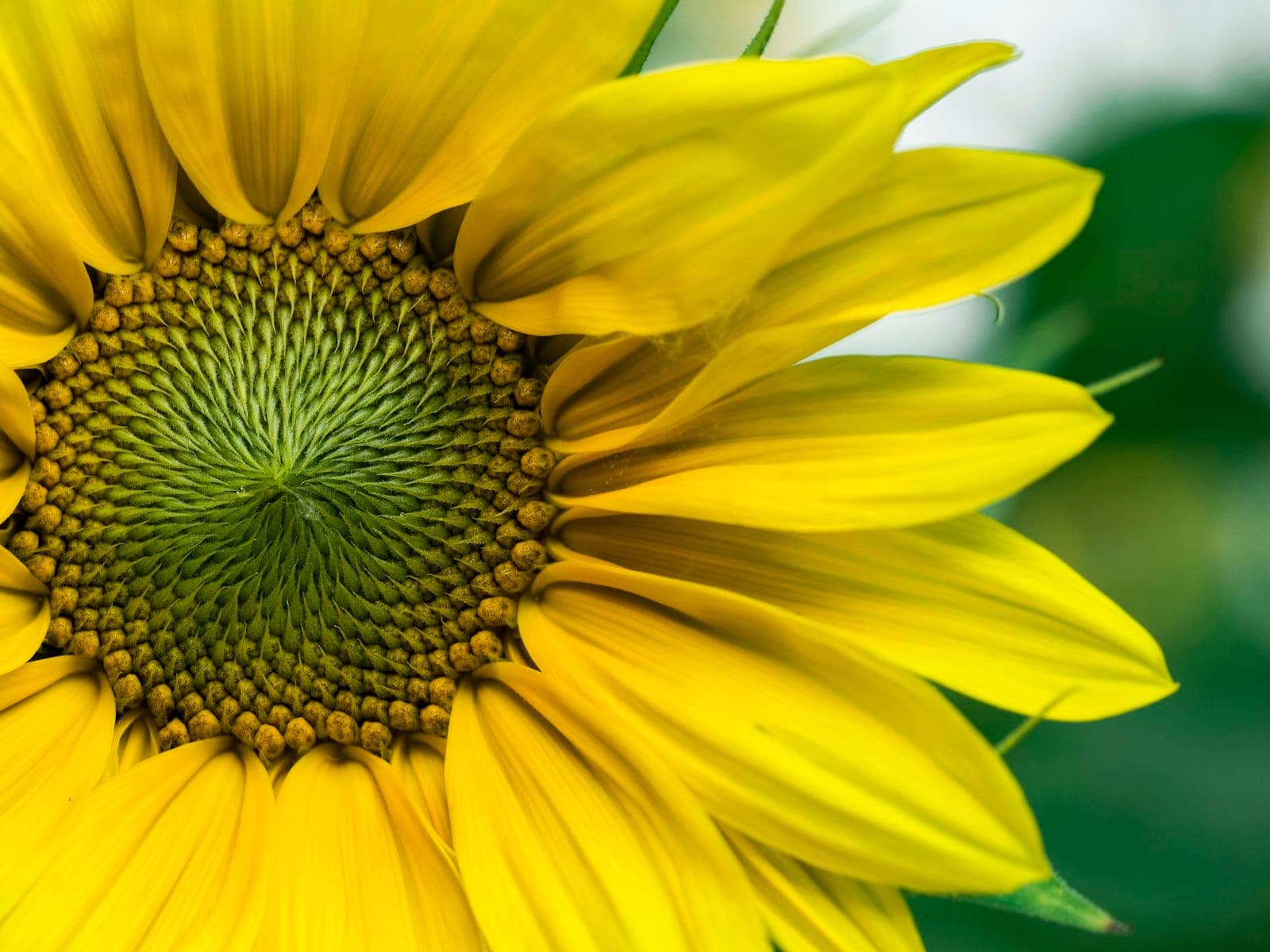
Photo: Aaron Burden / Unsplash
In this article · 8 sections
Search the internet for “golden ratio” and you’ll find the Egyptian pyramids, the Parthenon, the Mona Lisa, famous logos, sunflowers, seashells, even the measurements of the “perfect face”. Could a number that is said to turn up in so many places really be the universe’s secret design rule? In this post we’ll first learn the real maths of the golden ratio, then act like scientists and test the claims one by one. You’ll see that the true story is less magical than the myths, but far more interesting.
What exactly is the golden ratio?
Imagine dividing a line segment into two parts: a longer part and a shorter part . If the ratio of the whole to the longer part equals the ratio of the longer part to the shorter part, the division is in the golden ratio:
This ratio is written with the Greek letter phi (). Its value is:
Where does this value come from? If we take the shorter part as and call the longer part , the definition gives us the equation . Multiplying both sides by , we get , that is, the equation . The positive solution of this quadratic equation is exactly . So the golden ratio is not a mysterious number; it is the solution of a simple equation.
The golden ratio has a few surprising properties. For example, to square it, you just add 1: . To find its reciprocal, you just subtract 1: . The digits after the decimal point staying the same is no coincidence; it follows directly from the definition.
The golden ratio in history
The oldest known clear definition of this ratio is in Euclid’s Elements, written around 300 BC. Euclid calls it the “extreme and mean ratio” and uses it to construct shapes such as the regular pentagon. Indeed, in a regular pentagon the ratio of a diagonal to a side is exactly . The golden ratio turns up again and again inside a five-pointed star.
In 1509 the Italian mathematician Luca Pacioli devoted a whole book to this ratio, De divina proportione (“On the Divine Proportion”). The drawings of geometric solids in the book were made by Leonardo da Vinci. The names “golden ratio” and “golden section”, however, are much more recent; they became widespread in Germany in the 19th century. So nobody in ancient times called it the “golden ratio”.
A hidden link to the Fibonacci numbers
1, 1, 2, 3, 5, 8, 13, 21, 34, 55, 89... In this sequence, each number is the sum of the two numbers before it. It is called the Fibonacci sequence. Now let’s look at the ratios of consecutive terms:
The ratios get closer and closer to . This is a genuinely surprising, proven result in mathematics.
Where does it really appear in nature?
The most solid example of the golden ratio in nature is the arrangement of leaves and seeds in plants. If you look closely at the seeds in the middle of a sunflower, you’ll see spirals turning one way and spirals turning the other. The numbers of these spirals are often two consecutive Fibonacci numbers, for example 34 and 55. A similar pattern can be seen in pine cones and pineapples.
Here is how this is explained: in a growing plant, each new seed forms at a position turned about 137.5 degrees from the previous one. This angle is called the “golden angle”, and it comes from dividing a full circle in the golden ratio. It lets the seeds pack tightly together without overlapping and without leaving gaps. So here the golden ratio is not a “rule of beauty” but an efficient result of the growth process. Even so, it isn’t perfect in every plant; there are exceptions too.
Myth or fact?
Now let’s test the most popular claims:
- The Parthenon was built using the golden ratio. There is no historical document to support this. Measurements give very different ratios depending on which points you measure from. If you pick enough points, you can find a ratio close to 1.6 in any building.
- The Egyptian pyramids were designed with the golden ratio. Some measurements of the Great Pyramid give ratios close to 1.6, but the same measurements can be explained with other numbers too. There is no evidence that the Egyptians used this ratio deliberately.
- The Mona Lisa’s face fits inside a golden rectangle. Where the rectangle is drawn is completely arbitrary. The fact that Leonardo illustrated Pacioli’s book doesn’t mean he used this ratio in his own paintings.
- The nautilus shell grows according to the golden ratio. The shell really is a logarithmic spiral, but measurements have shown that its growth ratio is usually clearly different from the golden ratio.
- People like the golden rectangle best. In the 19th century the psychologist Gustav Fechner reported results pointing that way. Later experiments, however, gave inconsistent results; people’s preferences vary from person to person and with the way the experiment is done.
- Some artists used the golden ratio on purpose. This is true. In the 20th century, for example, the architect Le Corbusier openly used the golden ratio in his system of measurements, which he called the “Modulor”. But even where it was used deliberately, that doesn’t prove the ratio is what makes the work “beautiful”.
In a paper published in 1992, the mathematician George Markowsky showed in detail that most claims of this kind rest on measurement errors and selective sampling.
Why are we so easily convinced?
There are two important reasons why these myths spread. The first is flexible measuring: a painting or a building has hundreds of possible lengths. If you pick out the ones close to 1.6 and ignore the rest, you are bound to find what you are looking for. The second is approximation: counting every ratio between 1.5 and 1.7 as “almost the golden ratio” makes the claim impossible to test.
This is exactly where scientific thinking comes in: to test a claim, you need to choose your measuring points in advance, record the counterexamples too, and compare the result with what chance alone would give.
Try it yourself
Take a ruler and measure your classmates’ heights and the height of their belly buttons from the floor (with their permission!). Work out the ratios. You’ll probably find results spread between 1.5 and 1.7. The average may come out close to 1.6, but look at how different the individual results are. Saying “the human body is built on the golden ratio” means ignoring this spread.
Summary
- The golden ratio is , and it has been known since Euclid.
- The ratio of consecutive Fibonacci numbers approaches the golden ratio; this is a proven fact.
- The golden angle and Fibonacci numbers often appear in the arrangement of seeds and leaves in plants.
- Most popular claims about the Parthenon, the pyramids, the Mona Lisa and the nautilus shell are not based on reliable evidence.
- When testing a claim, you need to choose the measuring points in advance and count the counterexamples too.
Frequently asked
4 questionsWhat is the value of the golden ratio?
How is the golden ratio related to the Fibonacci sequence?
Was the Mona Lisa painted using the golden ratio?
Does the golden ratio really occur in nature?
Sources
3 sources- 1.MacTutor History of Mathematics — The Golden ratio (opens in a new tab)mathshistory.st-andrews.ac.uk
- 2.Markowsky, G. — Misconceptions about the Golden Ratio, The College Mathematics Journal, 23(1), 1992
- 3.Livio, M. — The Golden Ratio: The Story of Phi, the World's Most Astonishing Number, Broadway Books (2002)
- #golden ratio
- #fibonacci
- #phi
- #mathematics and art
- #scientific thinking