The law of conservation of mass: where does the mass go when wood burns?
When wood burns, only a handful of ash is left, yet a rusting nail gets heavier. Does mass vanish, or appear out of nowhere? We explain the law of conservation of mass, Lavoisier's experiments and how to balance chemical equations.
By Kuazara Bilim EkibiPublished: Updated: 7 min read
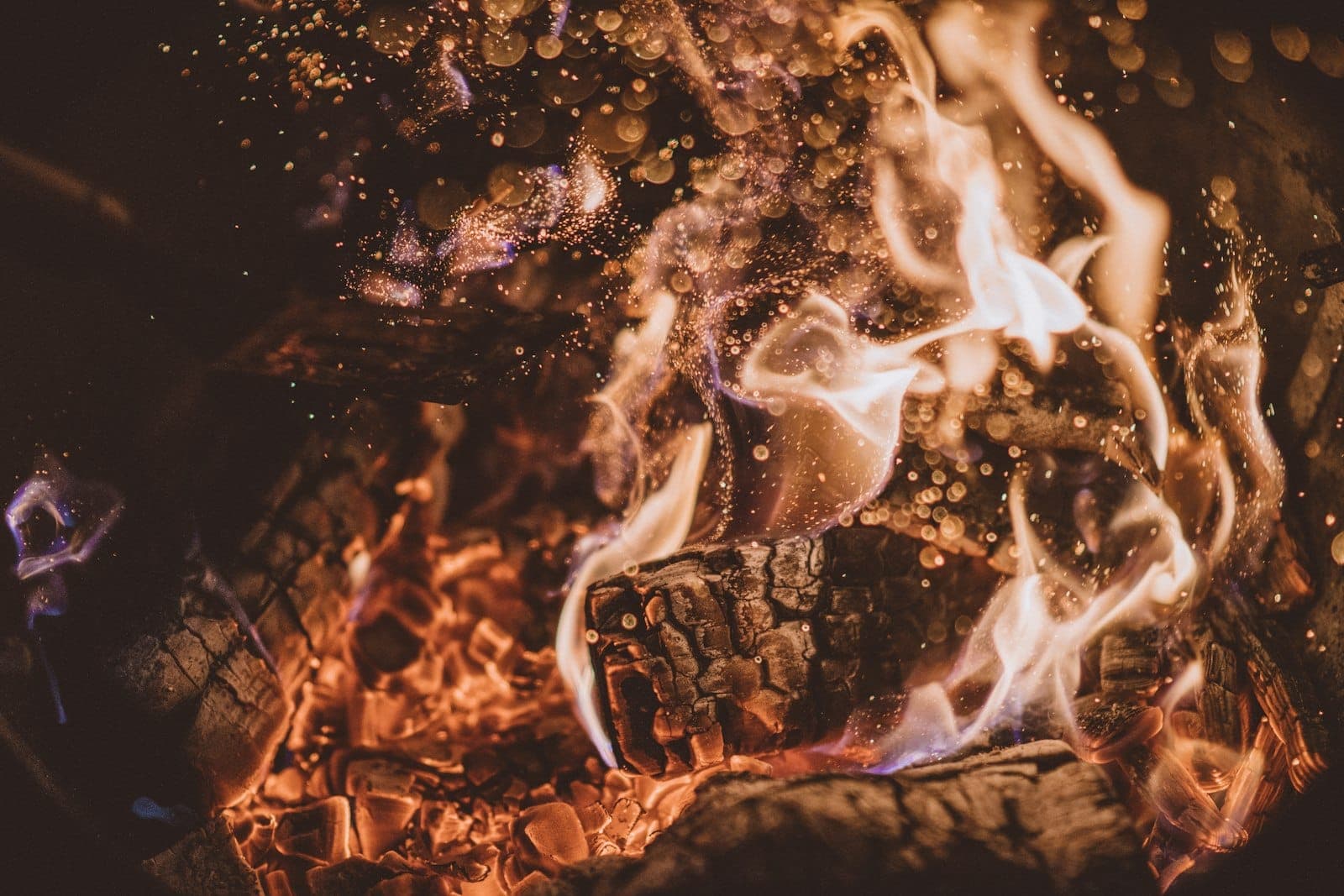
Photo: Joshua Newton / Unsplash
In this article · 8 sections
In a fireplace, or the wood stove of a village house, a few kilos of wood burn, and by morning only a handful of ash is left. Meanwhile, an iron nail left out in the rain in the garden gets slightly heavier as it rusts. At first glance, mass seems to disappear in one place and appear out of nowhere in another. Yet one of the most basic rules of chemistry says exactly the opposite: mass is conserved in chemical reactions. In this article we explain the law of conservation of mass, how it was discovered, and how the two puzzles above are solved.
Physical change and chemical change
First, let’s separate two kinds of change.
In a physical change, the identity of the substance doesn’t change; only its shape, state or appearance does. Ice melting, paper tearing and sugar dissolving in water are physical changes. Melted ice is still water.
In a chemical change (a chemical reaction), substances turn into other substances. The new substances have different properties from the ones you started with. Wood burning, iron rusting, baking a cake and making yoghurt from milk are chemical changes.
Some signs that a chemical reaction has taken place:
- A change of colour (an apple turning brown after it is cut)
- Gas being given off (fizzing when baking soda is added to vinegar)
- Heat or light being released (burning)
- A precipitate forming (cloudiness when two clear solutions are mixed)
- A change of smell (food going off)
None of these signs is conclusive proof on its own, but they are good clues for suspecting a reaction.
What is the law of conservation of mass?
The law of conservation of mass says that in a chemical reaction taking place in a closed system, the total mass of the reactants equals the total mass of the products:
The reason is simple: in chemical reactions, atoms are neither destroyed nor created. Only the bonds between them break and new bonds form. The atoms are rearranged. Imagine building a car out of Lego bricks, then taking it apart and building a house: the shape has changed, but the number of bricks and their total weight stay the same.
Lavoisier and closed containers
The systematic proof of this law is associated with the 18th-century French chemist Antoine Lavoisier. Lavoisier’s great contribution was to carry out reactions in closed containers and to weigh everything with precise balances before and after the reaction.
Earlier scientists worked with open containers, so it was hard for them to notice gases escaping or being taken from the air. Lavoisier showed that metals gain mass when heated in air, and that this increase comes from a component of the air: the gas he would later name oxygen. This work showed that burning is not the escape of a mysterious substance called “phlogiston” but substances combining with oxygen, and it became one of the foundations of modern chemistry. A famous summary attributed to Lavoisier goes: in nature nothing is lost, nothing is created, everything is transformed.
Solving the puzzles
Where does the mass go when wood burns? Most of wood is made of compounds of carbon, hydrogen and oxygen atoms. During burning, these atoms combine with oxygen from the air to form carbon dioxide and water vapour. These products are gases and go up the chimney into the air. All that is left behind is the minerals that don’t burn: the ash. If we burned the wood inside a giant closed container along with its air, and could also weigh all the gases produced, we would see that the total mass had not changed. In fact, the mass of the products is greater than the mass of the wood, because oxygen from the air also takes part in the reaction.
Why does a rusting nail get heavier? Iron reacts with oxygen and water from the air to form iron oxide (rust). Because oxygen atoms from the air are added to the nail, its mass increases. The mass has not appeared out of nowhere; it has come from the air.
Chemical equations and balancing
Conservation of mass gives us a rule for writing chemical equations: there must be the same number of atoms of each element on both sides of the equation.
Let’s look at hydrogen burning to form water. The unbalanced version:
There are 2 oxygen atoms on the left and 1 oxygen atom on the right. Let’s balance it:
Now there are 4 hydrogen and 2 oxygen atoms on the left, and 4 hydrogen and 2 oxygen atoms on the right. The equation is balanced.
Let’s check with masses. Taking the approximate atomic masses as 1 for H and 16 for O:
- Reactants:
- Products:
So if 4 grams of hydrogen react with 32 grams of oxygen, 36 grams of water form.
Careful when balancing: you only change the coefficients in front of the molecules. You don’t change the small subscripts in the formula. If you turn into , you are no longer writing water but hydrogen peroxide.
Common misconceptions
“Matter is destroyed when things burn.” Matter is not destroyed; it turns into gas and mixes with the air.
“When sugar dissolves in water it disappears and its mass is gone.” Dissolving sugar is a physical change. The mass of the solution equals the mass of the water plus the mass of the sugar. You can check this yourself with kitchen scales.
“Gases have no mass.” Gases have mass too. A litre of air at room conditions weighs about 1.2 grams.
“If mass is conserved, the number of molecules stays the same after a reaction.” What is conserved is the number of atoms and the mass. The number of molecules can change: in the example above, 3 molecules became 2.
An extra note: in nuclear reactions there are measurable conversions between mass and energy, explained by Einstein’s relation . In chemical reactions this effect is so tiny that no balance can measure it. That is why conservation of mass is an extremely good law for chemical reactions.
Try it at home: the balloon bottle
You will need: a small plastic bottle, a balloon, a funnel, vinegar, baking soda, kitchen scales.
- Pour about half a glass of vinegar into the bottle.
- Using the funnel, put two teaspoons of baking soda into the balloon.
- Stretch the neck of the balloon over the mouth of the bottle without letting the baking soda spill in.
- Put the set-up on the scales and note the mass.
- Lift the balloon so the baking soda falls into the vinegar. It will start to fizz and the balloon will inflate.
- When the reaction has finished, weigh the set-up again.
The mass stays almost the same. The carbon dioxide gas produced is trapped in the balloon. Now repeat the experiment without the balloon, with the bottle open: the mass goes down because the gas escapes into the air.
A detail for careful observers: when the balloon inflates it pushes air aside, and the buoyant force from the air increases slightly. So a sensitive balance may show a very small decrease even with the closed set-up. This difference comes from buoyancy, not from mass disappearing.
Summary
- In a physical change the identity of the substance is kept; in a chemical change new substances form.
- In a closed system, the total mass is the same before and after a chemical reaction.
- This is because atoms are neither destroyed nor created.
- When wood burns, mass goes into the air as gases; rust gets heavier by taking oxygen from the air.
- Chemical equations are balanced so that the number of atoms of each element is equal on both sides.
For more, take a look at our Science topics and our chemistry articles.
Frequently asked
4 questionsWhat is the law of conservation of mass?
Where does the mass go when wood burns?
What is the difference between a chemical change and a physical change?
How do you balance a chemical equation?
Sources
3 sources- 1.OpenStax, Chemistry 2e — Bölüm 4: Stoichiometry of Chemical Reactions (opens in a new tab)openstax.org
- 2.Encyclopaedia Britannica — Antoine Lavoisier (opens in a new tab)britannica.com
- 3.Khan Academy — Chemical reactions and stoichiometry
- #conservation of mass
- #chemical reaction
- #Lavoisier
- #combustion
- #balancing equations