
ScienceMiddle school
Phases of the Moon
Move the Moon around the Earth and see how much of its sunlit half we can see from here.
Science · Middle school
Scale a model up k times: its surface grows k², its weight k³. At what size do the legs break, and why are elephant legs so thick?
In the learning section below the figure, predict, try, complete the tasks and check yourself with short questions.
ScienceMiddle school
Move the Moon around the Earth and see how much of its sunlit half we can see from here.

ScienceMiddle school
Change the date and the latitude: how does the axial tilt change the angle of sunlight and the length of the day?
ScienceMiddle school
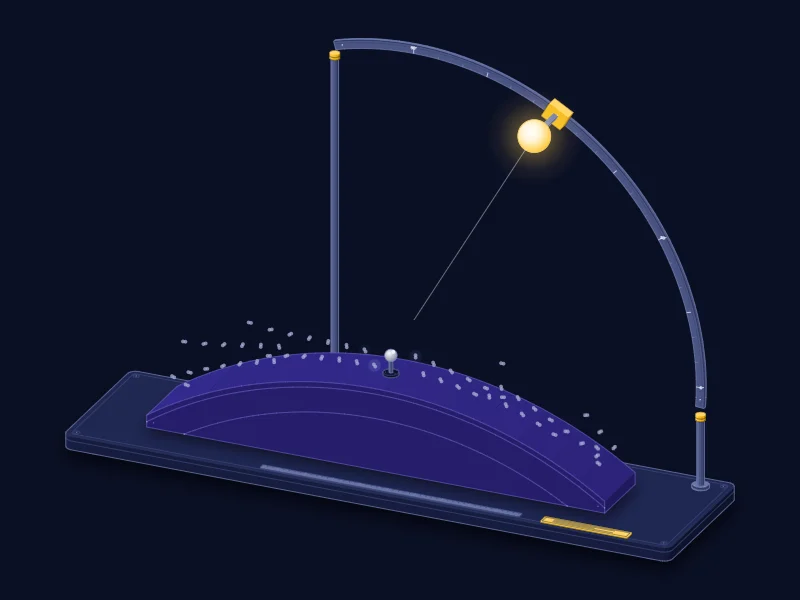
Lower the lamp: air scatters blue light far more than red, giving a blue sky at noon and a red Sun at dusk.
Change k: the surface grows as k², the weight as k³; watch the stress on the gauge
Gauge (load ÷ strength): 0.1
Body: 72 unit squares on the surface, 36 unit cubes inside.
Gauge (load ÷ strength): 0.1 · With this rule the legs reach their breaking limit at k = 10.
Leg length ÷ diameter: ×1
If the model is made twice as big in every direction (length, width and height), how many times heavier does it get?