What is DNA? How heredity, genes and eye colour are passed on
What is DNA, and how is a gene different from a chromosome? We explain the basics of heredity with Mendel's peas, show with real genetics why eye colour is not as simple as people think, and extract DNA from strawberries.
By Kuazara Bilim EkibiPublished: Updated: 7 min read
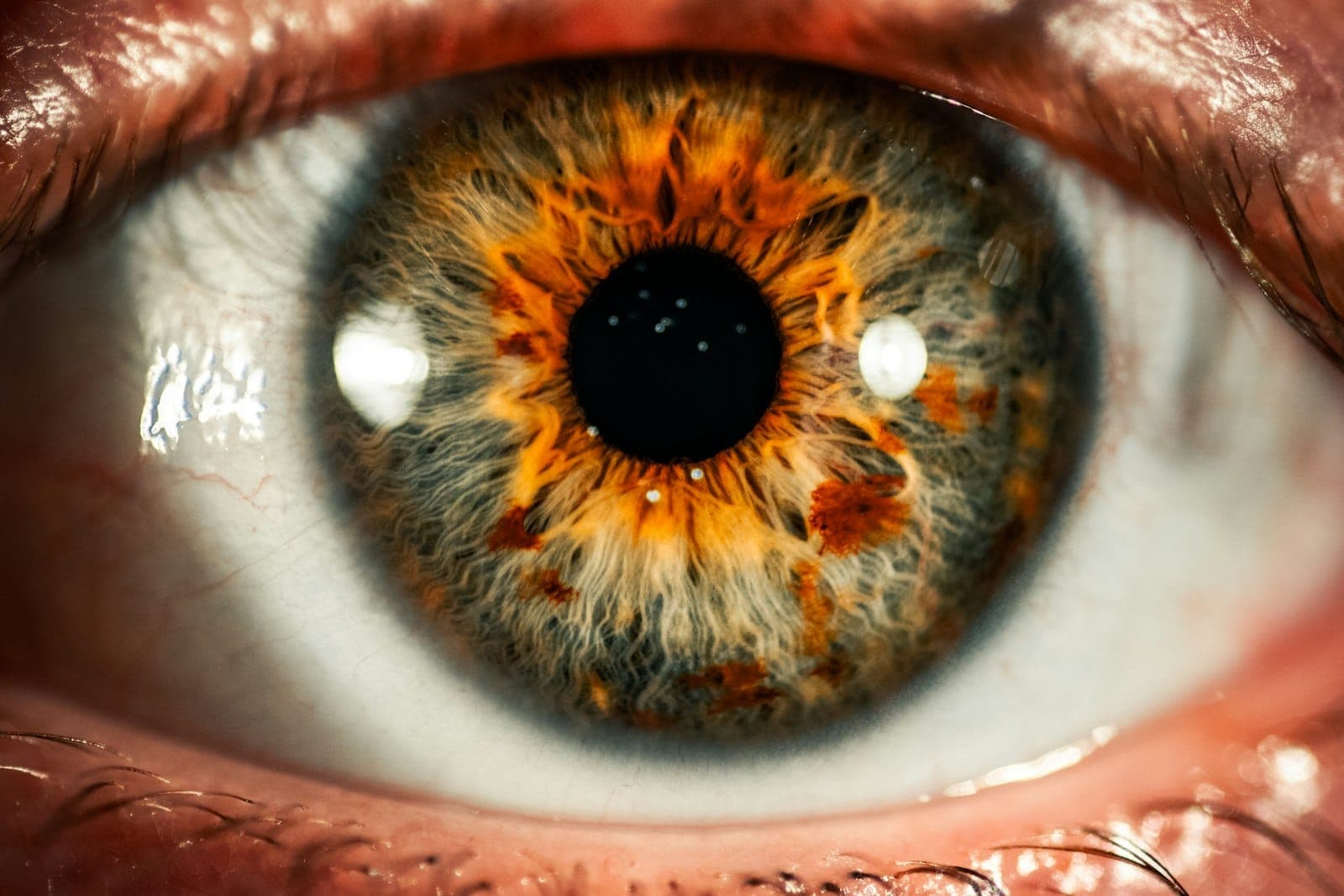
Photo: Colin Lloyd / Unsplash
In this article · 7 sections
“She has her mother’s eyes and her father’s nose.” You have almost certainly heard someone say this next to a baby. But how does a trait get “passed on” from a mother or father to a child? Why do brothers and sisters look alike but not exactly the same? How can two brown-eyed parents have a blue-eyed child? The answer to these questions is stored in a molecule inside our cells: DNA. In this article we explain DNA, genes and the basic rules of heredity, and we also show why eye colour is more complicated than the simple examples in school textbooks.
What is DNA?
DNA (deoxyribonucleic acid) is the molecule that carries the hereditary information determining the structure and workings of living things. It is found in the nucleus of most of the cells in our body.
The shape of DNA was worked out in 1953 by James Watson and Francis Crick, who also drew on X-ray diffraction data from Rosalind Franklin and Maurice Wilkins: a double helix. Picture a ladder twisted around itself. The two sides of the ladder are made of sugar and phosphate. The rungs are made of four different bases:
- A — Adenine
- T — Thymine
- G — Guanine
- C — Cytosine
These bases always pair in the same way: A with T, and G with C. Thanks to this pairing rule, DNA can copy itself. When the ladder splits down the middle, each half becomes the template for the missing side.
The information in DNA is written in the order of these four letters. Just as computers code everything with 0s and 1s, living things code their instructions as sequences of A, T, G and C. Human DNA contains about 3 billion base pairs.
Gene, chromosome, DNA: what’s the difference?
These three ideas are often mixed up. A library analogy makes things easier:
- DNA is the language the books are written in, that is, the sequence of letters.
- A gene is a stretch of DNA containing instructions for a particular job, like a recipe in a book. Most genes carry the recipe for a protein the cell will make.
- A chromosome is DNA tightly packed around proteins, like a single volume in the library.
Human body cells contain 23 pairs, or 46 chromosomes. One member of each pair comes from the mother and the other from the father. So each gene usually has two copies. Different versions of the same gene are called alleles.
Mendel and his peas: the rules of heredity
The first person to study the rules of heredity systematically was Gregor Mendel, an Austrian monk who lived in the 19th century. Mendel crossed thousands of pea plants and counted how traits such as seed colour and seed shape were passed down through the generations.
Mendel’s key idea was this: some alleles are dominant and some are recessive. If a dominant allele is present, the trait follows it. A recessive trait shows up only if both alleles are recessive.
In peas, yellow seed colour (Y) is dominant and green (y) is recessive. If both parents are Yy, the possible offspring can be worked out like this:
| Y | y | |
|---|---|---|
| Y | YY (yellow) | Yy (yellow) |
| y | Yy (yellow) | yy (green) |
This table is called a Punnett square. The result: about three quarters of the offspring have yellow seeds and one quarter green. In his experiments Mendel did indeed find ratios very close to 3 to 1. Be careful: these ratios are probabilities. It is not guaranteed that exactly one in four offspring will be green; the ratio is approached on average across a large number of offspring.
Eye colour: not as simple as people think
For many years, schools taught eye colour as a simple single-gene example: “brown is dominant, blue is recessive”. That account works as a starting model, but the real picture is more complicated.
What determines eye colour is the amount of the pigment melanin in the coloured part of the eye (the iris). A lot of melanin gives a brown appearance, a little gives blue. In-between colours such as green and hazel come from a combination of the amount of melanin and the way light is scattered in the iris. Incidentally, there is no blue pigment in a blue eye; the blue appearance comes from light being scattered in the tissue of the iris.
More than one gene affects the amount of melanin. The genes called OCA2 and HERC2 on chromosome 15 have the biggest effect, but other genes contribute too. This makes eye colour a polygenic (many-gene) trait. The consequences:
- Two brown-eyed parents can have a blue-eyed child.
- Two blue-eyed parents usually have blue-eyed children, but occasionally they can have a child with darker eyes. This cannot be explained by the simple single-gene model, but it is possible under the many-gene model.
- Eye colour does not split into two boxes, “brown” and “blue”; it varies across a wide range.
The fact that babies’ eye colour can change during their first months and years is also down to melanin production in the iris increasing over time.
Common misconceptions
“Every trait is determined by a single gene.” Many traits, such as height, skin colour and eye colour, are determined by the combined effect of many genes and the environment.
“The dominant allele is the one that is more common in the population.” No. Dominance describes how an allele shows up in an individual; it has no direct connection with how common it is in the population.
“The muscles I build by doing sport will be passed on to my child.” Traits acquired during a lifetime do not change the DNA sequence, so they are generally not passed on to children.
“Brothers and sisters carry the same genes.” Apart from identical twins, siblings receive different combinations of alleles from each parent. That is why they are similar but different.
Try it at home: Extract DNA from strawberries
With this experiment you can see DNA with the naked eye. Because it uses alcohol, do it with an adult and keep away from flames.
You will need: 2-3 strawberries, a zip-lock freezer bag, half a glass of water, a teaspoon of salt, a tablespoon of washing-up liquid, a sieve or coffee filter, a clear glass, high-strength alcohol chilled in the fridge (ethyl alcohol from a pharmacy is suitable), a toothpick.
- Mix the water, salt and washing-up liquid. This is the solution that will break down the cell membranes.
- Put the strawberries in the bag, add a few spoonfuls of the solution and mash for two minutes.
- Strain the mixture through the sieve into the clear glass.
- Slowly pour the cold alcohol down the side of the glass so that it forms a layer on top of the strained liquid.
- Within a few minutes a white, stringy substance will appear at the boundary between the two liquids. You can wind it around the toothpick.
What you are seeing is millions of DNA molecules clumped together. The washing-up liquid breaks down the membranes, the salt helps the DNA clump together, and the DNA comes out of solution because it does not dissolve in alcohol.
Summary
- DNA is a double-helix molecule that carries hereditary information as a sequence of the bases A, T, G and C.
- A gene is a stretch of DNA carrying a particular instruction; a chromosome is packaged DNA. Humans have 46 chromosomes.
- Mendel discovered dominant and recessive alleles and the probability rules of heredity.
- Eye colour is determined not by a single gene but by several genes.
- Traits acquired during a lifetime are generally not inherited.
For more on living things and heredity, take a look at our Science topics and our biology articles.
Frequently asked
4 questionsWhat is DNA?
What is the difference between a gene and a chromosome?
Can two brown-eyed parents have a blue-eyed child?
How many chromosomes do humans have?
Sources
3 sources- 1.OpenStax, Biology 2e — Bölüm 12: Mendel's Experiments and Heredity; Bölüm 14: DNA Structure and Function (opens in a new tab)openstax.org
- 2.MedlinePlus Genetics — Is eye color determined by genetics? (opens in a new tab)medlineplus.gov
- 3.Khan Academy — Classical and molecular genetics
- #DNA
- #heredity
- #gene
- #chromosome
- #eye colour
- #Mendel