
ExperimentsHigh school and university
The gold foil experiment
Fire alpha particles at gold foil; swing the detector, count the ones that bounce back and trace the nucleus.
Experiments · High school and university
Change the wavelength, the intensity and the metal: it is the photon’s energy, not the intensity, that frees electrons.
In the learning section below the figure, predict, try, complete the tasks and check yourself with short questions.
ExperimentsHigh school and university
Fire alpha particles at gold foil; swing the detector, count the ones that bounce back and trace the nucleus.
ExperimentsHigh school and university
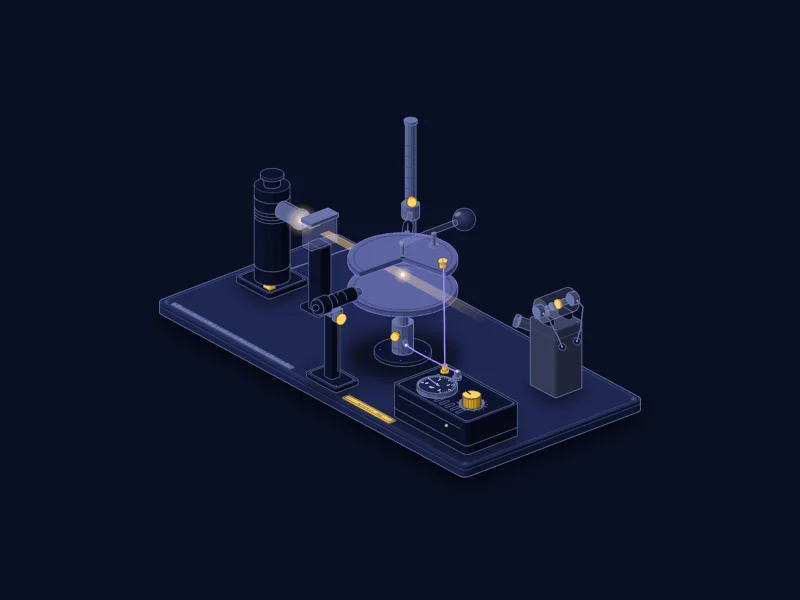
Adjust the voltage, hold the drop still in the microscope and work out the charge of the electron yourself.
ExperimentsHigh school
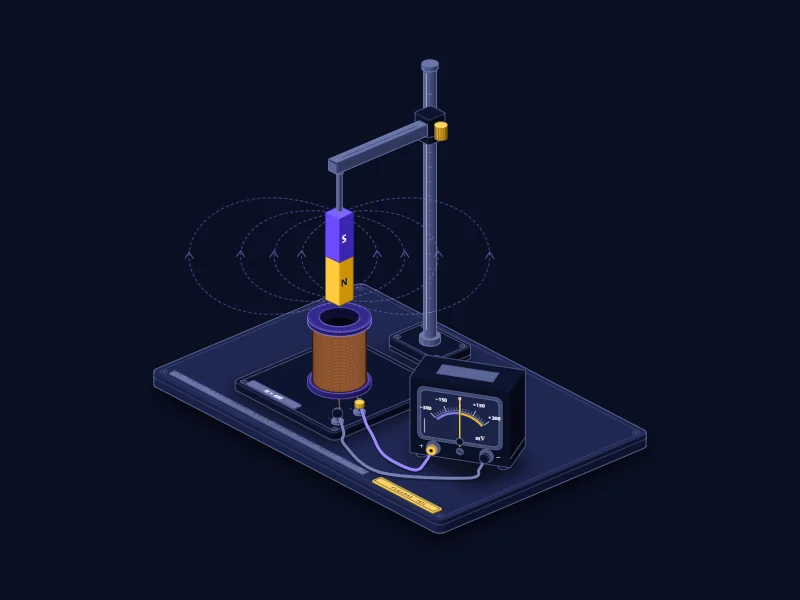
Move the magnet in the coil: the galvanometer swings while the flux changes, and the current stops when the magnet stops.
Change the wavelength, intensity, metal and voltage below
400 nm · Kmax 0.74 eV
Each photon gives one electron its energy hf; φ of it is spent getting out of the metal, the rest is kinetic energy.
slope h/e = 4.14×10⁻¹⁵ V·s, the same for every metal
What happens if you shine very bright violet light (400 nm, 100% intensity) on a copper plate?
400 nanometre light, Sodium. Fastest electron energy 0.74 eV, stopping voltage 0.74 V, relative current 60.