
ExperimentsHigh school and university
The gold foil experiment
Fire alpha particles at gold foil; swing the detector, count the ones that bounce back and trace the nucleus.
Experiments · High school and university
Adjust the voltage, hold the drop still in the microscope and work out the charge of the electron yourself.
In the learning section below the figure, predict, try, complete the tasks and check yourself with short questions.
ExperimentsHigh school and university
Fire alpha particles at gold foil; swing the detector, count the ones that bounce back and trace the nucleus.

ExperimentsHigh school and university
Change the wavelength, the intensity and the metal: it is the photon’s energy, not the intensity, that frees electrons.
ExperimentsHigh school
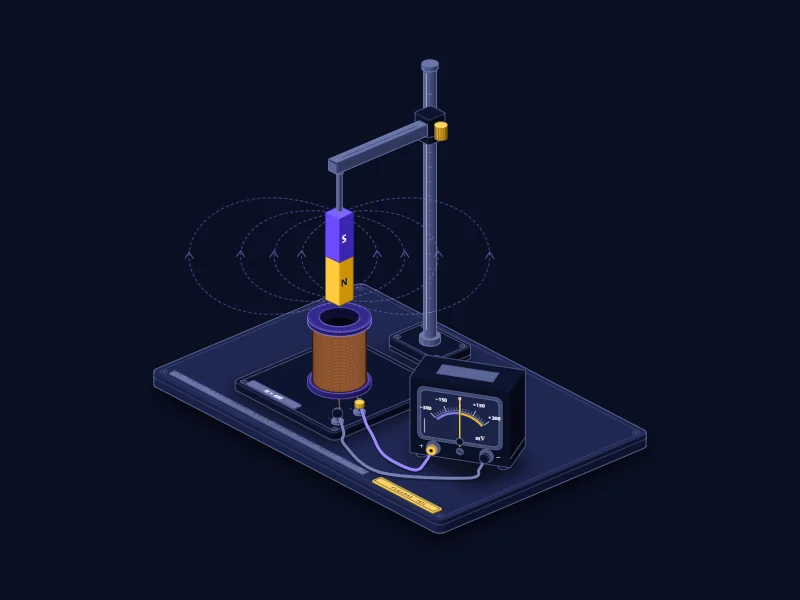
Move the magnet in the coil: the galvanometer swings while the flux changes, and the current stops when the magnet stops.
Adjust the voltage until the drop stands still in the microscope
q / e
3.02
Drift speed: 0.1 µm/s
hovering
When the drop hovers, this comes out very close to a whole number.
A drop of radius 1 µm hovers at 446 V. To hold a drop with the same charge but half the radius (0.5 µm), what should the voltage be?
The drop is hovering. Calculated q/e: 3.02.