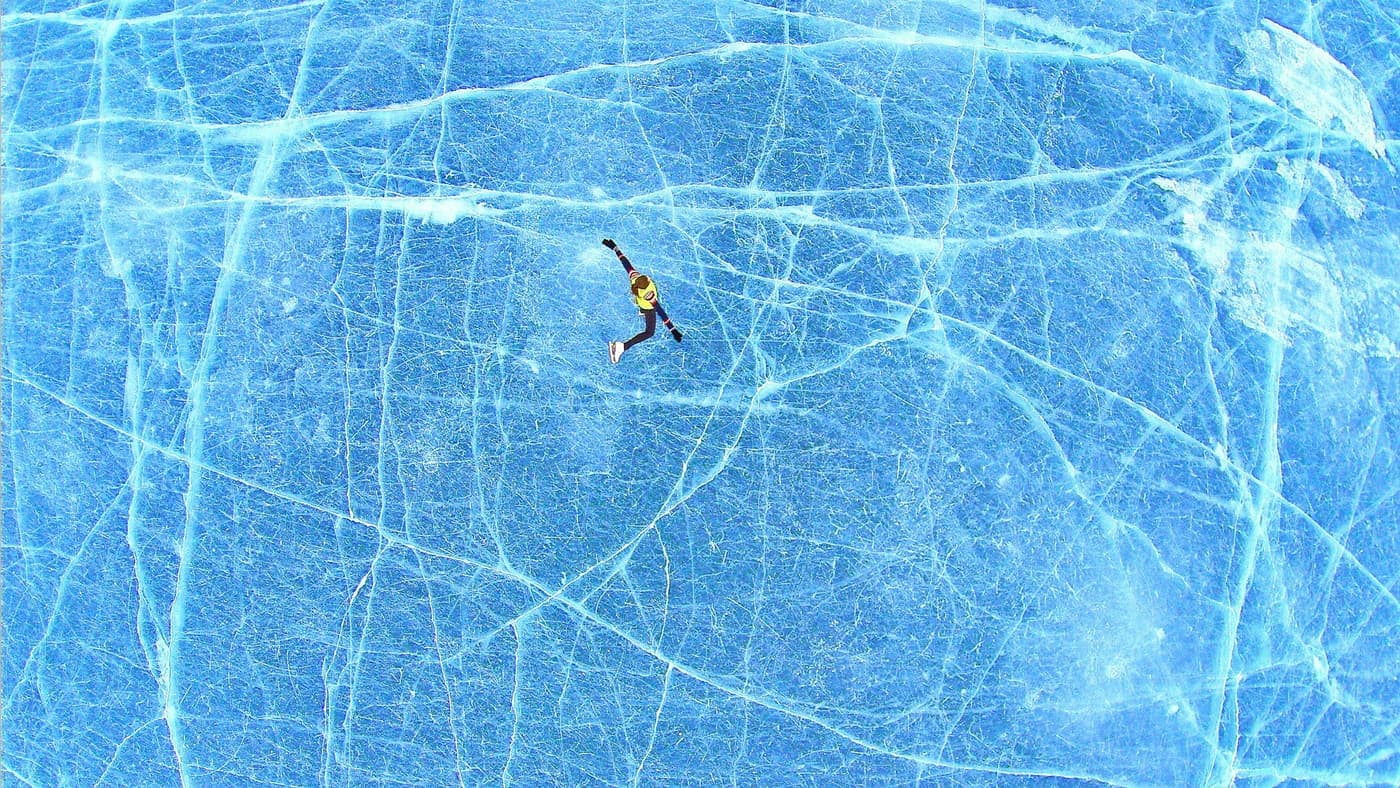
Why do we slip on ice?
- 4 steps
- 1 h 6 min
- 7 simulations
Journey · History
From a single shadow to giant observatories: the relay race of the sky-measurers
Nobody had walked all the way round the Earth, and nobody had gone into space to look at it from outside. Yet about 2,250 years ago a scholar in Alexandria worked out the size of our planet to the right order of magnitude. All he had was a shadow, an estimated distance between two cities and the geometry of parallel lines. Linking what you cannot measure to what you can: that idea was handed down to every observer of the next two thousand years.
This journey begins by reminding you what an angle is and how it is measured. Next you calculate the Earth's circumference yourself from Eratosthenes's shadow. Then, in Samarkand, the city of Ulugh Beg's great stone arc with a radius of about 40 metres, you find latitude from the height of the Pole Star, and in Istanbul, at Taqi al-Din's observatory, you see why a clock can work as an angle-measuring instrument. At every stop you follow how knowledge passed from one culture to the next, and who added what.
In the last step you try to put what you have measured on paper: Piri Reis's map of 1513 shows why flattening a globe onto a plane always distorts something. Along the way you'll pick up a useful habit too: telling apart what is documented, what is an estimate and what is legend.
We suggest going in order; each step builds on the one before. You can try every lesson’s simulation without an account.
Step 115 min
Angles are the language of everyone who measures the sky. First, refresh what an angle is and how to measure one with a protractor.
Step 218 min
Use a shadow angle and the distance between two cities to calculate the Earth's circumference yourself, and see which number is still debated.
Step 318 min
Find latitude from the Pole Star at Samarkand's giant arc, and discover why a bigger instrument measures more precisely.
Step 418 min
In Istanbul a clock becomes an angle-measuring instrument. Put seventeen centuries of sky-measurers in order yourself.
Step 518 min
Fitting the measured Earth onto a flat sheet of parchment: see why every projection distorts something, and put the legend of an ice-free Antarctica to the test.