Who was Ulugh Beg? The ruler who measured the sky and the Samarkand Observatory
Picture a ruler who busies himself with stars instead of war and has a giant observing instrument built near his palace. We tell the story of the observatory Ulugh Beg founded in Samarkand, his star catalogue and his tragic end.
By Kuazara Bilim EkibiPublished: Updated: 7 min read
In this article · 8 sections
Picture a ruler in Central Asia at the start of the 15th century. His grandfather is one of the most famous conquerors in history. He himself, though, cares more about the sky than the sword: at night he measures the positions of the stars, he argues with mathematicians, and near his palace he has one of the largest observing instruments ever built up to that time. This ruler is Ulugh Beg, and the Samarkand Observatory he founded is one of the most impressive buildings in the history of science.
Timur’s grandson, patron of science
Ulugh Beg’s real name was Muhammad Taraghay. “Ulugh Beg” is a title meaning “great beg” (great lord). He was born in 1394 in Sultaniyeh, in present-day Iran. His grandfather was Timur, who built a vast empire, and his father was Shah Rukh, who came to the throne after Timur.
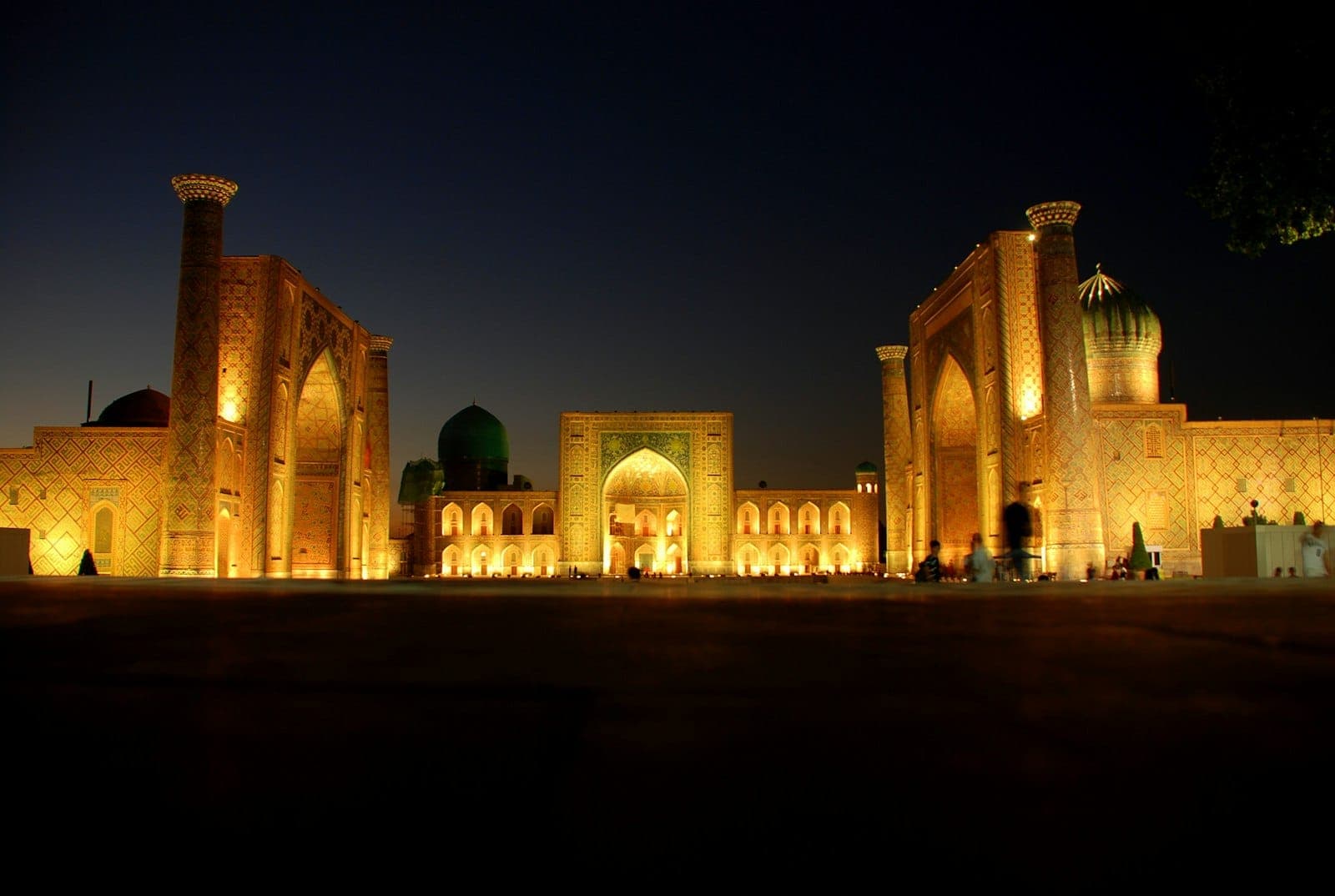
While Ulugh Beg was still young, his father made him governor of Samarkand, in present-day Uzbekistan, and the surrounding region. Ulugh Beg governed Samarkand for about forty years. During that time he turned the city into a centre of science and the arts. Between 1417 and 1420 he had a madrasa (a college of higher learning) built on Samarkand’s famous Registan Square. Astronomy and mathematics were taught there, and scholars gathered from every corner of the region. It is reported that Ulugh Beg himself attended these classes and also taught.
A giant wall sextant
Ulugh Beg’s biggest project was the observatory he had built on a hill near Samarkand in the 1420s. At the heart of this three-storey cylindrical building was a giant meridian arc sunk into the ground. The radius of this instrument, called the “Fakhri Sextant” in the sources, is estimated to have been about 40 metres.
Why was such a large instrument needed? When you measure an angle, the bigger the instrument’s scale, the easier it is to tell small differences in angle apart. On a small protractor, a 1-degree interval is a few millimetres; but on an arc with a radius of 40 metres, 1 degree corresponds to about 70 centimetres. We can see this with the formula for the length of an arc:
At this scale it was possible to mark even very small fractions of a degree. The telescope had not yet been invented, so the precision of naked-eye observations depended largely on the size and build quality of the instrument.
A team of scientists
The Samarkand Observatory was not a one-man project. Ulugh Beg was surrounded by the leading scholars of the time:
- Qadi Zada al-Rumi: a mathematician and astronomer born in Bursa. He was one of those who taught at the madrasa and guided the observatory’s early work.
- Jamshid al-Kashi: one of the strongest calculators of his time. His calculation of pi to 16 decimal places remained unbeaten for a long time.
- Ali Qushji (Ali Kuşçu): a student of Ulugh Beg who carried on the work in the observatory’s later years.
Through years of observations and calculations, this team produced a major work.
Zij-i Sultani: a new star catalogue
The observatory’s most important product is the set of astronomical tables called the Zij-i Sultani (or Zij-i Gurgani). A “zij” is a type of work made up of tables and explanations used to calculate the motions of the Sun, the Moon and the planets.
The most striking part of this work is a star catalogue giving the positions of about 1000 stars. To see why this mattered, you need to know one thing: for centuries astronomers had largely relied on the catalogue of Ptolemy, who lived in the 2nd century, passing on his values with corrections. Ulugh Beg’s catalogue, by contrast, was one of the rare works that determined star positions largely through new observations. This is why many historians regard it as the most comprehensive star catalogue of the period between Ptolemy and Tycho Brahe, the Danish astronomer who worked at the end of the 16th century.
The Zij-i Sultani also contained detailed trigonometric tables. These tables gave the sine and tangent values needed to calculate angles in the sky with very high accuracy.
Why so much calculation?
For an astronomer, observation is only half the job. A star’s position in the sky changes with the observer’s latitude, the day of the year and the time. To convert the measured angles into a common coordinate system you constantly need triangles, angles and ratios. In a world without calculators, that meant thousands of pages of calculation by hand.
A small error in the tables could spread to hundreds of results. So the Samarkand team took great care to calculate the basic values as accurately as possible. Al-Kashi, for example, used an iterative method that improved the result a little at each step to find the sine of 1 degree with very high accuracy. If you consider that computers today do many calculations in a similar way, by approaching the answer step by step, you can better appreciate how far-sighted this approach was. He also completed the work in which he calculated pi to 16 decimal places around 1424, in Samarkand.
A tragic end
Ulugh Beg’s scientific success was not matched in his political life. He came to the throne after his father Shah Rukh died in 1447, but struggles over the throne soon began. In 1449 he was killed on the orders of his own son, Abd al-Latif.
After his death the observatory was neglected and in time fell into ruin. For centuries nobody knew exactly where it had stood. In 1908 the Russian archaeologist Vasily Vyatkin found its remains. Today in Samarkand you can still see the underground section of the giant meridian arc.
Myth or fact? Ali Qushji’s journey
After Ulugh Beg’s death, Ali Qushji left Samarkand. After a long journey he reached Ottoman lands and, in the reign of Mehmed the Conqueror, settled in İstanbul. He taught at the Hagia Sophia madrasa, and his works on mathematics and astronomy were studied in Ottoman madrasas for a long time. This is an important example of the scientific tradition of Samarkand being carried to Anatolia.
There is one point in this story that should not be exaggerated: very precise figures for the values Ulugh Beg measured circulate online; for example, it is said that he found the length of the year “with an error of a few seconds”. Different sources give different values and different comparisons on this. What is certain is that the Samarkand team made some of the most precise measurements of its time; but you need to be cautious when quoting individual numbers.
Connection to today
Ulugh Beg’s story shows that science advances not only through individual geniuses but through institutions: a school (the madrasa), a laboratory (the observatory), a team and years of patient data collection. Today’s giant telescopes and space observatories work on the same principle: bigger and more precise instruments, longer observations and international teams. There is also a crater on the Moon named after Ulugh Beg.
Summary
- Ulugh Beg (1394-1449) was Timur’s grandson and the ruler of Samarkand.
- In the 1420s he had an observatory built with a giant meridian arc about 40 metres in radius.
- He worked together with scholars such as Qadi Zada al-Rumi, al-Kashi and Ali Qushji.
- The Zij-i Sultani is an important catalogue containing the positions of about 1000 stars, determined by new observations.
- After Ulugh Beg’s death, Ali Qushji came to İstanbul and carried this scientific tradition to the Ottomans.
Frequently asked
4 questionsWho was Ulugh Beg?
When was the Samarkand Observatory founded?
What is the Zij-i Sultani?
What was Ali Qushji's connection with Ulugh Beg?
Sources
3 sources- 1.MacTutor History of Mathematics — Ulugh Beg (opens in a new tab)mathshistory.st-andrews.ac.uk
- 2.Encyclopaedia Britannica — Ulūgh Beg
- 3.MacTutor History of Mathematics — Ghiyath al-Din Jamshid Mas'ud al-Kashi (opens in a new tab)mathshistory.st-andrews.ac.uk
- #ulugh beg
- #samarkand
- #observatory
- #history of astronomy
- #ali qushji