Types of angles: how to tell acute, right, obtuse and reflex angles apart
How can you tell whether an angle is acute, right or obtuse? Using a paper-corner test, clock-face examples and triangles, we explain the types of angle step by step, including straight angles, full turns and reflex angles bigger than 180°.
In this article · 9 sections
Have you ever looked closely at the pointed tip of a slice of pizza, the gap between the screen and keyboard of an open laptop, or the corner of a book? They are all angles, but they are not all the same type. Some are sharp, some make a perfect corner, and some are opened right out.
In this article we work through the types of angle step by step. We will see how to tell acute, right and obtuse angles apart, what straight angles and full turns are, and where angles bigger than 180° come from. Grab a sheet of paper; it will be your first measuring tool.
A quick reminder first: what is an angle?
An angle is the shape formed by two rays that start from the same point. The shared point is the vertex of the angle, and the rays are its arms. An angle with vertex and the points and on its arms is written ; the vertex letter always goes in the middle.
The size of an angle tells you how far one arm has turned relative to the other. We measure this amount of turn in degrees:
- A full turn:
- A half turn:
- A quarter turn:
The most important idea to hold on to is this: the size of an angle does not depend on the length of its arms. Draw the arms short or extend them to the edge of the page; if the amount of turn is the same, the angle is the same.
If you would like a closer look at the parts of an angle and how to measure one with a protractor, have a look at the lesson What is an angle and how do you measure it?.
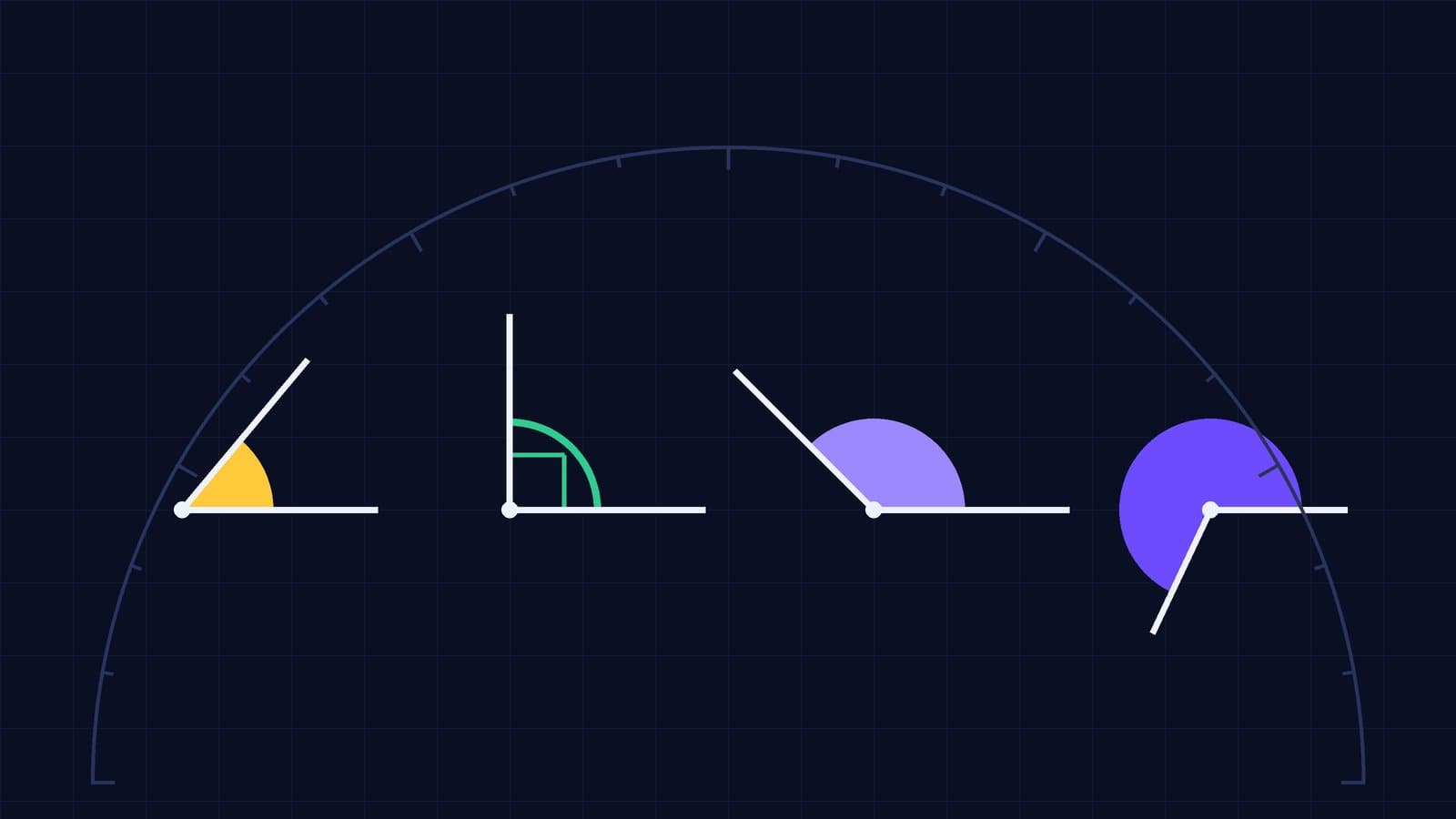
How are angles classified by size?
The only thing that decides an angle’s type is its size. The whole classification is built around two important “signposts”: (a quarter turn) and (a half turn).
| Type of angle | Size | As a turn |
|---|---|---|
| Acute angle | Less than a quarter turn | |
| Right angle | Exactly a quarter turn | |
| Obtuse angle | More than a quarter turn, less than a half turn | |
| Straight angle | Exactly a half turn | |
| Reflex angle | More than a half turn, less than a full turn | |
| Full turn | One complete turn |
Look carefully at the inequalities in the table: the boundaries are exact. is acute, is a right angle and is obtuse. There is no such type as “nearly right”.
This way of sorting angles is very old. The definitions at the start of Book I of Euclid’s Elements, written around 300 BC, already describe the right angle, the obtuse angle as one greater than a right angle and the acute angle as one less than a right angle.
The arms of a straight angle lie on the same line, pointing in opposite directions, so at first glance a straight angle looks like an ordinary straight line. In a full turn the arms end up on top of each other again, but a whole turn has happened in between. When there has been no turn at all and the arms simply lie on top of each other, some books call this a zero angle ().
Angles between and are called reflex angles. We will look at them more closely in a moment.
For explanations and practice on acute, right, obtuse and straight angles and full turns, see the Types of angle lesson as well.
The easiest way to tell acute, right and obtuse apart: a paper corner
You don’t always need a protractor to work out an angle’s type. Very often a single question gets you there: “Is this angle smaller or bigger than a right angle?”
A ready-made right angle is right at your fingertips: the corner of an A4 sheet, an exercise book or a book. You can use that corner as a right-angle tester:
- Place the corner of the paper on the vertex of the angle you are checking.
- Line up one edge of the paper with one arm of the angle.
- Now look at the other arm:
- If the arm stays inside the paper, the angle is acute.
- If the arm lies exactly along the edge of the paper, the angle is a right angle.
- If the arm falls outside the paper and does not go past a half turn, the angle is obtuse.
Two in-between values are also handy when you estimate by eye:
- is exactly half a right angle. It is the angle you get when you fold a corner of the paper so that one edge lies along the neighbouring edge.
- is a right angle plus half a right angle: .
With these benchmarks you can place an angle roughly. For example, an angle that looks a little bigger than half a right angle is somewhere around to , and it is definitely acute.
In diagrams, a right angle is marked with a small square drawn in its corner. When you see that mark, you know the angle is without measuring.
If two lines cross at a right angle, they are perpendicular to each other, written . Two perpendicular lines make four right angles where they meet. Think of a plus sign: all four angles between its arms are .
Angles bigger than 180°: the “other side” of an angle
When you draw two rays from the same starting point, you actually split the plane into two parts. That is why the same two arms define two angles: one on the “inside” and one on the “outside”. Together these two angles always make a full turn:
For example, if there is an obtuse angle of between the arms, then on the other side of the same arms there is an angle of . This second angle goes past a half turn, so it is a reflex angle.
Here is an everyday example. One slice has been cut from a pizza, and the angle at the tip of the slice is (an example value). The angle at the centre of the pizza left on the plate is . The slice you cut makes an acute angle, while the pizza that is left makes a reflex angle.
So when we say “the angle”, which one do we mean? Unless stated otherwise, people usually mean the smaller angle, the one that is no more than . If the reflex angle is meant, it is normally marked separately on the diagram or stated clearly in the question.
Most protractors only have scales from to , so you can’t measure a reflex angle directly. There are two ways round this:
- Measure the smaller angle and subtract it from . If the smaller angle is , the reflex angle is .
- Extend one of the arms to mark off a straight angle of , then measure the remaining part and add it to .
Both methods should give the same answer. Using one to check the other is a good habit.
Types of angle on a clock face
A clock is a brilliant laboratory for seeing types of angle. The face has 12 numbers, and since a full turn is , the gap between two neighbouring numbers is .
On the hour, the smaller angle between the hour hand and the minute hand looks like this:
| Time | Smaller angle | Type |
|---|---|---|
| 1:00 and 11:00 | Acute | |
| 2:00 and 10:00 | Acute | |
| 3:00 and 9:00 | Right | |
| 4:00 and 8:00 | Obtuse | |
| 5:00 and 7:00 | Obtuse | |
| 6:00 | Straight | |
| 12:00 | Hands on top of each other |
Remember that every row hides a second angle. At 4:00 the smaller angle is , so the angle on the other side is a reflex angle of .
Once minutes come into it, you need to remember that the hour hand moves too. The minute hand makes a full turn in 60 minutes, so it turns per minute. The hour hand moves one number, or , per hour, so it turns per minute.
Example: half past three (3:30). At first glance it is tempting to say “the hour hand is on 3, the minute hand is on 6, that’s 3 gaps, so ”. But at 3:30 the hour hand is exactly halfway between 3 and 4.
- The minute hand has turned from 12.
- The hour hand has turned from 12.
- The angle between them: .
So at 3:30 the hands make an acute angle, not a right angle.
You can pack these steps into a single formula. If the time is hours and minutes:
If the result is bigger than , subtract it from to get the smaller angle.
Example: ten past ten (10:10). . That is bigger than , so it is the angle on the reflex side. The smaller angle is , which is an obtuse angle.
Types of angle in triangles and polygons
Types of angle are also used to name shapes. The interior angles of a triangle add up to , and triangles are sorted into three groups according to their largest angle:
- Acute-angled triangle: all three angles are acute. Example: , , .
- Right-angled triangle: one angle is a right angle. Example: , , .
- Obtuse-angled triangle: one angle is obtuse. Example: , , .
Why can’t a triangle have two obtuse angles? Each obtuse angle is more than , so two of them add up to more than , leaving no room for a third angle. For the same reason a triangle can’t have two right angles either: , and the third angle would shrink to . So every triangle has at least two acute angles.
In a right-angled triangle the other two angles add up to , so they are complementary. Complementary and supplementary angles link up nicely with the types of angle:
- The complement of an acute angle is also acute: .
- The supplement of an acute angle is obtuse: .
- The supplement of a right angle is another right angle: .
To explore these relationships through a cycle-lane example, take a look at the lesson Adjacent, complementary and supplementary angles.
As for polygons: all four angles of a square and a rectangle are right angles. Each interior angle of a regular hexagon is , so it is obtuse; the hexagonal cells of a honeycomb are a close real-life example.
Polygons with a part that is pushed inwards, shaped like an arrowhead or a letter “V”, are called concave polygons. In these polygons at least one interior angle is bigger than , in other words a reflex angle. In convex polygons, which have no part pushed inwards, every interior angle is less than .
Things that are easy to mix up
When types of angle get confusing, it is usually because of how an angle looks rather than because of the definitions. Here are the situations that come up most often:
“A right angle has to stand upright.” At first glance it seems that way, because we usually see right angles drawn with one arm horizontal and the other vertical. But if you turn a sheet of paper round on the table, its corner is still . “Right angle” says nothing about which way the angle faces on the page; it tells you the two arms are perpendicular to each other.
“An angle with longer arms is bigger.” The size of an angle is the amount of turn, not the length of the arms. A angle with short arms is obtuse; a angle with arms stretching for kilometres stays acute.
“An obtuse angle is any angle bigger than .” Obtuse angles lie between and . An angle of is also bigger than , but because it goes past a half turn it is reflex, not obtuse. In the same way, is a straight angle, not an obtuse one.
“You can tell from by eye.” For angles very close to a boundary, judging by eye is hard. That is exactly why right angles are marked with a small square in diagrams. If there is no square and the angle looks very close to , the safest approach is to check the information you are given before calling it a right angle. Some books even point out that their diagrams are not drawn to scale.
“The first number I see on the protractor is the angle.” A protractor has two scales: one increases from left to right, the other from right to left. If an arm passes the line marked and , the scale that starts at on the other arm tells you which number to read. Asking “Does this angle look acute or obtuse?” before you read keeps the two scales from getting mixed up.
“An angle has only one size.” The same two arms define two angles, and together they make . Check which side the question means; if it is not marked, the smaller angle is usually intended.
Try it yourself: an angle hunt at home
All you need for this short activity is a sheet of paper, a pencil and, if you have one, a protractor.
1. Make your own right-angle tester. Take any piece of paper, even one with uneven edges, fold it once and press the crease flat. Then fold it again so that the first crease lies exactly on top of itself. The corner where the two creases meet is exactly . Fold that corner in half once more and you get a angle.
2. Go hunting. Find and note down the following at home or in your classroom:
- Two acute angles (hint: the blades of half-open scissors, the tip of a pizza slice)
- Two right angles (hint: the corner of a tile, a window frame)
- Two obtuse angles (hint: a chair back tilted backwards, a laptop opened up wide)
- One reflex angle (hint: look at the outside corner of a wall; the angle between the two walls, measured through the open air, is )
Sort each angle with your paper tester first, then, if you have a protractor, measure it to check. No protractor? In the Lab’s Protractor figure you can drag an angle or type in its size and watch its type change.
3. Quick questions.
- What type of angle is ?
- At 8:00, what is the smaller angle between the hands, and what type is it?
- If the smaller angle between two arms is , what is the angle on the other side?
- If two angles of a triangle are and , what type of triangle is it?
Answers: 1) Obtuse, because . 2) There are 4 gaps between 8 and 12: , an obtuse angle. 3) , a reflex angle. 4) The third angle is , so it is a right-angled triangle.
In summary
- Only its size decides an angle’s type; neither the direction it faces nor the length of its arms matters.
- An acute angle is less than , a right angle is exactly , and an obtuse angle lies between and .
- A straight angle is and a full turn is ; angles between and are reflex angles.
- The same two arms define two angles, and together they make .
- The corner of a sheet of paper is a handy right-angle tester for telling acute, right and obtuse angles apart.
- Every triangle has at least two acute angles; a triangle can have at most one right angle or one obtuse angle.
To build on this with lessons, work through What is an angle and how do you measure it?, Types of angle and Adjacent, complementary and supplementary angles in that order. For geometry and much more, take a look at our Maths topics and our maths articles.
Frequently asked
5 questionsWhat is the difference between acute, right and obtuse angles?
An acute angle is less than 90°, a right angle is exactly 90°, and an obtuse angle lies between 90° and 180°. You can tell them apart quickly by placing the corner of a sheet of paper on the vertex and comparing the arms.
What is an angle bigger than 180° called?
An angle between 180° and 360° is called a reflex angle. You can find it by measuring the smaller angle between the same two arms and subtracting it from 360°.
Is a rotated right angle still a right angle?
Yes. An angle's type depends only on its size. Whichever way you turn a right angle, the angle between its arms stays 90°; the name tells you the arms are perpendicular to each other.
How many obtuse angles can a triangle have?
At most one. The interior angles of a triangle add up to 180°, so two obtuse angles would already go past that total. For the same reason, every triangle has at least two acute angles.
At what times do the clock hands make a right angle?
Looking only at whole minutes, the hands make exactly 90° at 3:00 and 9:00. They also make 90° at other moments during the day, but those moments don't fall on a whole minute. At 3:30, for example, the hour hand has moved on too, so the angle is 75°.
Sources
5 sources- 1.Euclid — Elements, Book I, Definitions 10–12 (right, obtuse and acute angles); D. E. Joyce's online edition, Clark University (opens in a new tab)
- 2.Heath, T. L. (1908) — The Thirteen Books of Euclid's Elements, Volume 1, Cambridge University Press
- 3.OpenStax — Prealgebra 2e, Chapter 9: Math Models and Geometry (angles, triangles) (opens in a new tab)
- 4.Wikipedia — Angle (types of angle, reflex angle) (opens in a new tab)
- 5.Wikipedia — Clock angle problem (opens in a new tab)
- #types of angles
- #acute angle
- #right angle
- #obtuse angle
- #reflex angle
- #geometry
- #protractor