Why do the angles in a triangle add up to 180°? A proof, a paper test and a sphere
A tiny triangle in your exercise book and a giant one on the playground obey the same rule: their interior angles add up to 180°. We show it with a paper-tearing test and prove it with a parallel line. Then we meet Euclid's parallel postulate and see why triangles on a sphere go over 180°.
In this article · 8 sections
Draw a tiny triangle in your exercise book. Then imagine chalking a huge triangle on the playground. One has sides a few centimetres long; the other’s sides are a few metres. Yet if you measure the interior angles of both and add them up, you reach the same answer: .
The triangle can be pointy or wide, right-angled or equilateral, and the answer stays the same. So why?
In this article we look for the answer in three steps. First, with paper and scissors, you will see the rule with your own eyes. Next, we will prove it by drawing a single parallel line. Finally, we will meet the hidden assumption behind the proof: Euclid’s parallel postulate. There is a surprise at the end, too. On the surface of a ball, the angles of a triangle add up to more than .
What is an interior angle, and what does 180° mean?
A triangle has three vertices, usually called , and . At each vertex, the two sides that meet there form an angle. These angles, which face into the triangle, are called interior angles. We write their sizes as , and .
Our rule says:
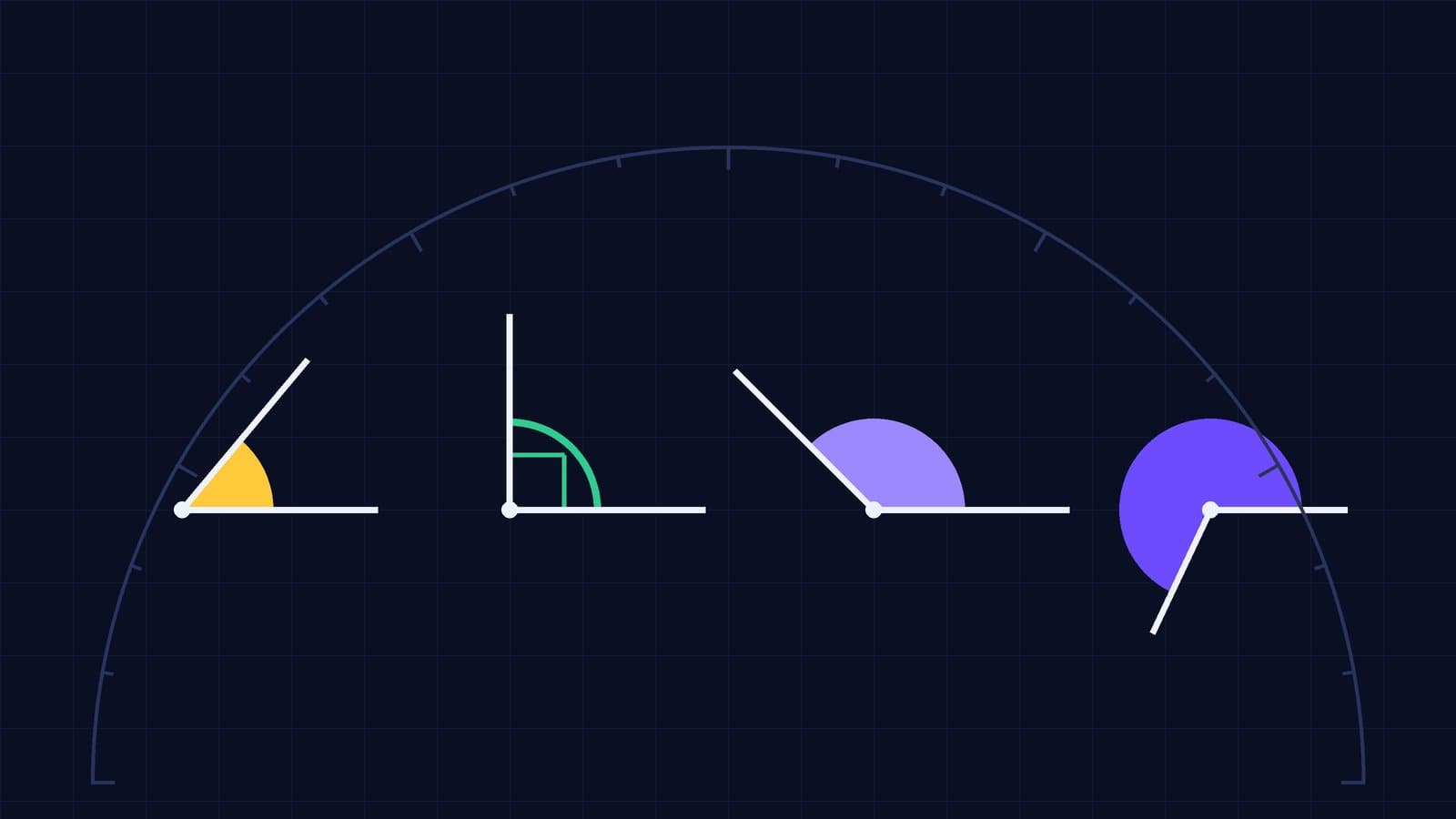
is not a random number. A full turn is , so is a half turn. An angle whose arms lie on the same line and point in opposite directions is called a straight angle.
In everyday language, then, the rule says: if you put the three angles of a triangle side by side, you get a straight line.
If you would like a reminder of how angles are classified as acute, right, obtuse and straight, have a look at the Types of angle lesson.
Try it yourself: the paper-tearing test
Before proving the rule, it is very helpful to get a feel for it with your hands. This test only takes a few minutes.
You will need: a sheet of paper, a pencil, a ruler, scissors and colouring pencils in three different colours.
- Draw a triangle of any shape on the paper and cut it out.
- Draw a small arc inside each corner and shade each one in a different colour. That way, once you have torn the corners off, you won’t lose track of which part is the angle.
- Tear the three corners off the triangle by hand.
- Lay the ruler on the table. Place the three torn corners side by side so that their points meet at one spot on the ruler’s edge and their edges touch.
- What do you see? Together, the three coloured angles form a perfectly straight line along the edge of the ruler.
Now repeat the test with very different triangles: a long, thin one; a wide one with one corner opened out almost flat; a huge one that fills the whole sheet. The result is the same every time.
No tearing needed: the folding method. Choose the longest side of the triangle as the base. Fold the top vertex down so that it lands on the foot of the line dropped straight down from the top to the base; the crease will be parallel to the base. Then fold the other two corners to the same point. The three corners meet side by side on the base and once again form a straight angle. You are also left holding a small rectangle.
A short note: this test shows the rule, but it does not prove it. There are two reasons. First, tearing paper and measuring with a protractor are never perfect; a difference of one degree is hard to spot by eye. Second, there are infinitely many different triangles, and we cannot test them all one by one. In maths, to say that something holds for every triangle, we need a proof. Let’s move on to it.
The proof: one parallel line is all you need
The key to the proof is a familiar property of parallel lines.
Alternate angles. When a third line crosses two parallel lines, the pairs of angles that sit between the parallels, on opposite sides of the crossing line, are called alternate angles. When you draw them, they look like the corners of a letter Z. With parallel lines, alternate angles are equal.
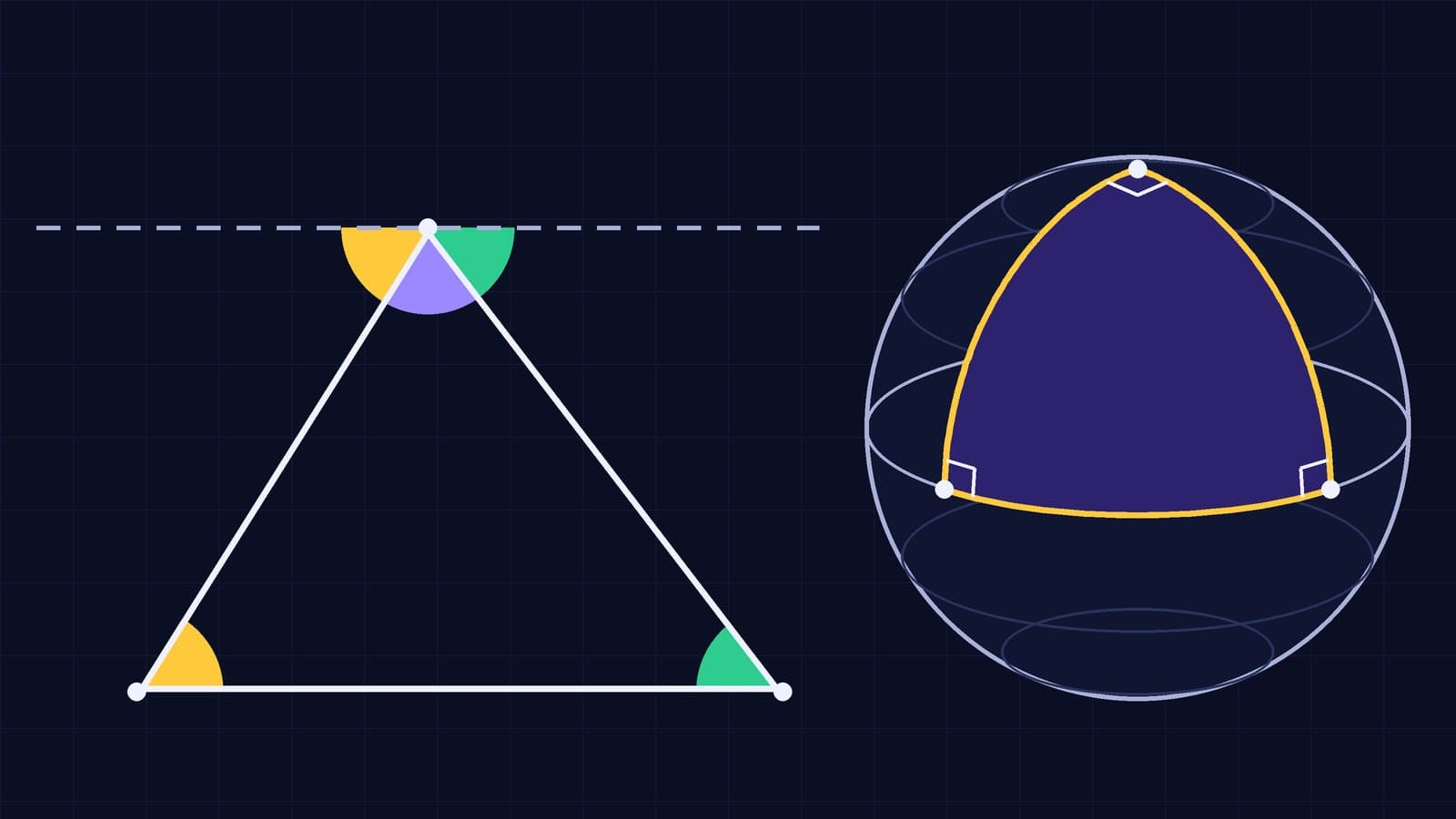
Now let’s build the proof step by step. Take any triangle , with at the top and side at the bottom.
- Draw a line through vertex , parallel to side . Mark a point on this line on the side and a point on the side.
- Think of side as a line crossing the parallels and . and are alternate angles, so they are equal:
- In the same way, side also crosses the two parallels. and are alternate angles:
- At point , just below line , three angles sit side by side: , and . Together they make up a straight angle:
- Replace the first and third terms with the angles they are equal to:
That’s it! The proof never used the triangle’s size, shape or side lengths. That is why the result holds for every triangle.
You can also see the link with the paper test. When you placed corners and next to , you were really moving them up alongside line . The proof explains why that move does not change the angles.
If you would like to revisit why angles sitting side by side on a straight line add up to , the Adjacent, complementary and supplementary angles lesson explains the idea with a cycle-lane example.
The hidden hero of the proof: Euclid’s parallel postulate
In the first step of the proof we did something that looks completely innocent: “draw a line through parallel to ”. In the second step we said “with parallel lines, alternate angles are equal”. Where do these two facts come from?
The answer goes back to Euclid’s Elements, written around 300 BC. Euclid built geometry on a handful of basic assumptions that are accepted without proof. These are called postulates.
The first four postulates are quite short. One says that a straight line can be drawn between any two points; another says that all right angles are equal. The fifth, however, is noticeably longer. In summary, it says:
If a straight line crossing two straight lines makes the two interior angles on the same side add up to less than two right angles, then the two lines, if extended far enough, meet on that side.
Today this assumption is usually stated in a shorter, equivalent form, named after the Scottish mathematician John Playfair: through a point not on a given line, exactly one line can be drawn parallel to the given line.
Let’s look at our two steps with this in mind. That a line through parallel to exists can be shown without the fifth postulate (Euclid does this in Book I, Proposition 31). But the step “with parallel lines, alternate angles are equal” (Book I, Proposition 29) rests directly on the fifth postulate; it is the first proposition in the Elements to use it. Euclid then proves, in Book I, Proposition 32, that the interior angles of a triangle add up to two right angles, in other words .
The fifth postulate looked so long, so much like a theorem waiting to be proved, that for centuries mathematicians tried to derive it from the other four. These attempts never succeeded. In the 19th century, Nikolai Lobachevsky and János Bolyai, working independently, replaced the fifth postulate with a different assumption and worked out its consequences in detail. In 1868 Eugenio Beltrami used a model to show that this new geometry is every bit as consistent as Euclid’s: if one of them contained a contradiction, so would the other.
In this hyperbolic geometry, more than one parallel to a line can be drawn through a point, and the angles of a triangle always add up to less than .
The lesson here is this: the rule “the angles add up to ” holds without exception on a flat plane, that is, in Euclidean geometry. But it is a consequence of the parallel postulate. Change the assumption, and the result can change too.
Triangles on a sphere: why the total goes over 180°
The clearest way to see how much the parallel postulate matters is to look at a surface that is not flat: the surface of a sphere.
You cannot draw a perfectly straight line on the surface of a sphere. Without leaving the surface, the shortest path between two points runs along an arc of a great circle. A great circle is a circle whose centre is the centre of the sphere.
If we treat the Earth as roughly a sphere, the equator is a great circle, and the lines of longitude running from pole to pole are halves of great circles. In spherical geometry, great circles play the role of “straight lines”. A triangle whose sides are arcs of great circles is called a spherical triangle.
Let’s draw an example triangle:
- Let one vertex be the North Pole.
- Travel from the North Pole down a line of longitude to the equator.
- Travel along the equator for a quarter of the way round the world, that is, a difference in longitude of .
- From there, travel back up another line of longitude to the North Pole.
All three angles of this triangle are right angles. Lines of longitude cross the equator at right angles, and the angle at the pole equals the difference between the two lines of longitude. The angle sum is:
This does not mean the rule has broken. It simply shows that the rule belongs to the flat plane.
On the surface of a sphere there are no parallel lines: any two different great circles always meet at two points. All lines of longitude, for example, meet at the poles. So the first step of our proof, “draw a line parallel to ”, simply cannot be carried out on a sphere.
The sphere also differs from some of Euclid’s other assumptions. For instance, infinitely many great circles pass through the North and South Poles, whereas on a plane exactly one line passes through two points. So a sphere is not a world in which only the fifth postulate has changed. Even so, it shows very clearly how not being flat affects angles.
There is another lovely result about spherical triangles: the amount by which the angle sum goes over is proportional to the triangle’s area. On a sphere of radius , with the angles measured in radians:
This result is named after Albert Girard. Let’s check our polar example with it. The triangle covers one eighth of the sphere’s surface, so its area is . The formula gives an excess of radians, which is : . It matches perfectly!
So why do we never notice this excess in everyday life? Let’s do an example calculation. Picture a triangle on the Earth’s surface with an area of 1 km², and take the Earth’s radius as roughly 6371 km. The excess is:
That is about 0.005 arcseconds, a little over a millionth of a degree. No protractor could ever show it. Over small regions the surface of a sphere is almost flat, which is why triangles in exercise books and on playgrounds follow the rule.
Try it with a ball: take a ball and a rubber band. Stretch the band around the widest part of the ball and you have a great circle. Let this band be your equator, and mark the top point that is the same distance from it in every direction as your “pole”. Stretch a second band through the pole and use it as a guide to draw two lines from the pole down to the equator. Then close the triangle with a stretch of the equator. How close to right angles do the two corners on the equator look? Watch how the total grows as you widen the angle at the pole.
What follows from the rule
Let’s return to triangles on the plane. The rule is the starting point for countless calculations in geometry.
Finding a missing angle. Suppose a carpenter has measured two angles of a triangular timber support for a roof as and . There is no need to measure the third:
At most one right or obtuse angle. Two right angles already make , leaving no room for a third angle. So a triangle can have at most one right angle or one obtuse angle. In a right-angled triangle, the other two acute angles add up to .
Equilateral triangle. All three angles are equal, so each one is .
Exterior angle. When you extend one side, the exterior angle you create equals the sum of the two interior angles that are not next to it. This is because the exterior angle and the interior angle beside it make , and so do the three interior angles. For example, if and , the exterior angle at is . Euclid states these two results together in the same proposition of the Elements (Book I, Proposition 32).
Polygons. You can split a convex quadrilateral into two triangles with one diagonal, so its interior angles add up to . In general, a convex polygon with sides can be split into triangles by the diagonals drawn from one vertex:
This gives for a pentagon and for a hexagon.
Try it yourself: three quick questions
- In a right-angled triangle, one of the acute angles is . What is the other acute angle?
- Can you draw a triangle with angles of , and ?
- What is each interior angle of a regular hexagon?
Answers: 1) . 2) No; , which is more than . 3) .
For more examples and practice, head to the Interior angles of a triangle lesson. In the Lab’s Protractor figure you can also change a triangle’s angles and watch the angle sum and the exterior angle for yourself.
Points that are easy to mix up
“A bigger triangle has bigger angles.” It looks that way at first glance. But an angle measures how far two sides are turned from each other, not how long they are. When you enlarge a photo of a triangle, the sides get longer while the openings at the corners stay the same. On a plane, the angles of every triangle add up to .
“If I know the three angles, I know the triangle exactly.” Not quite. A triangle with angles of , and could be the size of an exercise book or the size of a building. The angles fix the triangle’s shape, not its size. Triangles with equal angles are called similar triangles.
“I measured , so the rule doesn’t always hold.” A protractor reading can be out by a degree or two because of the thickness of the lines, how the protractor is placed and the angle you look from. The rule rests on proof, not on measurement. If your total is very close to , the gap comes from the measuring process.
“I did the test, so I’ve proved it.” The paper-tearing test is strong evidence, but it only tells you about the triangles you tried. The proof with a parallel line covers every triangle at once.
“The sphere example shows the rule isn’t really true.” No. The rule holds without exception for triangles on a plane. The sphere example shows that the rule depends on a flat surface and on the parallel postulate. Knowing the conditions under which a rule holds means understanding it more deeply.
Summary
- The interior angles of every triangle on a plane add up to . The triangle’s size or shape does not change this.
- The paper-tearing and folding tests show the rule. The proof draws a line through one vertex parallel to the opposite side and uses alternate angles.
- This proof rests on Euclid’s fifth postulate, the parallel postulate.
- On the surface of a sphere there are no parallel lines, and the angles of a spherical triangle add up to more than . The excess is proportional to the triangle’s area.
- Many results follow from the rule, such as finding a missing angle, the exterior angle property and the polygon angle sum .
For more on angles and triangles, take a look at our Maths topics and our maths articles.
Frequently asked
5 questionsWhy do the angles in a triangle add up to 180°?
If you draw a line through one vertex parallel to the opposite side, the angles at the other two vertices reappear on that line as alternate angles. All three angles then sit side by side at that vertex and form a straight angle, which is 180°.
Is the paper-tearing test a proof?
No. The test shows the rule convincingly, but it only tells you about the triangles you tried, and measuring is never perfect. The geometric proof using a parallel line shows that the rule holds for every triangle.
What is Euclid's parallel postulate?
It is the fifth basic assumption in Euclid's Elements. In its common equivalent form, it says that through a point not on a given line, exactly one line can be drawn parallel to that line. The 180° angle sum of a triangle rests on this assumption.
What do the angles of a triangle on a sphere add up to?
In a spherical triangle, whose sides are arcs of great circles, the angles always add up to more than 180°. The excess is proportional to the triangle's area. For example, a triangle with one vertex at the North Pole and two on the equator can have three 90° angles, making 270° in total.
Can a triangle have two right angles?
Not on a plane. Two right angles already make 180°, leaving no room for a third angle. So a triangle has at most one right angle or one obtuse angle.
Sources
6 sources- 1.Euclid — Elements, Book I, Postulate 5 and Propositions 29, 31 and 32; D. E. Joyce's online edition, Clark University (opens in a new tab)
- 2.Heath, T. L. (1908) — The Thirteen Books of Euclid's Elements, Volume 1, Cambridge University Press (notes on the fifth postulate)
- 3.Greenberg, M. J. — Euclidean and Non-Euclidean Geometries: Development and History, W. H. Freeman
- 4.Wikipedia — Parallel postulate (opens in a new tab)
- 5.Wikipedia — Spherical geometry (opens in a new tab)
- 6.Wikipedia — Hyperbolic geometry (Lobachevsky, Bolyai, Beltrami) (opens in a new tab)
- #angles in a triangle
- #angle sum
- #parallel lines
- #Euclid
- #parallel postulate
- #spherical geometry