Field
Science
Lower-secondary science: the Solar System and the Moon, electric circuits, force and motion, matter and heat. Every lesson has a question to wonder about, a simulation and a short quiz to test yourself. Don't memorise it, understand it.
- 4 units
- 16 lessons
- about 277 min
- Grade 5
- Grade 6
- Grade 7
- Grade 8
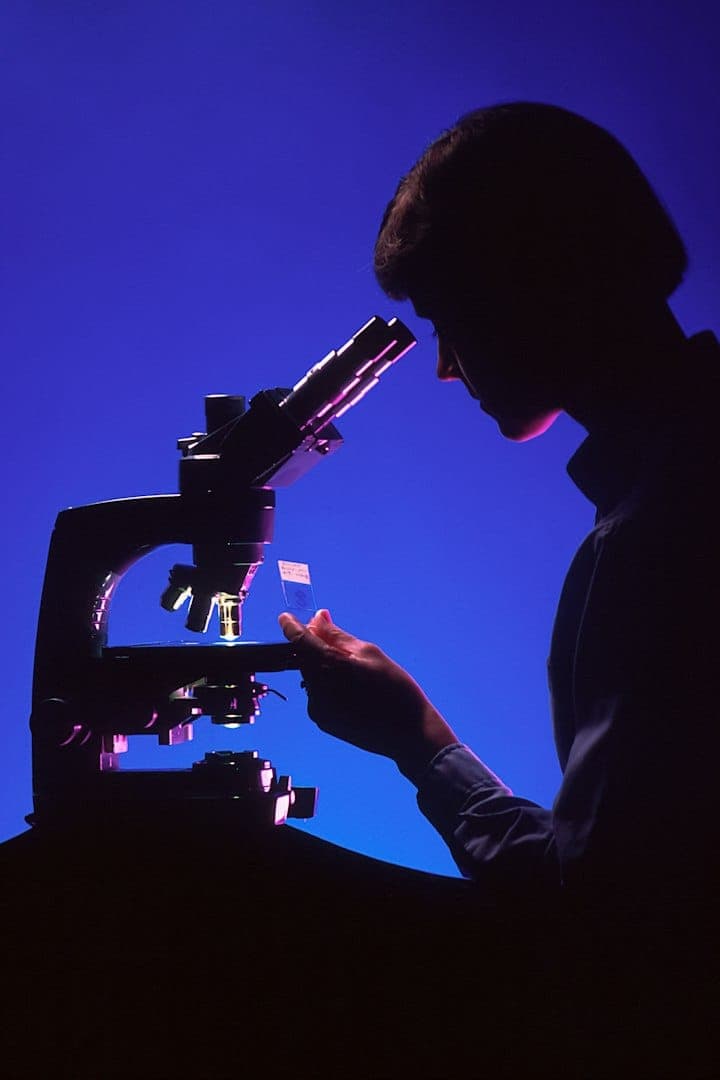
Photo: National Cancer Institute / Unsplash
The Sun, the Earth and the Moon
Picture the sizes and distances of the planets to scale, and discover the real reasons behind day and night, the phases of the Moon and the seasons.
- The Solar System and the planets
Explore the order of the eight planets, their sizes and their distances from the Sun. If the Sun were a beach ball, how big would the Earth be? Use scale to grasp how empty and how vast space really is.
- 18 min
- 1 simulation
- Mini quiz
- The Earth's rotation and day and night
Does the Sun really rise in the east and set in the west, or is it us who are turning? Discover how the Earth's rotation on its axis makes day and night, and why one turn takes about 24 hours.
- 15 min
- 1 simulation
- Mini quiz
- The phases of the Moon
Why does the Moon sometimes look like a thin crescent and sometimes like a big full moon? Discover that the phases come from our viewing angle, not from the Earth's shadow, and that one cycle of phases takes about 29.5 days.
- 18 min
- 1 simulation
- Mini quiz
- What causes the seasons?
Is it hot in summer because we are closer to the Sun? No! Discover that the real cause of the seasons is the Earth's axis, tilted by about 23.5°, by looking at the angle of the Sun's rays and the length of the day.
- 20 min
- 1 simulation
- Mini quiz
Electric circuits
Build circuits with cells, bulbs, switches and wires; sort conductors from insulators, and find out how series and parallel connections change how brightly a bulb shines.
- Circuit components and a simple electric circuit
What is inside a torch? Learn what the cell, bulb, switch and connecting wire each do, and find out why a bulb only lights when the circuit is an unbroken path.
- 15 min
- 1 simulation
- Mini quiz
- Conductors and insulators
Why is the inside of a cable metal and the outside plastic? Use a simple test circuit to find out which materials conduct electricity and which do not, and learn how this protects you from electric shock.
- 15 min
- 1 simulation
- Mini quiz
- Series circuits
What happens if you connect bulbs one after another along a single path? Find out why, in a series circuit, the bulbs get dimmer as you add more, and why they all go out when one is removed.
- 18 min
- 1 simulation
- Mini quiz
- Parallel circuits
When one of the lamps in your home blows, why do the others keep working? Find out how each bulb in a parallel circuit has its own branch, why the brightness does not drop, and what price you pay for it.
- 18 min
- 1 simulation
- Mini quiz
Force and motion
Measure force with a spring balance and work out speed; find out how balanced and unbalanced forces change motion, and the two sides of friction in everyday life.
- Force and the spring balance
Pushing a door, kicking a ball, stretching a spring: all of these are forces. Find out what a force is, why its unit is the newton, and how a spring balance (dynamometer) measures force by how far a spring stretches.
- 15 min
- 1 simulation
- Mini quiz
- Speed: distance and time
Who is faster: someone who runs 100 metres in 15 seconds, or someone who cycles 1 kilometre in 3 minutes? Find out that speed is distance travelled divided by time taken, and learn the units m/s and km/h and how to convert between them.
- 18 min
- 2 simulations
- Mini quiz
- Balanced and unbalanced forces
In a tug of war, why does the rope stay still while both teams pull as hard as they can? Learn to calculate the resultant force, and find out that balanced forces don't change motion while unbalanced forces change speed or direction.
- 18 min
- 2 simulations
- Mini quiz
- Friction
Why do we slip on ice but not on a carpet? Find out that friction acts opposite to motion, depends on how rough the surfaces are, and in everyday life both helps us and causes problems.
- 15 min
- 2 simulations
- Mini quiz
Matter and heat
Explain the states of matter with the particle model, tell heat apart from temperature, find out why temperature stays constant during a change of state, and spot the traces of thermal expansion in everyday life.
- States of matter and the particle model
An ice cube, a glass of water and the steam rising from a kettle are the same substance. Find out how the arrangement of particles, the space between them and their motion explain the difference between solids, liquids and gases.
- 18 min
- 1 simulation
- Mini quiz
- Heat and temperature: the difference
Which is hotter, a glass of tea or a bathtub of lukewarm water, and which carries more energy? Find out that heat is energy being transferred, temperature measures the average motion of particles, and what thermal equilibrium means.
- 18 min
- 1 simulation
- Mini quiz
- Changes of state
Ice melts into water, water evaporates into the sky, and water vapour turns into droplets on a cold glass. Explore melting, freezing, evaporation and condensation, and learn why the temperature stays constant during melting and boiling.
- 20 min
- 1 simulation
- Mini quiz
- Thermal expansion in everyday life
Why are gaps left in bridges, and why does a stuck jar lid open easily under hot water? Find out that substances expand when heated and contract when cooled, and how much solids, liquids and gases expand.
- 18 min
- 1 simulation
- Mini quiz