Technology and EngineeringMiddle school
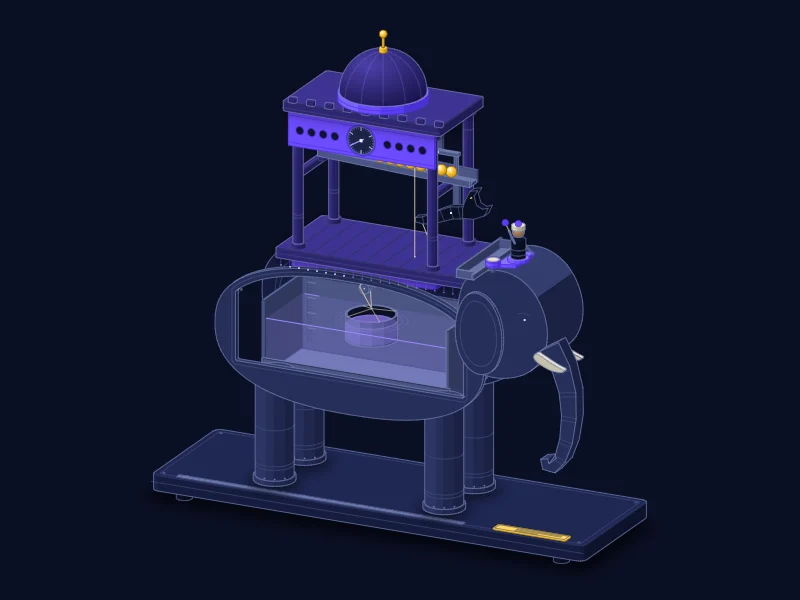
Inside the Elephant Clock
How does the sinking bowl in al-Jazari’s Elephant Clock measure half an hour? Scrub through time and follow it.
Technology and Engineering · High school
Move the sun and the panel: how do the angle of the light and a single shaded cell change the panel’s power?
In the learning section below the figure, predict, try, complete the tasks and check yourself with short questions.
Technology and EngineeringMiddle school
How does the sinking bowl in al-Jazari’s Elephant Clock measure half an hour? Scrub through time and follow it.
Technology and EngineeringMiddle school
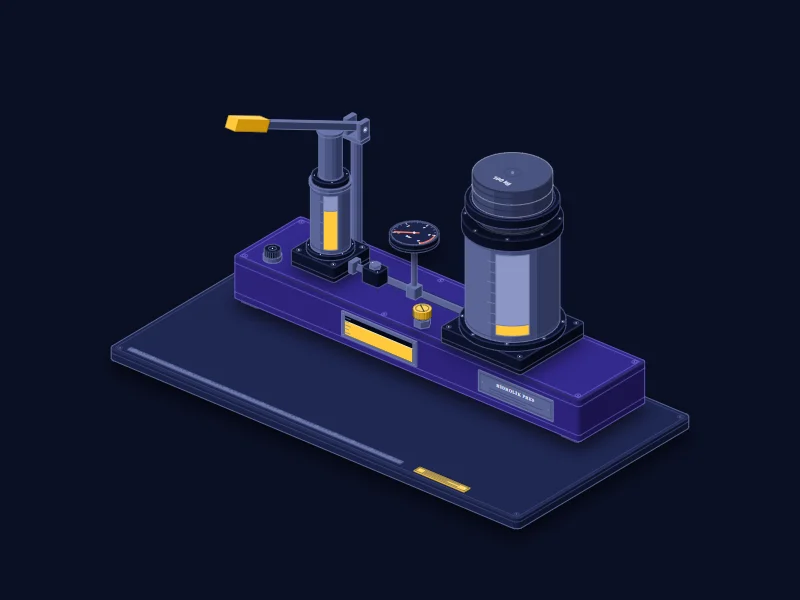
Pump the lever: the pressure on the small piston passes unchanged to the big one, and the force grows.
Technology and EngineeringHigh school
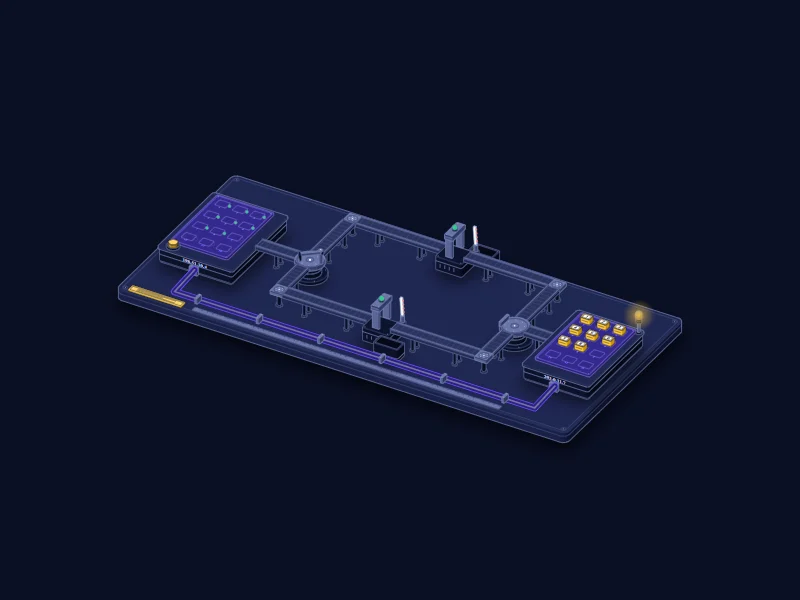
Split a message into packets and send it; cut a line and watch the routers deliver them another way.
Move the sun and the panel with the sliders, tap a cell or the junction box
Every cell carries the same current.
219 W
You can use a comma or a point. If the irradiance box is empty, it is worked out from the sun height.
Walk up the scale ladder: each step is ×10. If another star took the Sun’s place, how much light would reach the panel?
If the Earth were a 1 cm bead, the Sun would be 1.09 m across: about 5 footballs side by side.
The Sun’s radius is 109 times the Earth’s; about 1.3 × 10⁶ Earths would fit inside it. Each square metre of its surface gives out σT⁴ of power; after travelling 1 AU this light has thinned to 1,361 W/m². That is the light the panel in the figure gets above the atmosphere.
The Sun’s radius is 109 times the Earth’s; about 1.3 × 10⁶ Earths would fit inside it. Each square metre of its surface gives out σT⁴ of power; after travelling 1 AU this light has thinned to 1,361 W/m². That is the light the panel in the figure gets above the atmosphere.
In reality: The Sun is on average 149.6 million km (1 AU) from the Earth. Light reaching the ground is weakened by the air: in the figure, with the Sun overhead, about 953 W/m² reaches the panel.
Assumptions: Stars are treated as evenly glowing spheres (σT⁴), with radius and temperature from published measurements; the brightness is worked out from these two, so it can differ a little from published values (about 15% for Arcturus). The panel is the one in the figure, 1.46 m² at 20% efficiency; the light is taken outside the atmosphere, hitting the panel straight on; the panel heating up, its efficiency dropping and the colour of the light are left out. In the comparison the Earth is 1 cm across.
The Sun is 30° above the horizon and the panel lies flat. What happens to the power if you tilt the panel to 60°?
The panel makes 219 W: 29.5 V, 7.44 A.